





 Portuguese
  English
  Spanish
  5 min of reading
  0 comments


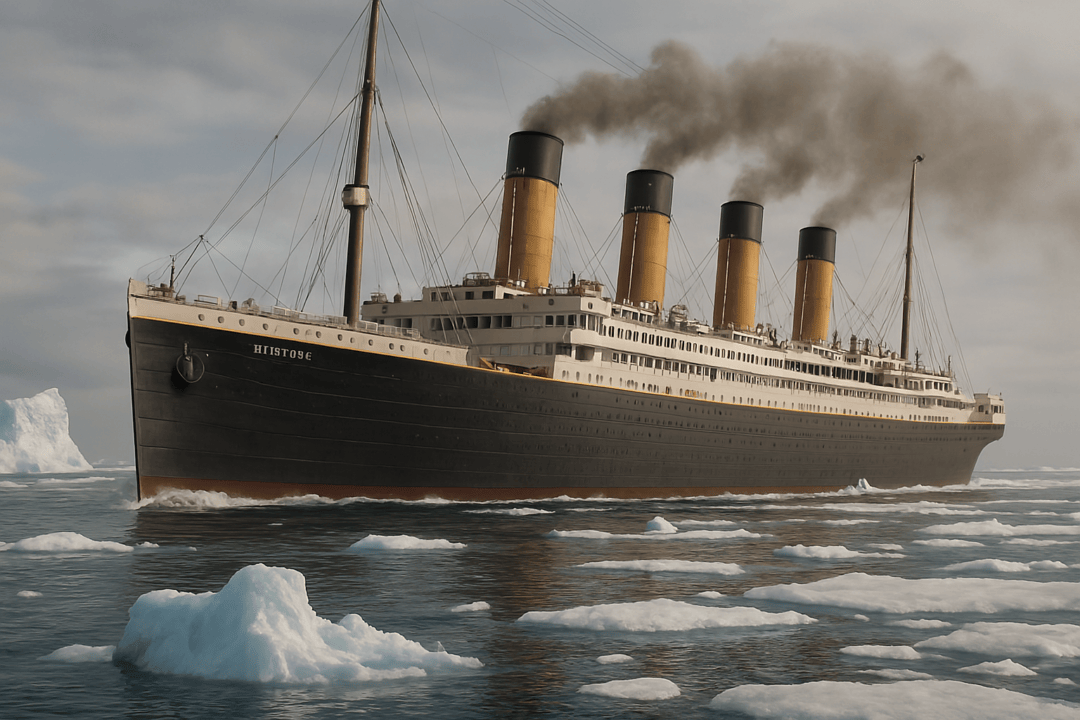
More Than A Century After The Sinking Of The Titanic, New Research Sheds Light On What Really Caused The Tragedy. According To Scientists, The “Unsinkable” Ship Sank Not Due To A Large Tear, But Due To Small Cuts In The Hull — The Size Of A Sheet Of Paper — That Compromised Its Structure And Led To Disaster. The Discovery Challenges Previous Versions Of History.
More than 110 years after the maritime tragedy that moved the world, new scans reveal unprecedented details about the final moments of the Titanic. The vessel, considered “unsinkable,” would have sunk after a collision that lasted only six seconds, with cuts in the hull the size of A4 paper sheets spread across six compartments.
The discoveries are part of a study conducted by experts from Magellan Ltd. and Professor Jeom-Kee Paik from University College London.
With images obtained at a depth of 4,000 meters, the research points out that the Titanic only made superficial contact with the iceberg.
-
In China, the world’s longest road tunnel is 22 km long, cuts through a mountain that has challenged engineers for 70 years, includes a 706 m ventilation tower, and reduces dangerous journeys from hours to just 20 minutes.
-
More than one million North Americans were ordered to close their windows and stay indoors because the air in the southern United States became so toxic that pollution levels reached 18 times above the World Health Organization’s safety limit.

-
China has accumulated up to 1.4 billion barrels of oil in strategic reserves, invested 25 years in renewable energy, and purchased 80% of cheap Iranian oil: how Beijing has prepared for decades for the crisis that is now shaking the world.

-
A single lake holds 20% of the planet’s non-frozen freshwater and is also the deepest and oldest on Earth.


Even so, the small holes resulting from the collision were enough to cause one of the worst maritime disasters in history.
Small Holes, Giant Consequences
Contrary to the popular idea that the Titanic suffered a large tear in its hull, new data show that the damage was smaller but strategically distributed.
The holes, similar in size to A4 paper sheets, were spread across six compartments.
Naval architect Simon Benson from Newcastle University explained that these holes allowed water to gradually enter different sections of the vessel. According to him, water enters slowly but continuously. One by one, the compartments were flooded until the ship could no longer sustain itself.
This discovery offers a new perspective on how a ship so large and modern for its time was defeated by an impact that, at first glance, did not seem so severe.
Sinking Digitization Reveals Surprising Details
The scans conducted by Magellan Ltd. were essential for this reassessment of events. Submersibles traversed all parts of the wreck, obtaining high-definition images that show unprecedented angles of the Titanic.
One of the areas studied was the boiler room, where the ship would have split in half.
Some boilers are deformed, with a concave appearance, suggesting that they were still operating at the time they were submerged.
Another important detail revealed by the images is a valve in the open position, indicating that steam was still flowing to the ship’s electrical generation system.
This confirms historical accounts that engineers remained at their posts until the end, ensuring light and electricity while the lifeboats were launched.
Unknown Heroes Worked Until The End
Expert Parks Stephenson highlighted the essential role of the engineers who stayed on board until the last moment.
The team, led by Joseph Bell, shoveled coal into the furnaces as the ship sank, allowing electrical systems to continue functioning.
According to Stephenson, these actions helped maintain calm and order during the evacuation. “They kept the chaos under control for as long as possible, and all this was symbolized by this open steam valve back there,” he said.
None of the engineers survived. But their sacrifice allowed hundreds of passengers more time to escape. The new analysis reinforces the importance of these silent actions during the disaster.
Documentary Will Show Digital Reconstruction
The images obtained by Magellan Ltd. are being used in a new documentary produced by National Geographic in partnership with Atlantic Productions. Titled “Titanic: The Digital Resurrection,” the production promises to digitally reconstruct the ship and the damage caused that tragic night.
The simulation will show the trajectory of the impact, the flooding of the compartments, and the final moments of the Titanic before it split in half. There will also be images of the current wreck, located nearly 13,000 feet deep.
Location And Current Condition Of The Wreckage
The remains of the Titanic are located about 350 nautical miles (approximately 640 km) from the coast of Newfoundland, Canada.
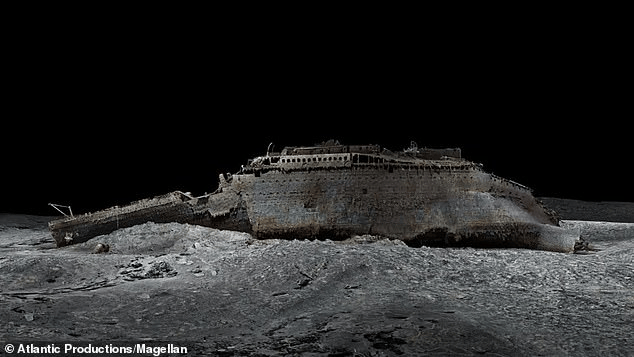
The front part of the ship, the bow, still maintains its “V” shape and has visible railings, despite being partially buried in mud.
The stern, however, presents a mass of twisted metal, the result of the violent impact with the ocean floor. The two sections are separated by about 800 meters.
Around the wreck, there is a field of debris that includes pieces of furniture, unopened champagne bottles, and even passengers’ shoes. According to experts, the remains are deteriorating rapidly and may completely disappear in the next 40 years.
The Original Disaster
The Titanic sank in the early hours of April 15, 1912, after colliding with an iceberg during its maiden voyage between Southampton and New York. Of the 2,224 passengers and crew on board, about 1,517 died.
The ship was built in Belfast between 1909 and 1912 by Harland and Wolff and belonged to the White Star Line.
At the time, it was the largest ship in the world, with gyms, swimming pools, libraries, and luxurious lounges. Many millionaires were on board, including Benjamin Guggenheim, John Jacob Astor IV, and Isidor Straus, co-owner of Macy’s.
The Titanic did not have enough lifeboats for all passengers. This was due to outdated maritime safety regulations. After leaving England, the ship made stops in France and Ireland before heading to the United States.
On April 14, at 11:40 PM, the iceberg was sighted. By 2:20 AM, the ship was completely submerged. James Moody, the officer on duty at the time of the collision, also died in the sinking.
Discovery Of The Wreckage Only Happened In 1985
Even with all the commotion generated by the disaster, the wreckage of the Titanic was only located in September 1985. The discovery took place more than seven decades after the sinking and drew global attention.
The location revealed that the ship had split in half before hitting the ocean floor. This contradicted previous theories suggesting that it had sunk whole.
The new images released now offer even more details about the current state of the Titanic and help to better understand how a succession of small damages could have caused the total collapse of the vessel.
One of the most symbolic images revealed by the new scans is that of the open steam valve, which remains on the ocean floor.
It represents the silent and heroic effort of a crew that remained steadfast until the end, ensuring light and order amid chaos. A final reminder that the Titanic still has stories to tell.







-

-

2 pessoas reagiram a isso.