





 English
  Francês
  Alemão
  Italiano
  Japonês
  Norueguês
  Portuguese
  Spanish
  4 min of reading
  0 comments


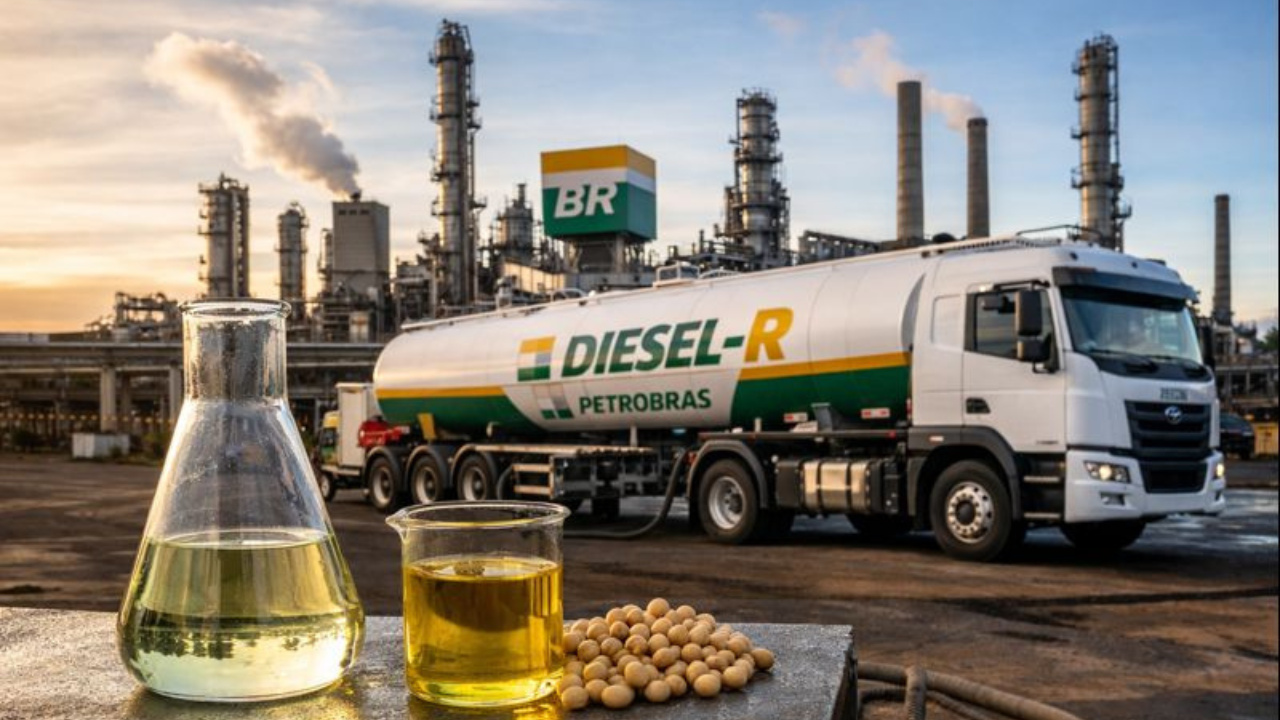
Renewable Fuel From Petrobras Cuts Emissions and Strengthens the Energy Transition Without Vehicle Adaptations.
Petrobras announced the advancement of Diesel-R, a fuel formulated with vegetable oils and mineral diesel, which promises to drastically reduce pollutant gas emissions without requiring changes in vehicles.
The product is already used by large consumers in Brazil, such as Volvo, and is part of the state-owned company’s strategy to enhance decarbonization and lead the energy transition through renewable fuels.
Diesel-R Reinforces Petrobras’ Strategy in the Energy Transition
Diesel-R emerges as a practical response from Petrobras to global environmental goals and market demands for lower environmental impact solutions.
-
Brazilian giant expands borders in the Southeast: Petrobras confirms new oil discovery in ultra-deep waters in the pre-salt of the Campos Basin.

-
Alert in the global energy market: Severe tropical cyclone hits the coast and disrupts gas production at major plants in Australia, threatening global supply.

-
Petrobras finds high-quality oil in the pre-salt at 113 km from RJ and reignites expectations about strategic reserves in the Campos Basin.

-
Ocyan opens registrations for startups focused on innovation in the oil and gas sector and will select projects for Innovation Day with the support of Nexio.


Although visually and chemically very similar to fossil diesel, the fuel incorporates vegetable oils into its composition.
Currently, the blend contains 10% renewable inputs.
However, the state-owned company is already working to double this percentage, aligning the product with its energy transition agenda.
According to the CEO of the company, Diesel-R represents an efficient alternative by maintaining the performance of conventional diesel.
In addition, it eliminates the need for any type of adaptation in engines or refueling systems.
Environmental Impact and Commitment to Decarbonization
Speaking to CNN Money, Magda Chambriard highlighted the environmental benefits of Diesel-R. The executive emphasized the fuel’s role in reducing emissions associated with transportation and industry.
“In this part of vegetable oil, we achieved an emissions reduction of 87%, which means significant reductions in emissions in Brazil and Petrobras’ commitment to decarbonization.”
This performance positions Diesel-R as one of the most promising renewable fuels in the short term, especially for companies looking to meet voluntary environmental goals.
How Diesel-R Is Produced in Refineries
The production process of Diesel-R uses soybean oil, similar to traditional cooking oil. This input arrives at the refineries and undergoes a coprocessing process with mineral diesel.
During this stage, the fuel goes through hydrotreatment, a technique that uses hydrogen to remove impurities.
Thus, the final product becomes chemically stable and compatible with the S-10 diesel already available on the market.
The result is a fuel that is practically indistinguishable from fossil diesel, even in laboratory tests.
Strategic Customers and Industrial Use of Diesel-R
Petrobras’ initial focus is on large consumers committed to reducing their carbon footprint.
Volvo is one of the most relevant examples of this adoption.
At the automaker’s plant in Curitiba, the company already uses Diesel-R in different stages of the production process.
“We use the fuel in the first refueling of all trucks leaving the factory and also in all tests conducted within the plant,” explains Alan Holzmann, director of strategy and product planning for trucks at Volvo.
Evolution of Diesel-R and Production on Demand
Diesel-R represents an evolution of Diesel-R10, launched during COP30, when it fueled the buses that transported participants of the climate summit in Belém.
Currently, Petrobras does not produce the Diesel-R line continuously.
The company sells the product on demand and directs sales exclusively to large consumers who voluntarily seek to reduce carbon emissions.
At the Presidente Bernardes Refinery (RPBC) in Cubatão (SP), the installed capacity reaches 60 million liters. Still, production directly depends on the interest of commercial partners.
Technical and Financial Challenges of Increasing the Renewable Blend
Expanding the renewable content to 20% requires investments and technical adjustments.
The hydrotreatment of coprocessed diesel requires more hydrogen than conventional diesel, making the process more complex.
“Due to the process of removing impurities, it has a condition of stability and greater difficulty of forming gums and other components that can be harmful to the engine,” details Edson Bruel, manager of ventures at RPBC.
Moreover, economic viability remains a challenge.
Biodiesel prices are very close to those of fossil diesel, which limits margins and pressures competitiveness.
Investments and Focus on Liquid Fuels
Despite the challenges, Petrobras is already planning new investments. According to Magda Chambriard, the company is advancing in the implementation of the first 100% dedicated biorefinery for this type of production in Rio Grande do Sul.
“It is so scalable that we are already investing, the project is already underway, for the first 100% biorefinery in Brazil, in Rio Grande do Sul.”
The state-owned company’s strategy for the next decade will remain focused on solutions based on “molecules,” that is, liquid fuels.
In this way, Diesel-R consolidates itself as one of the pillars of decarbonization and the energy transition in the country.








Seja o primeiro a reagir!