





 Portuguese
  English
  Spanish
  9 min of reading


Do You Want to Understand How Petrobras Affects Our Country and More Important Information About It? Keep Reading!
Petrobras is a mixed-economy oil company, meaning that although it is controlled by the government, it receives private investments. It works with the exploration and refining of oil, in addition to production and some of its by-products, as Petrobras also stands out in the technological field, especially when we talk about oil exploration.
Petrobras is important to the Brazilian economy in several aspects. It has been responsible, along with other companies, for more than 10% of the national GDP.
In recent times, this company has been constantly mentioned in various news for various reasons, from the possibility of its privatization and other related issues, so an extensive overview of its history seems, at the very least, fair.
-
Petrobras evaluates suspension of sales to distributors and considers canceling the cooking gas auction following guidelines from the Federal Government.
-
Lula reveals a masterstroke by Petrobras to undo a deal made by Bolsonaro, which involves the return of an important refinery that currently produces less than half of what was expected and makes Brazil dependent on international diesel.
-
A study confirms that the natural gas sector will reduce greenhouse gas emissions in Brazil by 0.5% and accelerate the energy transition by 2026.

-
Petrobras implements a severe adjustment and confirms a 55% increase in the price of aviation kerosene with a proposal for installment payments for the companies.


We will also show the political changes that have occurred in this market, which cannot be ignored.
What Is the Economic Relevance of Petrobras in the Brazilian Economy?
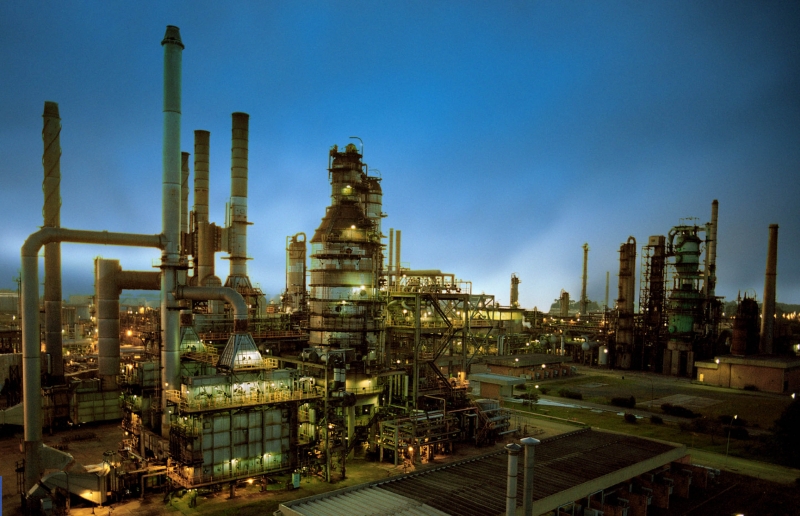
Two fundamental aspects that need to be considered when discussing Petrobras’ importance for the Brazilian economy as a whole.
The first aspect relates to the size, power, and importance of this company to the Brazilian economy overall.
Petrobras is one of the largest job generators in Brazil. From oil work, research, biological conservation, and other policies developed by this government-controlled company, such as sponsorship of cultural projects like films and similar initiatives, Petrobras plays an extremely important role in the Brazilian economy.
This has become even more real after the discovery and exploration of oil reserves in the so-called pre-salt layer, which has generated, since its discovery, a considerable increase in oil production in the country.
Additionally, several cities in Rio de Janeiro and Espírito Santo receive financial allocations related to this operation, which strengthens the public coffers in these regions for local social projects.
An example of this is the minimum income project in the city of Maricá, which deposits a monthly amount in a local currency that can only be used in the city for all citizens who have lived there for more than two years.
Moreover, it is essential to understand that, under government control, despite private investments, Petrobras can be used to maintain fuel prices within a mean, which becomes extremely important for overall pricing in Brazil.
In Brazil, the entire freight transport system is largely dependent on the road network, meaning that the associated costs of transporting food, medicine, and many other essential items for people in general are affected by fuel costs.
Finally, Petrobras is also of great importance as one of the few Brazilian companies standing out when it comes to developing new technologies.
In Brazil, research and development do not attract investors’ interest, so it ends up being up to state-owned companies to create new technologies and, through these technologies, attract foreign investments and generate interesting commercial agreements.
We also have the fact that Petrobras is a profitable company and that part of its profits are reverted to the public coffers.
A Brazil without Petrobras would be much more sensitive to international fluctuations in oil prices, as we would constantly be at the mercy of changes in crude oil prices, given that most countries with oil reserves similar to ours maintain some type of closer control over these values, keeping fuel prices within a margin necessary for overall economic activity.
Video: What Is the Origin of Petrobras?


Petrobras was born out of a political decision made right after World War II. If you read the article about oil, you know that after World War II the world recognized the importance of oil and decided to make its exploration one of the most profitable businesses in the world.
This led to a significant discussion in Brazil regarding the most coherent stance our country should take concerning national oil.
There were two diverging opinions in this regard: there were those who believed we should allow the exploration of oil by private companies, which would essentially mean being at the mercy of international companies, especially American ones.
And there were those who believed that state monopoly was the better option.
Through a long campaign, the decision for monopoly was maintained and in 1953, by law sanctioned by then-President Getúlio Vargas, Petrobras was established.
Since then, Petrobras has been responsible for the entire process of extracting and refining oil in Brazil, with private initiative participating only from the point of wholesale sales. That is to say, Petrobras sold to fuel and gas distributors, who then sold to gas stations and gas-selling companies.
The early years of Petrobras were not so positive, as its first president, American Walter Link, had to flee the country due to accusations from journalists of inadequate work on purpose.
During the years of military rule, Petrobras expanded its investments. New gas and oil pipelines were built, in addition to its first subsidiary, Petroquisa, which focused on petrochemical research.
Braspetro, Petrobras’ second subsidiary, created in 1973, was responsible for discovering oil in the Majnoon field in Iraq, which was one of the company’s greatest successes at that time.
After years of exclusivity in Brazil, it was only in 1997, with President Fernando Henrique Cardoso, that Petrobras began to compete with private companies in oil extraction and refining. Nevertheless, it still remains the largest oil company in the country, with its subsidiaries making considerable advancements, especially in the technological field.
The Change of the Pre-Salt Layer
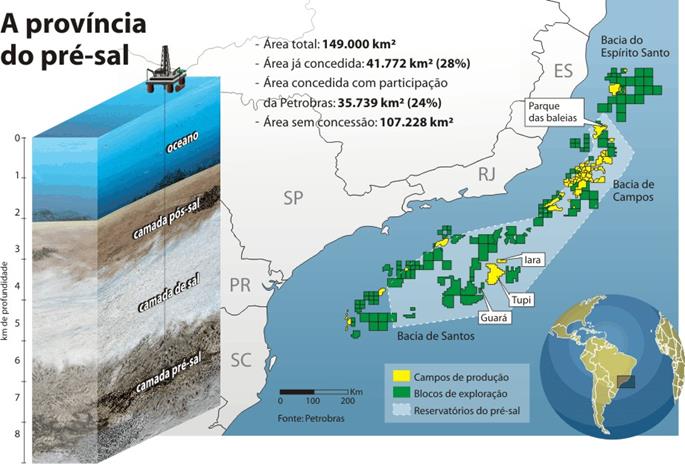
Petrobras’ shift towards the technological field began in the year 2000, with the PROCAP-3000 (Petrobras Technological Program in Ultra-Deep Water Exploration Systems). In 2001, the concession for exploration of the so-called BM-S-10 block was granted, where the first pre-salt drilling would take place.
For those who did not live through that period, there was a lot of skepticism from the general public regarding Petrobras’ investments in the pre-salt, as there was a considerable chance that all this investment would yield nothing.
The responses to this skepticism began in 2005, when, in addition to reaching the pre-salt layer, Petrobras also purchased Perez Companc Energía (PECOM Energía S.A.), the second-largest oil company in Argentina.
In 2006, celebrating its 53rd anniversary, Petrobras achieved the incredible self-sufficiency of oil in Brazil, which is noteworthy and extremely interesting for the reasons already mentioned.
A few years after this, intense accusations of government corruption undermined the company’s credibility, leading to various issues concerning shareholders and similar parties. Following that, through support and loans, the company is in the process of recovering from this last crisis, although it has not lost its power or relevance in the national market.
Interestingly, in recent years, even with all the initial discredit, the oil wells that Petrobras opened in the pre-salt account for about 50% of the oil barrels produced in Brazil.
In summary, the pre-salt was a crucial point in Petrobras’ history, making it the world leader in deep water and ultra-deep water exploration and also granting the company technological expertise that led to interesting international contracts.
What Products Are Produced by Petrobras?
It may seem, given the focus on oil extraction thus far, that Petrobras doesn’t work much on refining and production. But that’s not true! At this time, Petrobras has 13 refineries and, although it plans to sell a good portion of them (as you will find out below), it will still have significant production capacity for various petroleum-derived products.
These Are Some of the Products That Petrobras Has Been Producing:
- These are some of the products produced by Petrobras in its various refineries.
- Gasoline
- Lubricating base oil
- Compressed natural gas.
- Natrual gas
- Liquefied petroleum gas (LPG)
- Solvents
- Sulfur
- Aromatic extracts
- Petroleum green coke paraffin
- Non-road diesel
- Marine diesel
- Bunker
- Aviation kerosene
- Aviation gasoline
- Petroleum asphalt cement
- Diluted petroleum asphalt
The Issue of Petrobras Privatization
Just as in its creation, Petrobras remains a point of discussion between two diverse opinions, where one viewpoint values the entry of foreign assets into Brazil through oil exploration as a positive way to accelerate the economy through privatization, while the other side continues to believe in total state control of the company.
It is interesting to understand that, regardless of this divergence of opinions, everyone believes that Petrobras’s trend is growth, especially due to its leadership in deep water and ultra-deep water oil exploration.
The movement to privatize state-owned companies is not exactly a novelty in Brazil. In the 1990s, there were a reasonable number of privatizations of companies in various sectors, from state banks to electricity companies and road concessions, in addition to Vale do Rio Doce, which is now just called Vale.
In this sense, it is always important to understand that, regardless of who controls Petrobras, the government still has the ANP (National Petroleum Agency), which is the body responsible for authorizing and controlling the extraction and trade of fuels in Brazil. In other words, the market continues to have regulation.
Another interesting detail about this subject is that, just like in various related issues, companies, whether public or private, do not “purchase” oil wells.
These wells are under a concession system, meaning that the government grants, through contract, the rights to explore oil to the company for X years, with a series of responsibilities on the part of the granted company, especially concerning local ecological and social aspects.
It is important to remember that, generally, these refineries, oil wells, and other oil-related activities end up being installed in cities far from urban centers, becoming a key piece of the local economy.
For that reason, it is vital that the Brazilian oil sector continues to develop more and more, generating value, jobs, and positive social impact, without compromising sustainability, which has always been one of the hallmarks of the Brazilian oil industry.
What Will Be Petrobras’ Future?
Despite some trends pointing to the growth of alternative energies for the future, the fact that Petrobras is an oil company that has already been recognized as one of the most sustainable and that we still have the expertise of biofuels (Proálcool, created in 1975 by Ernesto Geisel, laid the groundwork for what we now call biofuels).
In this sense, it is quite possible that, with the consistent increase in oil prices due to its scarcity, if by then it is not possible to have fully converted to another fuel option that does not generate a carbon footprint, the use of vegetable compounds to “enhance” oil could be an interesting alternative for this situation.
It is also worth noting that, in the event of a considerable drop in economic interest in oil for fuels, it still has various other applications, and it would be extremely challenging for all these applications to be discouraged at once.
In other words, Petrobras has an extremely positive outlook as a company, potentially being a decisive part of the country’s economic recovery after all the losses caused by the pandemic.
An interesting detail that has been widely discussed is the sale of refineries by the current management. About 8 refineries have already been sold, and according to the company’s own website, where these sales are communicated, there is a justification for selling the refineries.
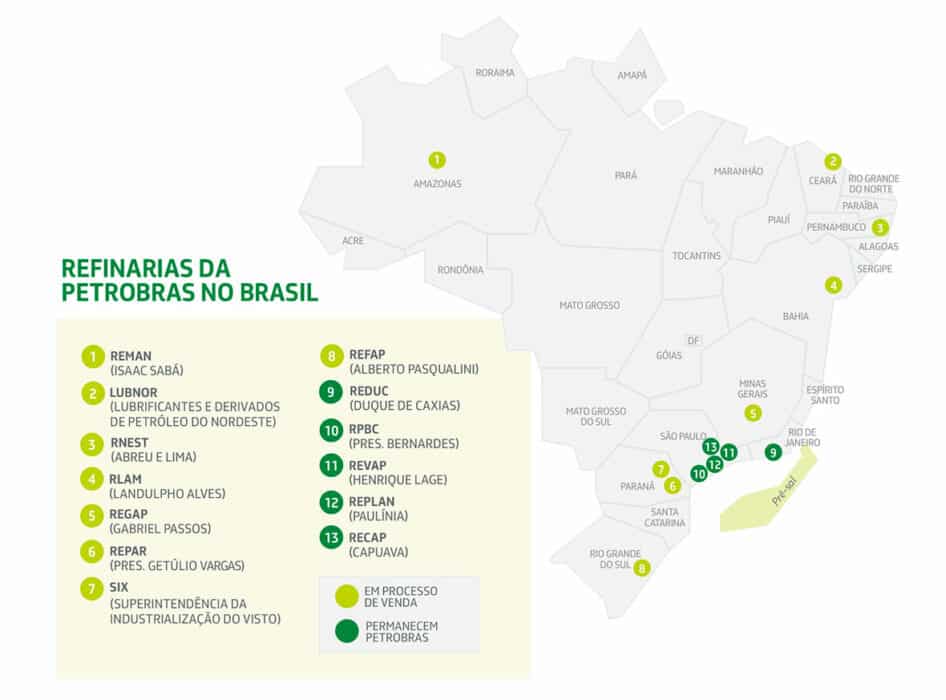
The refineries that still remain with Petrobras are:
- REDUC (Duque de Caxias/RJ)
- RPBC (Presidente Bernardes/SP)
- REVAP (Henrique Lage/SP)
- REPLAN (Paulínia/SP)
- RECAP (Capuava/SP)
The refineries to be sold to the private sector are:
- REMAM (Isaac Sabá/AM)
- LUBNOR (Lubricants and oil derivatives of the Northeast. Fortaleza/CE)
- RNEST (Abreu e Lima/PE)
- RLAM (Landulpho Alves/BA)
- REGAP (Gabriel Passos/MG)
- REPAR (Presidente Getúlio Vargas/PR)
- SIX (Superintendent of Industrialization of Visto. São Mateus do Sul/PR)
- REFAP (Alberto Pasqualini/RS)
According to the company, these refinery sales will allow it to focus on oil extraction, its specialty. Thus, it is essential to understand that it is not a reduction of the company’s power but rather a strategic reformulation of its priorities and the opening of new paths.
What did you think of this article? Did you miss any information? Share your thoughts with us and let’s enrich our knowledge about this important company even more!










Seja o primeiro a reagir!