





 Portuguese
  English
  Spanish
 3 min of reading
  0 comments


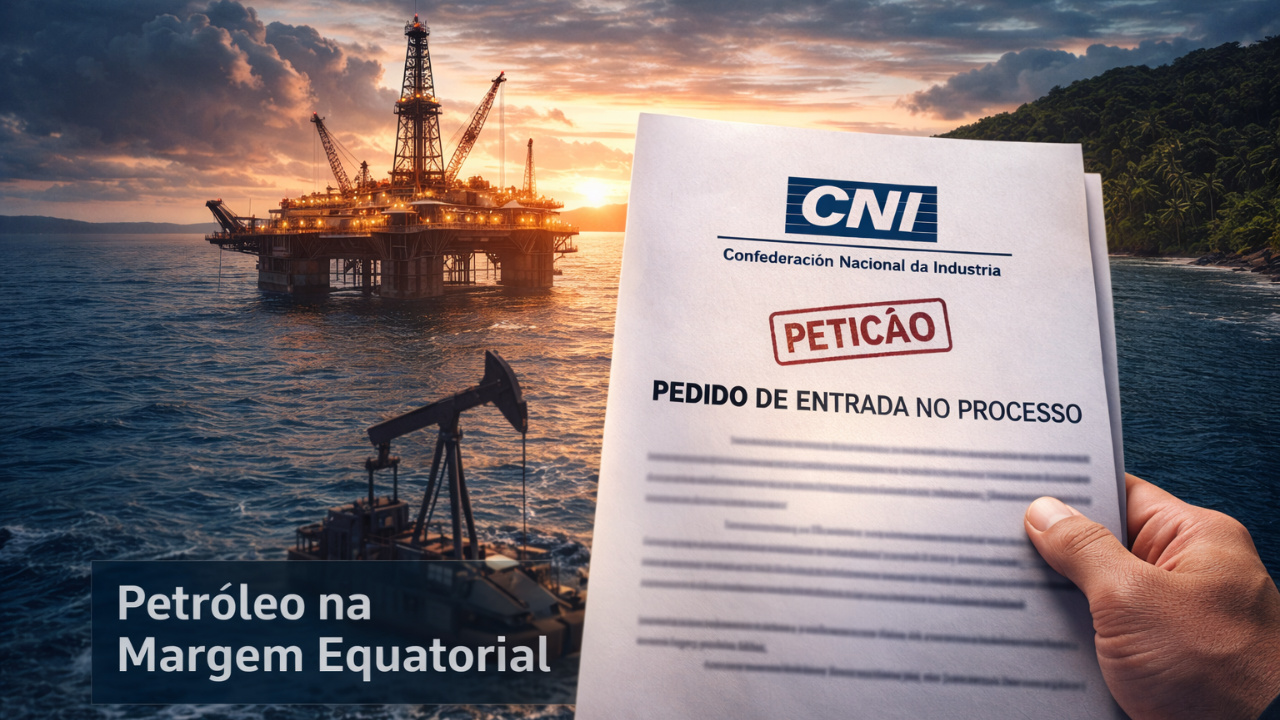
Oil in the Equatorial Margin Enters the Center of the Judicial Debate After Request from CNI to Participate in MPF Action in Pará.
The advancement of oil projects in the Equatorial Margin has gained a new legal chapter. The National Confederation of Industry (CNI) filed a request in the Federal Court of Pará this Tuesday to enter as an interested party in the public civil action brought by the Federal Public Ministry (MPF).
The process questions the auction that marked blocks intended for oil exploration in the region.
According to the entity, the debate requires a technical and legally grounded approach. For CNI, administrative decisions backed by technical criteria must prevail over generic assessments in highly complex issues, such as energy resource exploration.
-
A study confirms that the natural gas sector will reduce greenhouse gas emissions in Brazil by 0.5% and accelerate the energy transition by 2026.

-
Petrobras implements a severe adjustment and confirms a 55% increase in the price of aviation kerosene with a proposal for installment payments for the companies.

-
The rise in oil prices could ensure an extra revenue of R$ 100 billion for the Federal Government, indicates a recent economic study.

-
Naturgy begins an investment of R$ 1.6 million to expand the gas network in Niterói and benefit thousands of new residences and businesses.


CNI Reinforces Role of the Judiciary and Legal Security
In the request sent to the court, CNI argues that the Judiciary should act cautiously when analyzing administrative decisions related to the oil sector. The entity maintains that judicial interference should only occur in cases of blatant illegality or evident absence of reasonableness.
“To ensure legal security, it is necessary for the Judiciary to operate, within the limits of its institutional capacity, with deference to the technical decisions of public administration, and only interfere or review administrative acts in a situation of ostensible absence of reasonableness or blatant illegality,” emphasizes CNI’s Legal Director, Alexandre Vitorino.
According to the confederation, regulatory predictability is essential to attract investments and ensure long-term planning for large-scale projects.
Oil Exploration and National Development
The document filed by CNI goes beyond the economic aspect. The entity argues that oil exploration in the Equatorial Margin should be viewed as an instrument of national development and the promotion of social justice.
In the confederation’s assessment, preventing the activity would mean restricting the country’s access to strategic resources. These resources, according to CNI, are fundamental for reducing historical deficits in infrastructure and public policies, as well as supporting the financing of the energy transition itself.
Furthermore, according to the document, the oil sector can contribute to generating revenues capable of enabling investments in innovation and solutions aimed at addressing the climate crisis.
Social Impacts and Local Communities Enter the Argument
Another point raised by CNI concerns the social impacts of exploration. The entity asserts that there are no indigenous communities directly affected in the areas that were auctioned for oil extraction in the Equatorial Margin.
This argument seeks to counter criticisms related to potential social and cultural damage. For the confederation, the debate should consider objective data and technical analyses, avoiding generalizations that could undermine strategic decisions for the country.
Oil and Climate Commitments at the Center of the Discussion
The relationship between oil exploration and Brazil’s climate commitments also appears centrally in the petition. CNI contests the thesis that the activity would be incompatible with the environmental goals undertaken by the country.
“It is imperative to refute the thesis that oil exploration in the Equatorial Margin would be antagonistic to Brazil’s climate commitments. On the contrary, modern economic doctrine and state strategic planning indicate that there is no accessible and scalable technology for an immediate energy transition. The oil and gas sector is part of possible solutions, without a doubt,” emphasizes CNI’s petition.
According to the entity, responsible oil exploration can coexist with decarbonization policies, acting as a financial base to accelerate the energy transition.
Debate on Oil Gains Institutional Weight
With the request to enter the MPF action, CNI amplifies the institutional weight of the debate on oil in the Equatorial Margin. The initiative reinforces the competition among legal, environmental, and economic viewpoints at a time when Brazil seeks to balance growth, sustainability, and energy security.
The decision of the Federal Court of Pará regarding the confederation’s participation is expected to influence the upcoming developments of the process and the future of oil projects in the region.






Seja o primeiro a reagir!