





 Portuguese
  English
  Spanish
  5 min of reading


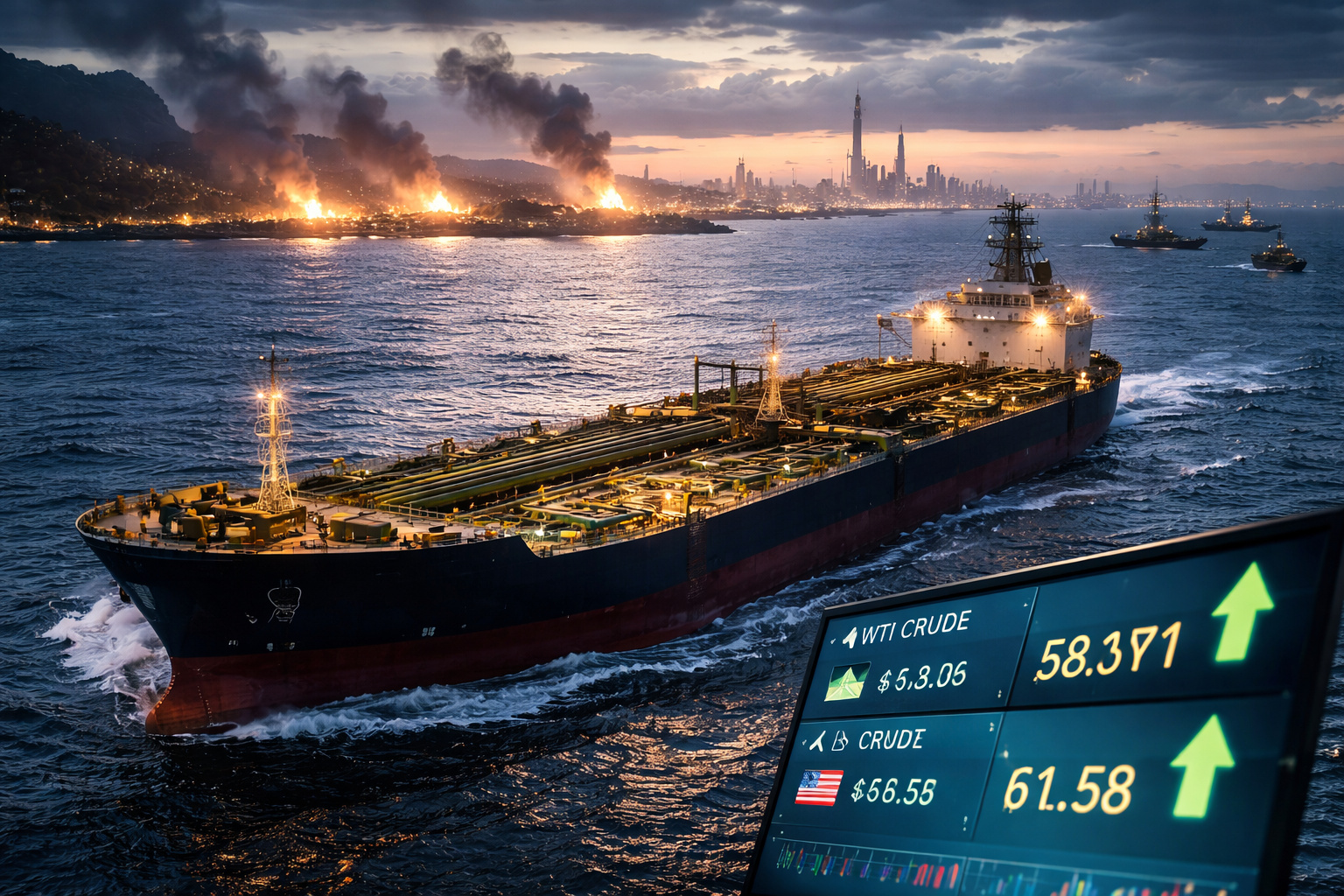
The International Oil Market Began the Week Under Strong Geopolitical Influence. On Monday, the 22nd, Prices Rose for the Fourth Consecutive Session, Reflecting an Environment Marked by Economic Sanctions, Armed Conflicts, and Increasing Supply Risks.
The Combination of These Factors Reinforced the Perception of Scarcity, Even in a Scenario of Moderate Global Demand.
According to Reuters, West Texas Intermediate (WTI) oil, a benchmark in the United States, closed up 2.63%, gaining US$ 1.49 and reaching US$ 58.01 per barrel for February contracts traded on the New York Mercantile Exchange (Nymex). At the same time, Brent, the global benchmark, rose 2.55%, with a gain of US$ 1.53, closing at US$ 61.58 per barrel for March contracts traded on the Intercontinental Exchange (ICE) in London.
This movement did not occur in isolation. On the contrary. It reflects a recurring pattern in the history of oil, where geopolitical events act as immediate triggers for price adjustments, even when long-term fundamentals remain relatively stable.
-
Lula reveals a masterstroke by Petrobras to undo a deal made by Bolsonaro, which involves the return of an important refinery that currently produces less than half of what was expected and makes Brazil dependent on international diesel.
-
A study confirms that the natural gas sector will reduce greenhouse gas emissions in Brazil by 0.5% and accelerate the energy transition by 2026.

-
Petrobras implements a severe adjustment and confirms a 55% increase in the price of aviation kerosene with a proposal for installment payments for the companies.

-
The rise in oil prices could ensure an extra revenue of R$ 100 billion for the Federal Government, indicates a recent economic study.


Oil and the Historical Influence of Geopolitics
Throughout the 20th century and the early 21st century, oil has established itself as one of the most sensitive commodities to international tensions. From the oil shocks of the 1970s, through the wars in the Middle East, to recent sanctions involving major producers, the relationship between politics and price has always been direct.
According to the International Energy Agency, armed conflicts and economic sanctions tend to create immediate volatility, as they affect expectations about supply, logistics, and transportation. Even if the physical volume impacted is small, the psychological effect on the market is usually significant.
In this context, the recent seizure of oil tankers off the coast of Venezuela by the United States has reignited fears about interruptions in the flow of Venezuelan oil. Although the country produces less than in the past, any additional restriction amplifies the perception of risk, especially in a market already pressured by other tensions.
Venezuela, Sanctions, and the Flow of Oil
Venezuela holds a historically significant role in the oil market. For decades, the country was among the largest global producers, supported by vast reserves. However, according to data from the Organization of the Petroleum Exporting Countries (OPEC), Venezuelan production has drastically declined since the 2010s.
Sanctions imposed by the United States have limited exports, access to financing, and the maintenance of infrastructure. Nevertheless, Venezuelan oil continues to appear on alternative routes and operations under constant international scrutiny.
According to the U.S. government, recent seizures aim to curb violations of existing sanctions. For the market, however, the practical result is increased uncertainty, particularly regarding the regularity of oil flow in the Caribbean region.
Oil and the War in Ukraine
Alongside the Latin American scenario, the market closely follows the developments of the war between Russia and Ukraine. According to the European Union, new sanctions against Russia are under discussion and implementation, affecting strategic sectors, including energy.
Russia ranks among the largest global oil producers and exporters. According to the International Energy Agency, any additional restrictions on Russian exports directly affect the balance between supply and demand, especially in Europe and Asia.
Moreover, attacks and military tensions increase logistical risks. The market reacts not only to actual production cuts but also to the possibility of future interruptions. Therefore, even during periods of moderate economic growth, prices remain supported.
Oil, Expectation, and Investor Behavior
The upward movement observed in recent sessions reflects primarily a change in investor sentiment. In times of uncertainty, oil tends to incorporate a geopolitical risk premium. This premium manifests itself in the form of appreciation, even when global inventories remain at comfortable levels.
According to analysts consulted by Reuters, the sequence of four consecutive rising sessions indicates that the market has begun to reassess short-term risks. Although factors such as economic growth and monetary policy influence oil, geopolitics has returned to the center of attention.
Moreover, funds and institutional investors adjust their positions in the face of unexpected events. This intensifies short-term movements and increases volatility, especially in futures contracts.
The Role of Oil in a Fragmented Global Scenario
The current scenario highlights a structural characteristic of the oil market. Even in a world discussing energy transition, the commodity remains central to the global economy. Transportation, industry, and energy generation still heavily depend on oil.
According to the International Energy Agency, global demand remains high, especially in emerging countries. At the same time, investments in new production progress unevenly, creating an environment ripe for supply shocks.
In this context, episodes like the seizure of oil tankers or economic sanctions gain disproportionate relevance. The market prices not only the present but also the future risk, which explains swift and intense reactions.
Oil and the Memory of Past Shocks
The recent reaction also reflects a collective memory of the market. Investors remember that geopolitical shocks often escalate quickly. The conflict in Ukraine, for example, caused Brent to surpass US$ 100 per barrel in 2022, according to ICE data.
Although the current scenario is different, the history influences decisions, leading traders to act cautiously in the face of early signs of escalation. Thus, even isolated events begin to carry more weight in price formation.
A Market Attentive to Every New Signal
By observing the behavior of oil in recent sessions, it becomes clear that the market remains highly sensitive. The combination of sanctions on Venezuela, restrictions on Russia, and armed conflicts keeps the scenario unstable.
According to Reuters, analysts state that as long as these factors persist, oil will continue to react to any new developments. Even if there is no immediate impact on physical supply, the perception of risk will continue to sustain prices.
Thus, the recent rise in oil should not be seen merely as a momentary movement. It reflects a fragmented global environment, where political decisions, conflicts, and sanctions shape expectations. In a market historically driven by geopolitics, oil continues to react to every sign of tension, reaffirming its central role in the global economy.









Seja o primeiro a reagir!