





 Portuguese
  English
  Spanish
  4 min of reading
  2 comments


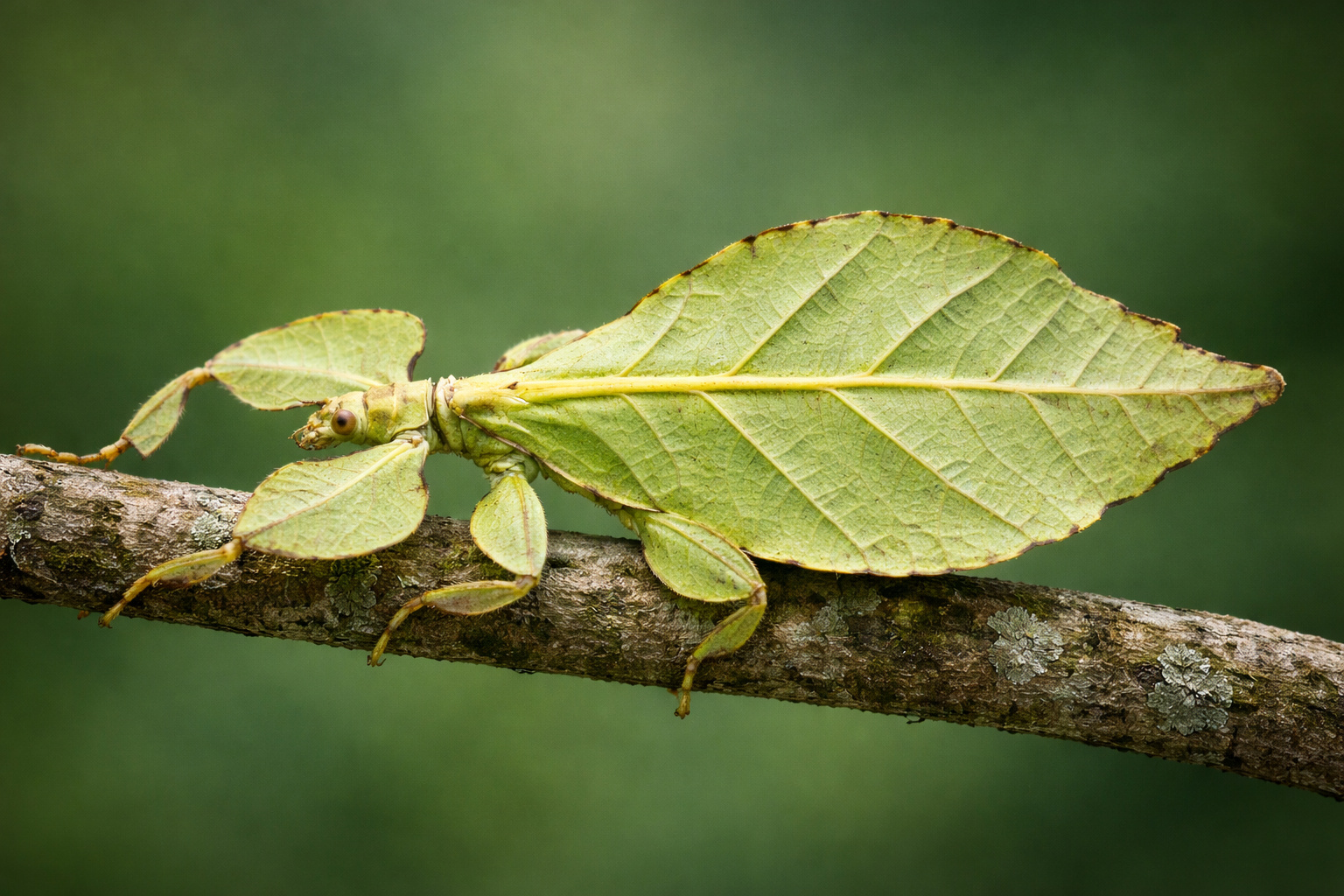


With Up to 28 Cm and Camouflage Identical to a Real Leaf, the Giant Leaf Insect Is One of Nature’s Greatest Masters of Disguise and Has Intrigued Scientists for Centuries.
For centuries, naturalists walked through tropical forests believing they were only observing ordinary leaves swaying in the wind. Amid branches, dense canopies, and green shadows, one of the greatest examples of camouflage ever produced by evolution simply vanished from human sight. This is the Phyllium giganteum, known as the giant leaf insect, an insect that not only mimics a leaf but also reproduces impressively accurate veins, spots, irregular edges, and even signs of “aging” in plants.
This extreme resemblance was so convincing that, for a long time, living specimens went unnoticed even in scientifically explored areas. The animal became one of the most radical examples of mimicry in the animal kingdom and a true challenge for evolutionary biology.
Where the Insect That Looks Like a Plant Lives
The Phyllium giganteum is primarily found in Southeast Asia, with records in areas of dense tropical forests, where plant diversity is high and visual predator pressure is intense. This environment provided the perfect setting for the refinement of almost absolute camouflage.
-
Motorola launched the Signature with a gold seal from DxOMark, tying with the iPhone 17 Pro in camera performance, Snapdragon 8 Gen 5 that surpassed 3 million in benchmarks, and a zoom that impresses even at night.

-
Satellites reveal beneath the Sahara a giant river buried for thousands of kilometers: study shows that the largest hot desert on the planet was once traversed by a river system comparable to the largest on Earth.

-
Scientists have captured something never seen in space: newly born stars are creating gigantic rings of light a thousand times larger than the distance between the Earth and the Sun, and this changes everything we knew about stellar birth.

-
Geologists find traces of a continent that disappeared 155 million years ago after separating from Australia and reveal that it did not sink, but broke into fragments scattered across Southeast Asia.

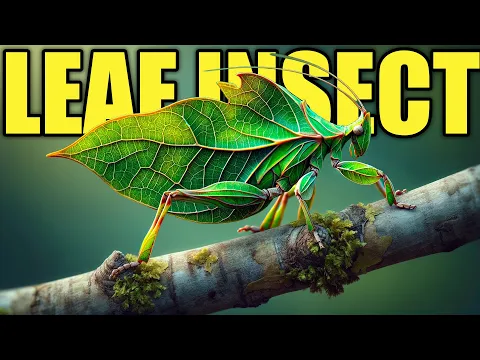

In the canopy and intermediate layers of the forest, the insect spends much of its time motionless, aligned with real branches and leaves. Its coloration varies between shades of green, yellowish, and even brown, allowing adaptation to different stages of the surrounding plants.
Dimensions That Break the Insect Standard
One of the most impressive aspects of the Phyllium giganteum is its size. Adult females can reach up to 28 centimeters in length, making it one of the largest folivorous insects known on the planet.
This significant size does not compromise its defensive strategy. On the contrary: the larger the “leaf,” the harder it becomes to distinguish it from the natural environment. The flattened, wide, and segmented body enhances the illusion of being part of the vegetation, while its legs have lateral expansions that mimic complete leaf blades.
Camouflage That Goes Beyond Shape
The mimicry of the giant leaf insect is not limited to shape. Studies published in the Zoological Journal of the Linnean Society indicate that camouflage involves multiple levels of adaptation:
The surface of the body presents veins almost identical to those of real leaves, with asymmetrical variations that break any artificial pattern. Dark spots simulate fungi, insect bites, or dry areas, something common in natural leaves. The edges of the body are rarely smooth, reproducing the typical wear and tear of vegetation.
Moreover, behavior reinforces the disguise. When the wind blows, the Phyllium giganteum slowly sways its body, mimicking the natural movement of leaves attached to branches. Even experienced predators, such as birds and reptiles, have extreme difficulty detecting it.
A Prolonged Deception Even for Science
This perfect camouflage explains why the giant leaf insect tricked not only predators but also scientists. For a long time, records of the species were rare, fragmented, and often based only on individuals collected by chance.
In the field, researchers could spend hours observing a tree without realizing they were in front of a living animal. In some cases, the insect was only identified when it moved or was accidentally touched.
This level of mimicry helped delay detailed descriptions of the species and reinforced debates about the limits of natural selection and visual adaptation.
Extreme Evolutionary Strategy Against Predators
From an evolutionary standpoint, the Phyllium giganteum represents an extreme solution to a basic problem: how to survive in an environment full of visual predators. Instead of fleeing, attacking, or developing toxins, the insect simply became invisible.
This strategy drastically reduces energy expenditure, as the animal can remain motionless for long periods. It primarily feeds on leaves, which further facilitates integration into the environment, without needing to move frequently.

Reproduction also benefits from this camouflage. Eggs are often left on the ground or among dry leaves, resembling plant fragments, making predation difficult from the early stages of the life cycle.
Comparisons with Other Masters of Disguise
Although there are other mimetic insects, such as stick insects and moths that mimic tree bark, few reach the level of Phyllium giganteum. Its camouflage not only fools from a distance but also upon close observation, which is rare even among highly specialized species.
While many animals rely on color patterns, the giant leaf insect integrates shape, texture, behavior, and imperfection, creating an illusion that is almost impossible to break.
What This Insect Reveals About Evolution
The Phyllium giganteum is more than a visual curiosity. It has become a symbol of how far natural selection can go when survival depends on invisibility. Its existence reinforces the idea that evolution does not seek aesthetic efficiency, but rather functional efficiency, even if it results in organisms that seem “almost unreal.”
For science, it also raises questions about how many other extremely well-camouflaged species remain underestimated or under-studied in the planet’s tropical forests.
In a world where we believe we have cataloged almost everything, the giant leaf insect reminds us that nature is still capable of hiding entire creatures in plain sight — not out of mystery, but out of evolutionary perfection.








E Eu que achava que o camaleão era o Rei da Camuflagem.
Muito interessante. Gostei muito desta informação. Parabéns.