





 Portuguese
  English
  Spanish
  6 min of reading
  0 comments


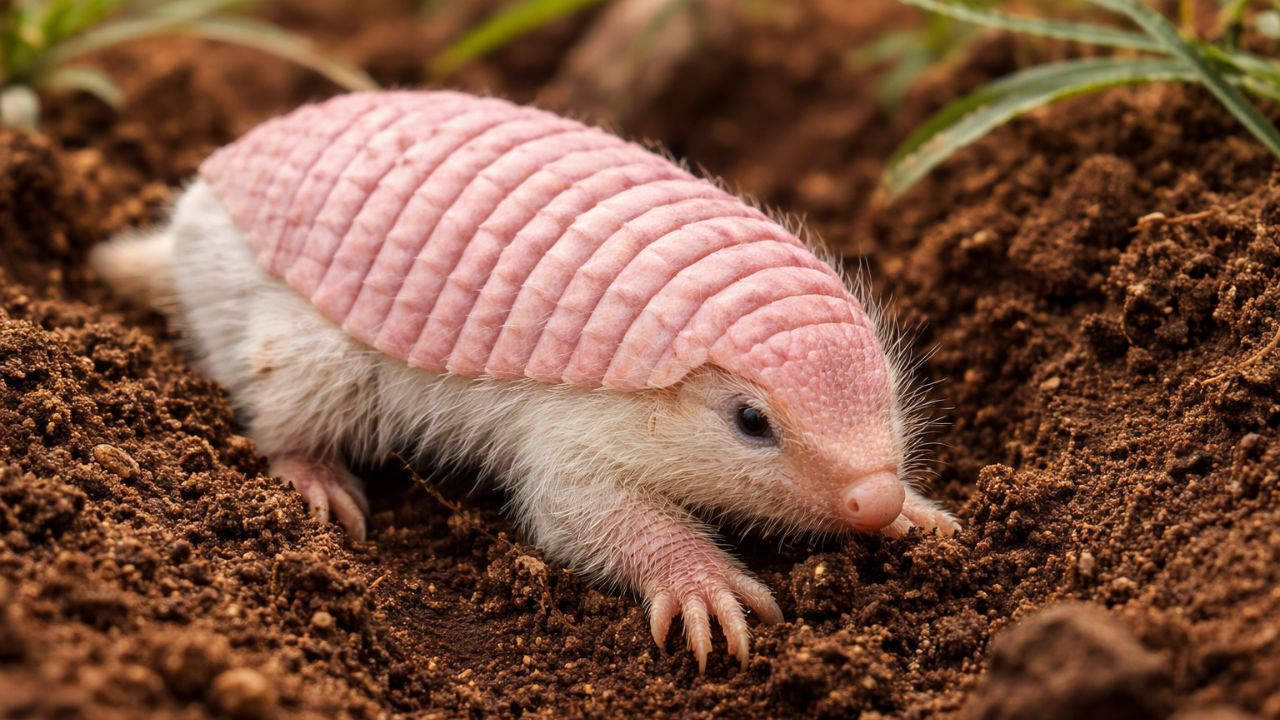
Almost Invisible and Extremely Rare, Pink Fairy Armadillo Lives Only in Arid Regions of Central Argentina, Measuring Up to 15 cm, Spending Its Life Underground, Having Little-Known Reproduction and Facing Increasing Risk of Extinction.
In the arid regions of central Argentina, an animal almost invisible to the human eye draws the attention of the global scientific community. The pink fairy armadillo (Chlamyphorus truncatus), considered one of the rarest mammals on the planet, has returned to the center of environmental discussions due to its unique characteristics, extremely limited distribution, and a level of ignorance that worries researchers.
Small, subterranean, and extremely sensitive to environmental changes, the animal lives only in specific areas of the country and faces increasing risks due to habitat degradation.
Understanding who the pink fairy armadillo is, where it lives, how it behaves, and why its preservation is urgent helps explain the importance of this species for the ecological balance of the Argentine plains.
-
China has created its first space exploration school, an academic structure with 14 areas, 22 new subjects, and a focus on interstellar propulsion to prepare for missions beyond the Moon and Mars.

-
Scientists discover in Fiji that a piece of land surrounded by mangroves is actually a giant mound of shells discarded by ancient inhabitants over 1,200 years ago.

-
No one was able to prove for over 500 years that this medieval city existed, until ground-penetrating radar mapped streets, houses, and entire structures beneath the soil of Norway, and the excavation confirmed a complete preserved city where there was once only legend.

-
In the United States, a valley 86 meters below sea level has reached 56.7°C and remains the place with the highest air temperature ever recorded on Earth, a direct result of a terrain that traps heat between high mountains in the midst of the desert.


Learn More About the Pink Fairy Armadillo
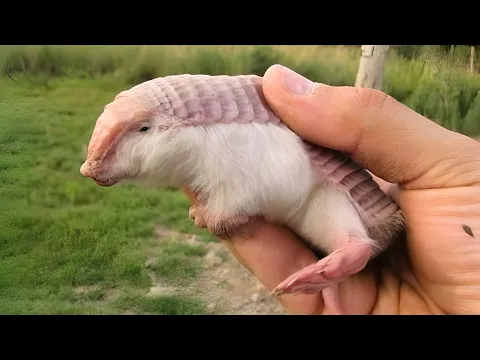
The pink fairy armadillo is the smallest armadillo species known in the world. Its small size is impressive: it measures between 9 and 15 centimeters in length and weighs about 120 grams, roughly the weight of a small smartphone. Despite this, its scientific relevance is enormous.
Its delicate appearance, with silky light fur and a flexible pink shell, makes it look like an animal straight out of a fairy tale.
However, this appearance hides a sophisticated evolutionary adaptation for underground life, making it a true specialist in surviving below the surface.
Where the Pink Fairy Armadillo Lives and Why Its Habitat Is So Restricted
The pink fairy armadillo is endemic to Argentina, meaning it does not naturally exist anywhere else in the world. It mainly inhabits the sandy plains and shrubland regions of the central part of the country.
The primary areas of occurrence include provinces such as Mendoza, La Rioja, San Luis, and parts of Buenos Aires.
These locations share an essential characteristic: loose and sandy soils, crucial for the animal to dig its tunnels easily.
On the other hand, this limited geographical distribution makes the pink fairy armadillo extremely vulnerable. Any significant change in the soil, vegetation, or climate can directly jeopardize its survival.
A Lifetime Hidden Beneath the Ground
The way of life of the pink fairy armadillo is one of the main reasons why the species is still little known. It is a nocturnal and subterranean animal, spending most of its time in tunnels it digs in the ground.
During the day, it remains hidden in its burrows, protecting itself from intense heat and predators.
At night, it comes out to feed, always with caution. When it feels threatened, its reaction is immediate: it quickly digs and disappears into the ground in a matter of seconds.
This extraordinary digging ability serves as its primary defense mechanism. Unlike other armadillos, it does not rely heavily on its shell but on the speed at which it can bury itself.

Unique Appearance of the Pink Fairy Armadillo Explains Its Curious Name
The name pink fairy armadillo did not arise by chance. The species has a flexible dorsal shell, pink in color, connected to the body by thin membranes. This structure does not cover the entire body, functioning more as a partial shield.
The tail, also pink, contributes to the unusual and charming look. In addition, the animal has small eyes and an elongated snout, typical characteristics of mammals adapted to subterranean life.
This combination of features makes the pink fairy armadillo one of the most unique animals in the animal kingdom, both aesthetically and evolutionarily.
Diet Adapted to Sandy Underground
The diet of the pink fairy armadillo perfectly reflects its lifestyle. It primarily feeds on ants, insect larvae, and other small invertebrates found in the soil.
Ants are the basis of its diet. To ensure this resource, the armadillo constructs its tunnels close to large colonies, securing a constant source of protein. Its strong claws and elongated snout facilitate the capture of these small animals.
Additionally, the pink fairy armadillo also consumes roots, bulbs, and plant parts found during digging. This dietary flexibility is essential for surviving in an environment where resources can vary with the seasons.
Social Behavior Is Still a Mystery
Little is known about the social life of the pink fairy armadillo. It is believed to be a solitary animal, encountering other individuals only during the reproductive period.
Its burrows form complex networks of subterranean tunnels, which may include specific chambers for resting, feeding, and escape routes.
However, since sightings are rare, much of this information is still based on occasional observations.
This lack of data complicates the complete understanding of the species’ behavior, making researchers’ work even more challenging.

Reproduction of the Pink Fairy Armadillo Remains Practically Unknown
One of the most intriguing aspects of the pink fairy armadillo is its reproduction. To date, there is no detailed information about mating, gestation, or care for the young.
It is only known that the animal is extremely delicate. Experts report that, in captivity, it survives for only a few days, which makes controlled studies unfeasible. This means that virtually all available knowledge depends on rare observations in a natural environment.
This gap represents a significant challenge for conservation, as effective strategies depend on understanding the species’ life cycle.
Surprising Adaptations for Underground Life
The body of the pink fairy armadillo is a true example of adaptation. Its front claws are robust and curved, ideal for quickly digging through sandy soils.
The tail acts as a sort of plug when the animal is in its tunnels, making it difficult for predators to enter. The silky fur protects against abrasion from the soil and helps regulate body temperature.
Observations indicate that the pink fairy armadillo is extremely sensitive to vibrations and changes in the environment, suggesting a highly specialized sensory system for detecting changes underground.
Conservation Status Concerns Experts
Currently, the pink fairy armadillo is classified as a species with “Insufficient Data.” This means there is not enough information to accurately determine its population size or growth trend.
However, records of sightings have been decreasing over the decades. This fact raises an alarm, as rarity may indicate a population decline.
The main threats include habitat destruction and fragmentation, climate change, and human activities such as intensive agriculture and livestock raising.

Agriculture and Livestock Present Direct Risks
The conversion of natural areas into agricultural zones is considered the greatest threat to the pink fairy armadillo. Soil compaction caused by grazing makes it difficult to dig tunnels, rendering the environment uninhabitable for the species.
Moreover, the use of pesticides drastically reduces the availability of insects, compromising its main food source. These changes affect not only the armadillo but the entire subterranean ecosystem.
Therefore, habitat preservation is essential to ensure the survival of the animal.
Ecological Importance of the Pink Fairy Armadillo
Despite being small and discreet, the pink fairy armadillo plays a crucial role in environmental balance. Its digging helps aerate the soil, facilitating water infiltration and plant growth.
As a predator of invertebrates, it contributes to the population control of subterranean insects. Additionally, its feces enrich the soil with nutrients, creating microenvironments favorable to biodiversity.
In other words, protecting the pink fairy armadillo means preserving fundamental ecological processes in the Argentine plains.
Conservation Requires Joint and Urgent Action
The protection of the pink fairy armadillo depends on coordinated efforts between researchers, landowners, and governmental agencies. More sustainable agricultural practices and the preservation of natural areas are essential steps.
Furthermore, each new sighting represents a valuable learning opportunity. Investing in field research is crucial to fill knowledge gaps about the species.
Although it may seem fragile and almost invisible, the pink fairy armadillo is a powerful symbol of Argentine biodiversity. Its preservation is not just a matter of protecting a rare animal, but of maintaining the balance of a unique and irreplaceable ecosystem.
Source: Agro em Campo, Animal Diversity Web.








-

-

-

-

7 pessoas reagiram a isso.