






 Portuguese
  Spanish
  3 min of reading
  0 comments


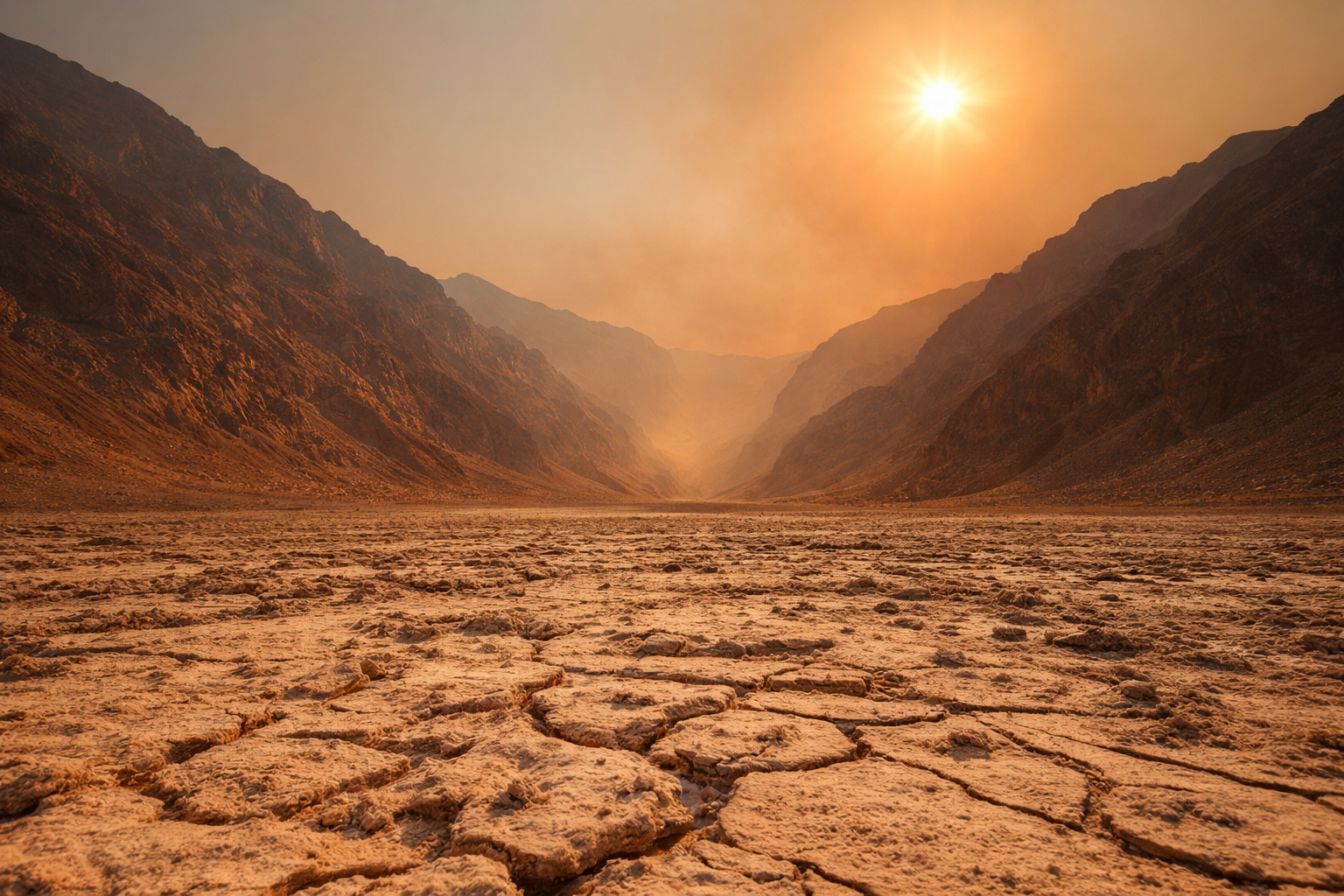
Death Valley, in the USA, holds the world record of 56.7°C. Understand how the valley’s topography traps heat and creates one of the most extreme environments on Earth.
When it comes to extreme heat, many people automatically think of deserts like the Sahara or regions in the Middle East. But the official record for the highest air temperature ever recorded on Earth belongs to a place in the United States: Death Valley, in California.
According to the National Oceanic and Atmospheric Administration (NOAA) and the World Meteorological Organization (WMO), the highest temperature ever recorded was 56.7°C, measured on July 10, 1913 in the Furnace Creek area. This number remains unbeatable more than a century later, solidifying the location as the hottest place ever recorded with official measurements.
A valley below sea level that traps heat
One of the most important factors in explaining this extreme heat is the unique geography of the region. The lowest point in the valley, known as Badwater Basin, is about 86 meters below sea level, making it the lowest point in North America.
-
Hidden beneath a small entrance in Namibia’s underground, the largest underground lake in the world is the size of 2 football fields, 264 meters deep, and even has rare animals that survive without sunlight.

-
The industry relies on oil to manufacture plastic, but a 16-year-old girl used banana peels and managed to create a bioplastic after two years of attempts.

-
Argentina issues radiological emergency alert after theft of Cesium-137, a substance that can cause severe burns and death, and became famous in Brazil due to the Goiânia accident in 1987.

-
While the world tries to prevent plastic in the oceans, an 18-year-old used oil, rust, and a magnet to solve the problem before it reaches the sea.





According to the National Park Service, this feature creates an environment where warm air tends to accumulate. The valley is surrounded by high, steep mountain ranges that act as natural barriers.
These mountains hinder air circulation, preventing heat from escaping easily. As a result, the warm air gets trapped, intensifies, and creates extreme conditions.
The desert’s “natural oven” effect
Death Valley functions almost like a natural oven. During the day, solar radiation intensely heats the ground and rocks of the desert. At night, instead of dissipating quickly, this heat is radiated back into the air, keeping temperatures high even after sunset.
The deep, enclosed topography amplifies this effect. The warm air, denser under certain conditions, descends to the bottom of the valley and accumulates. At the same time, the absence of significant moisture reduces the environment’s ability to dissipate heat.
This combination of factors — low altitude, enclosed topography, warm ground, and dry air — creates a perfect recipe for extreme temperatures.
A record confirmed by science and global monitoring
The record of 56.7°C is not just an isolated historical data point. It has been analyzed, reviewed, and maintained by scientific institutions over time.
The World Meteorological Organization maintains the official archive of climate extremes on the planet and confirms that Death Valley continues to hold the world record.
Additionally, the National Committee on Climate Extremes in the United States, linked to NOAA, also validates this record as the highest ever accurately measured.
Much more than a number: an extreme environment
Death Valley is not just the place with the highest temperature record. It is also one of the most extreme environments on the planet in terms of climatic conditions.
During the summer, temperatures above 45°C are common, and the ground can reach even higher values. The combination of intense heat, dry air, and direct solar radiation creates a hostile scenario where survival requires extreme adaptation.
Even so, the location is home to adapted life forms and attracts visitors from around the world, curious to see up close the place where the Earth reaches its thermal limits.
What makes this phenomenon unique on the planet
Although other regions of the world also record very high temperatures, none have officially surpassed the value recorded in Death Valley.

This is because few places combine so many favorable factors for extreme heat at the same time: negative altitude, enclosed topography, clear skies, low humidity, and intense solar radiation.
In the end, Death Valley is not just a hot desert. It is a clear example of how geography can shape the climate in extreme ways, transforming an isolated valley into one of the most inhospitable places on Earth — and, to this day, the hottest ever recorded.





Be the first to react!