





 Portuguese
  English
  Spanish
  7 min of reading
  0 comments


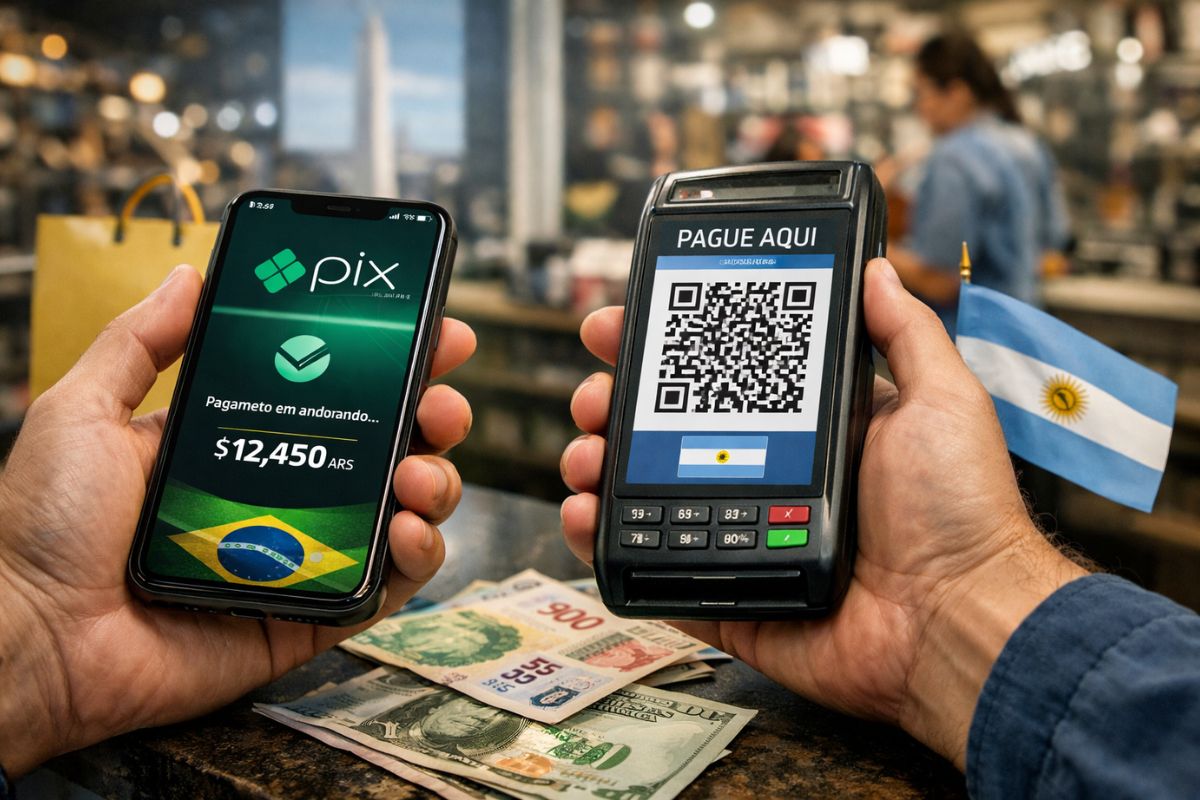
Pix Starts Operating in Physical Stores in Argentina Through QR Code Scanning, with Automatic Currency Conversion, Direct Debit from Accounts in Brazil and IOF Charges, While the Merchant Receives in Pesos and Banco do Brasil Tests a New Step in Digital International Expansion.
The Pix has begun to gain new reach by being used for in-person purchases in Argentina. The novelty, launched by Banco do Brasil in partnership with Banco Patagonia, allows Brazilians to make payments in physical stores in the neighboring country using their cell phones, in a dynamic very close to what they already know in Brazil.
In practice, the operation reduces steps, avoids prior registration, and shortens the path between the purchase decision and payment confirmation. The gesture of the user does not change, but the reach of the tool, which moves from the domestic environment to operate in an international transaction with automatic currency conversion.
How Pix Works in Physical Stores in Argentina
The system was designed to be simple. The merchant displays a QR code, which can appear on a device or another display, and the customer uses their Brazilian financial institution’s app to scan this code. After that, just verify the transaction details and confirm the payment, without the need for prior activation.
-
BRICS is building its own payment system that could be operational by 2030, and experts say it could increase trade between the countries by up to 10% per year and add 3% to the GDP of each member of the bloc.
-
Government suspends over 3 million traffic fines in Brazil and drivers breathe a sigh of relief.

-
Iran has just approved toll charges for ships in the Strait of Hormuz and has completely prohibited the passage of vessels from the United States and Israel in the world’s most important maritime route for the global energy market.

-
Government cancels R$ 25 million “celebration” for Brasília’s anniversary and allocates funds to health.


This operational design helps explain why the solution tends to be perceived as intuitive by those who already use the system in Brazil.
The experience preserves the logic of traditional Pix, even when the purchase takes place outside the country. Instead of creating an entirely new flow for the consumer, the operation adapts an already consolidated habit to an international context.
Another relevant point is that the feature is not restricted to Banco do Brasil clients. According to released information, any Pix user can utilize the new feature, even without being a customer of the institution. This broadens the potential reach of the tool and prevents the solution from being limited to a specific customer base.
By bringing payments to Argentine physical stores, the model also responds to a concrete situation of travel and consumption.
Those in the country who need to pay for a meal, a daily purchase, or any in-person expense now have an option that eliminates extra steps and concentrates everything on their cell phone. It’s a small operational change in appearance, but significant in practical effect.
What Happens to the Exchange Rate and the Amount Paid by the Brazilian
Behind the speed of the operation lies a financial mechanism that facilitates the transaction in two currencies simultaneously. The customer pays in reais, while the merchant receives in local currency. This bridge between the two sides of the purchase is done through an automatic conversion integrated into the payment itself.
This means that the experience may seem simple on the screen, but involves a currency exchange process coupled with the transaction. Instead of the consumer having to handle the currency exchange separately, the system automatically takes care of this step in a matter of seconds. The purchase retains the appearance of a daily payment, but its structure is already international.
In practice, the debit comes directly from the user’s checking or savings account in Brazil and appears on the statement as a regular Pix transaction. This detail is significant as it reduces the sense of complexity. The consumer does not need to interpret a completely new financial product to complete a purchase abroad.
The Tax on Financial Operations, the IOF, is applied to the transaction since it involves exchange and credit. Thus, the amount to be paid depends on the purchase value and the incidence of this tax. It’s not just a purchase in pesos converted to reais, but an international financial operation processed automatically.
Who Can Use It and Why the Novelty Draws Attention
One of the most relevant aspects of this launch is the combination of ease of use and broader reach. Since the solution can be used by any Pix user, not just customers of the bank that launched the service, the feature starts with broader coverage than that of a closed functionality.
This point helps explain why the novelty draws attention. Pix has established itself in Brazil as a daily use tool, linked to the idea of speed and convenience. When this same tool begins to serve also for purchases in another country, the impact is not only on the technology but on changing perceptions of what the system can do.
There is also an important strategic component. Banco do Brasil associates the launch with its international operations and commitment to innovation in payment methods.
In this regard, the operation does not appear merely as a specific service for tourists or travelers, but as part of a broader policy of digitalizing financial services.
At the same time, Argentina emerges as a natural environment for this first step. Proximity to Brazil, the flow of Brazilians in the country, and the need to simplify international payments help justify the choice. The debut does not seem casual; it responds to real use and a concrete demand for mobility and consumption.
The Technology That Allows Payment in Seconds
Although the process is simple for the buyer, the technological structure behind the operation is more complex. According to Banco do Brasil, the conversion is made possible through APIs, interfaces that connect different financial systems and allow for automatic transaction processing.
These interfaces act as bridges between platforms that need to communicate in real time. On one side is the customer’s Brazilian financial institution; on the other, the network that enables receipt in Argentina. Between them, technology must validate data, convert currency, register the operation, and finalize the payment quickly enough so that the experience does not feel stalled.
The solution was developed in partnership with Banco Patagonia, an Argentine institution that is part of the Banco do Brasil conglomerate. Additionally, the system utilizes the Wapa billing solution and the technological infrastructure of Coelsa, a company operating in the payment method market in Latin America. This is not just a new button in the app, but an integration between multiple layers of financial operation.
This type of arrangement shows that the expansion of Pix beyond Brazil depends less on replicating the visual interface and more on building compatibility between distinct ecosystems. The payment happens in seconds precisely because there was a prior design capable of uniting the banking system, the payment mechanism, technological processing, and currency conversion into a single journey.
What the Launch in Argentina Reveals About the Next Steps
After entering Argentina, Banco do Brasil began studying the expansion of the solution to other countries in the Americas, Europe, and Asia, especially in regions with a strong presence of Brazilians. This movement suggests that the current debut may serve as an operational laboratory for a broader presence abroad.
The strategic reading is clear: if international payments can be simplified to the point of approaching the domestic experience, the service gains immediate value for those living, traveling, or consuming outside Brazil. Pix is starting to be seen not just as a national success but as a tool with cross-border potential.
This does not mean that the expansion is already consolidated in other markets, but it indicates a direction. The initiative fits into a strategy to expand the offering of digital financial services and make international payments less bureaucratic. In a scenario where convenience and speed weigh increasingly, such advancements tend to be observed with attention.
There is also an important symbolic effect. When a solution widely used in Brazil manages to cross borders without requiring the user to make a radical change in behavior, it reinforces the idea of technological maturity. What was previously associated with local routines now becomes part of a broader logic of circulation, consumption, and financial integration.
What Changes for Brazilians from Now On
For Brazilians going to Argentina, the most visible change is the ability to pay in physical stores with fewer steps and with the cell phone at the center of the operation.
Instead of relying exclusively on more traditional alternatives, users now have a means they already know, with direct debit from their accounts and quick confirmation. Familiarity becomes a practical advantage at the time of purchase.
In a broader sense, the novelty shows that Pix is beginning to occupy a different space than that which made it popular in Brazil.
It remains a simple tool to use, but now carries an international dimension that can change the consumption experience outside the country and pave the way for new markets.
And, in light of this advancement, one question that is likely to generate real debate arises: would you use Pix on an international trip or do you still prefer more traditional payment methods outside Brazil?







Seja o primeiro a reagir!