





 Portuguese
  English
  Spanish
  3 min of reading
  0 comments


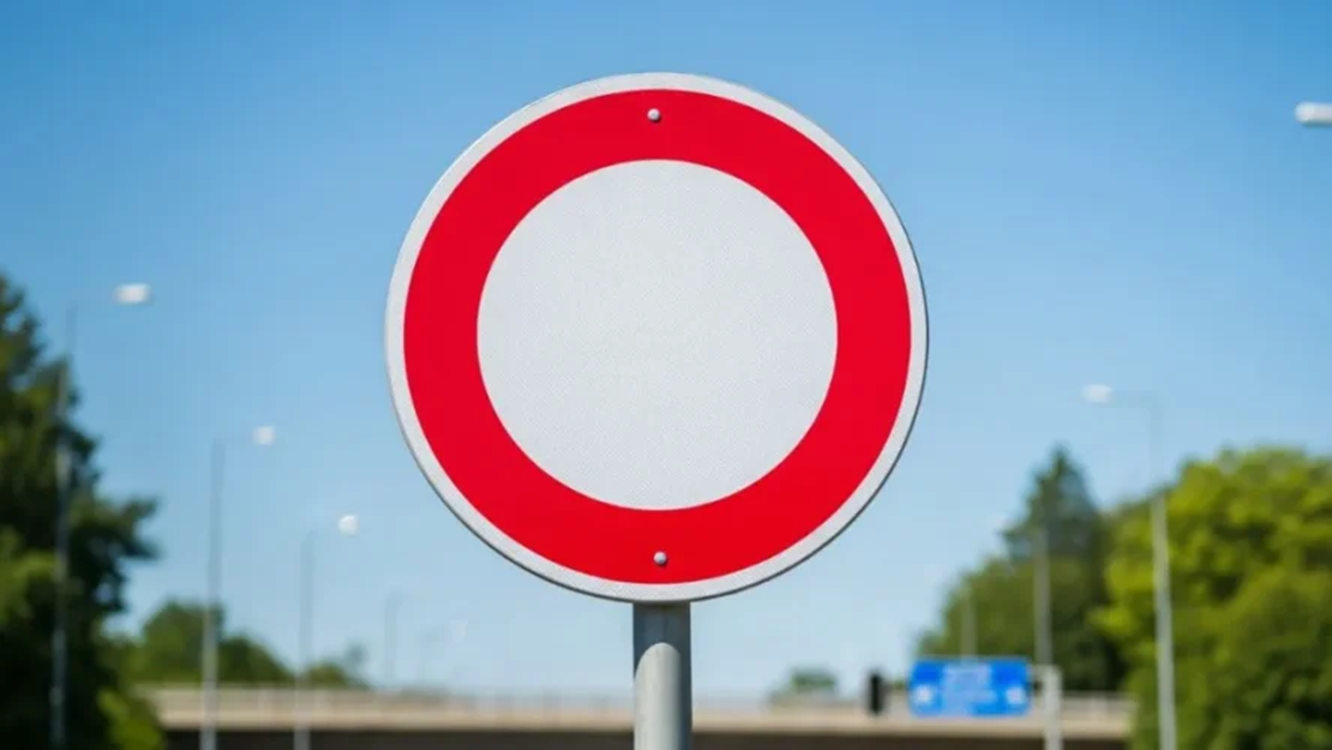
Misleading Posts Show A Sign Without A Symbol As New Total Prohibition Rule, But Sign Never Existed In Brazil
A post that went viral on social media at the beginning of June shows a supposed new traffic sign with a red circle and a completely blank white center.
The image, which was nicknamed “R-100“, suggests that the sign indicates a total prohibition of circulation for all types of vehicles — cars, motorcycles, bicycles, scooters. But, according to G1, the information is false.
According to the National Association of Traffic Departments (AND), the R-100 sign simply does not exist in Brazil.
-
Hidden marks on the walls of the site associated with the Last Supper of Jesus for centuries have been deciphered in Jerusalem, revealing medieval inscriptions left by pilgrims, European nobles, and travelers from the Middle East.
-
One of the most important lakes in the United States for birds, the balance of nature, and the climate has dried to historic levels, leaving boats stranded, revealing salt flats, and showing how the lack of water can transform an entire landscape.

-
It’s not Cristiano Ronaldo or Messi: the richest football player in the world is only 27 years old, has a fortune of 100 billion reais, and is the nephew of a sultan from an Asian country that few people know about.

-
At 77, the king of one of the most famous and powerful crowns on the planet is said to be under pressure to leave the throne, while behind the scenes there are already talks of a new coronation that could cost R$ 260 million.


The Viral Sign Is Invented
The post claims that the “without symbol” sign is being used to indicate total traffic blockage in some regions.
The text adopts an alarmist tone and states that many people are confused by the new model.
The problem is that this “model” was never officially created.
The image shows only a circle with a red border and a white center.
Without the characteristic diagonal line of prohibition signs and without any icon. This contradicts the standard established by the Brazilian Manual of Traffic Signaling (MBST).
According to AND, every prohibition sign must follow clear standardization rules.
The presence of a red diagonal line crossing the symbol of the prohibited action is a common requirement in signs like “no parking“, “no overtaking“, “no entry“, among others.
How A Real Traffic Sign Is Born
Brazil has strict rules for approving a new road signage sign. The process is neither simple nor quick.
The first stage involves a technical study. This study is conducted by specialized agencies and must justify the need for the new signage.
Once the study is approved, the proposal is analyzed by the National Traffic Council (Contran), which may establish a specific resolution.
Only after that, the sign enters the Brazilian Manual of Traffic Signaling. It is this manual that defines the shape, color, symbol, and meaning of each sign used in the country.
The so-called “R-100” has never gone through any of these stages. It has not been studied, has no resolution, and does not appear in the manual.
Signs Are Standardized Nationally
Another important detail: all traffic signs in Brazil must follow the same standard anywhere in the national territory.
There is no local, municipal, or regional signaling that creates its own models. Any alteration or creation must follow the rules of the Contran.
This ensures that anyone, from any state, understands the meaning of the signs while traveling on the roads.
Creating a new sign, like the image of the “R-100”, may seem like a joke, but in practice, it can confuse drivers, cause misunderstandings, and even lead to accidents.
Signs Must Have A Clear Meaning
The use of symbols is essential in any signaling system.
The red circle with a white background, without any symbol in the center, does not communicate any objective information to the driver.
For this reason, the Brazilian manual stipulates that every sign must have a standardized icon — an arrow, a letter, a number, or a line.
Removing this and leaving the center of the sign blank goes against the logic of public signaling.
The proposal for the “R-100”, as it circulates on social media, is not only false: it is illogical.







-

-

2 pessoas reagiram a isso.