





 Portuguese
  English
  Spanish
  4 min of reading
  0 comments


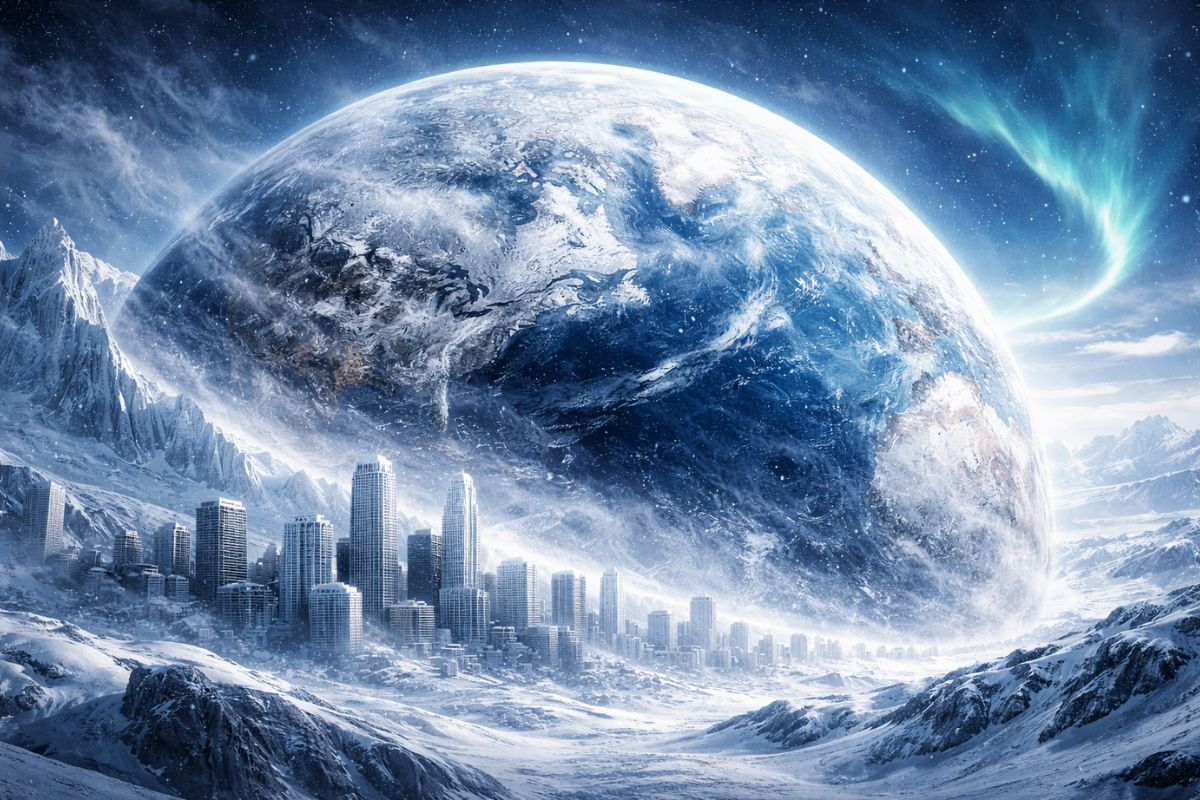
Models From The University Of Bremen And The University Of California, Riverside Suggest That The New Ice Age Is Not A Paradox: Extra Heat Increases Phosphorus In The Ocean, Fertilizes Algae, Depletes Oxygen And Creates A Cycle That Traps Carbon In Sediments, Potentially Cooling The Earth For Tens Of Thousands Of Years.
The possibility of a new ice age associated with global warming stems from a counterintuitive mechanism: excess heat not only warms but can also trigger biogeochemical responses capable of pulling the climate system in the opposite direction over long time scales.
The study published in Science works with models that integrate rocks, oceans, and marine biology, suggesting that phosphorus, algae, and oxygen may form a feedback loop that accelerates carbon sequestration and, under specific conditions, pushes the planet toward deep and lasting cooling.
The Earth’s Thermostat And Why It Does Not Always Protect

The Earth is often described as a system with a “natural thermostat,” where the climate tends to self-adjust.
-
Motorola launched the Signature with a gold seal from DxOMark, tying with the iPhone 17 Pro in camera performance, Snapdragon 8 Gen 5 that surpassed 3 million in benchmarks, and a zoom that impresses even at night.

-
Satellites reveal beneath the Sahara a giant river buried for thousands of kilometers: study shows that the largest hot desert on the planet was once traversed by a river system comparable to the largest on Earth.

-
Scientists have captured something never seen in space: newly born stars are creating gigantic rings of light a thousand times larger than the distance between the Earth and the Sun, and this changes everything we knew about stellar birth.

-
Geologists find traces of a continent that disappeared 155 million years ago after separating from Australia and reveal that it did not sink, but broke into fragments scattered across Southeast Asia.
The classical explanation involves the slow erosion of silicate rocks, which over a long time helps to balance carbon dioxide and, consequently, moderates global temperature.
However, the geological record shows that this control can fail, as in periods when the planet froze from pole to pole.
The hypothesis discussed in the study is that, beyond the rocks, there is a fast component that can destabilize the adjustment: biological cycles in the ocean that respond to global warming with changes in the availability of phosphorus, the productivity of algae, and the state of oxygen.
The Trigger Of Phosphorus In The Ocean In A Warmer World
The central reasoning starts with a simple chain: with rising CO₂ emissions and temperature, the input of phosphorus into the oceans increases.
This enrichment acts like a fertilizer, stimulating explosions of algae and raising biological productivity at the surface of the sea.
From there, the dynamics become more technical. The algae remove carbon from the water through photosynthesis and, when they die, part of that carbon is transported to the seabed.
This “deposit” at the bottom of the sea can trap carbon for very long periods, altering the CO₂ balance in the system and paving the way for cooling that, at its limit, feeds the hypothesis of a new ice age.
When Oxygen Falls, The Cycle Becomes A Self-Feeding Conveyor Belt
The key to the model lies in oxygen.
An explosion of biological productivity consumes oxygen dissolved in the water and can lead to low oxygen conditions, with severe impacts on marine life.
In oxygen-poor environments, the behavior of phosphorus changes, and this is the turning point.
Instead of being buried and removed from the system, phosphorus is recycled from the sediment, feeding new blooms of algae.
The study describes a feedback loop that becomes increasingly efficient at sequestering carbon: more nutrients, more algae, less oxygen, more recycling of phosphorus, and a progressive push toward extreme cooling associated with the new ice age.
What The New Models Add And Why It Matters
The cited work points out that the difference lies in integrating rapid feedbacks into traditional models.
In addition to silicate weathering, sedimentary chemistry, phosphorus cycle, and the state of oxygen in the ocean come into play, precisely where the “biological accelerator” would operate most strongly.
The result is an uncomfortable conclusion: after the “great human experiment” of releasing CO₂ on an unprecedented scale, the system does not necessarily return smoothly to the previous equilibrium.
In specific scenarios, it may surpass the compensation point and fall into very cold phases for tens of thousands or hundreds of thousands of years, keeping alive the hypothesis of new ice age linked to global warming.
What Limits The Scenario And What Cannot Be Concluded Now
The study itself recognizes that this extreme cooling depends on a critical condition: an atmosphere less rich in oxygen, something that was more common in certain periods of geological history.
In the present, the same mechanism could occur less intensely, which reduces the immediate impact, but does not eliminate the relevance of considering long-term effects.
Another point is that the described risk is not a “button” that triggers tomorrow.
The hypothesis involves centuries, millennia, and the interaction between emissions, erosion, nutrients, and biological response.
Still, the technical message is clear: global warming does not guarantee just continuous warming, it can reorganize cycles of phosphorus, algae, and oxygen in such a way that changes the climate destiny of the planet over very long horizons, including the possibility of a new ice age.
The idea of a new ice age caused by global warming does not arise from a rhetorical trick, but from a biogeochemical chain: more heat may mean more phosphorus, more algae, less oxygen, and a carbon sequestration so accelerated that the system begins to cool for long periods.
The central warning is not about an immediate winter, but rather about how ocean cycles can amplify human choices over time scales that politics rarely perceives.
If you had to bet on the most dangerous impact, what seems more plausible: global warming pushing the planet toward continuous hot extremes, or creating long-term triggers for a new ice age via the ocean? And which part of this mechanism convinces you or makes you more skeptical: phosphorus, algae, or oxygen?








-

-

-

6 pessoas reagiram a isso.