





 English
  Francês
  Alemão
  Italiano
  Japonês
  Norueguês
  Portuguese
  Spanish
  4 min of reading
  25 comments




Scientific Project Proposes Underwater Curtain to Block Warm Currents and Attempt to Stabilize the So-Called Doomsday Glacier
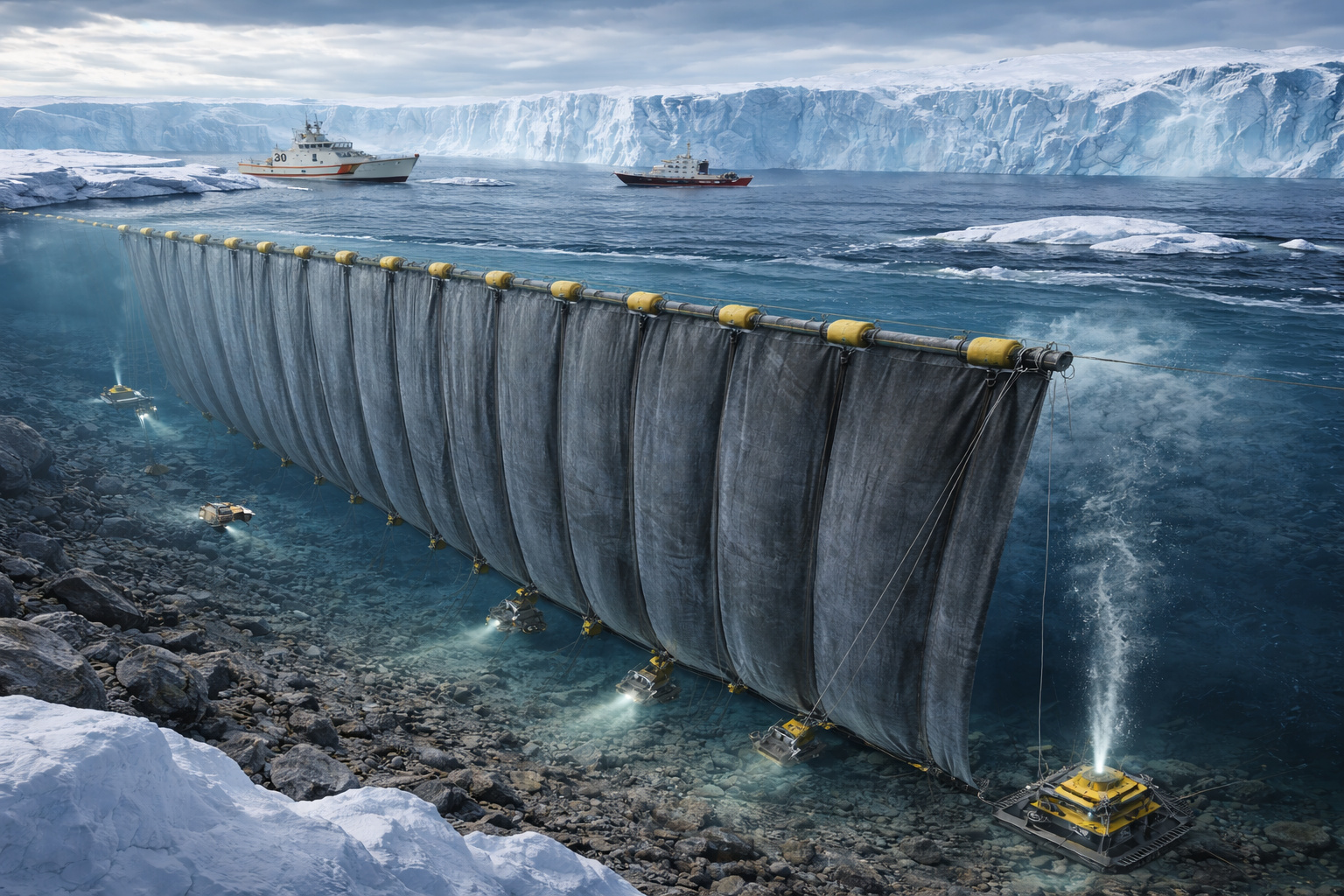
A proposal with significant climate impact was recently presented by international researchers, attracting the attention of the global scientific community. In 2025, the Seabed Curtain Project proposed the installation of an underwater structure to try to slow the melting of the Thwaites Glacier, located in West Antarctica.
Known as the “Doomsday Glacier”, this formation is considered one of the most unstable on the planet and plays a strategic role in the stability of the Antarctic ice sheet. According to information released by UOL in 2025, the total collapse of the glacier could raise global sea levels by about 65 centimeters, affecting coastal cities and millions of people.
Moreover, experts warn that the loss of Thwaites could accelerate the melting of other areas in West Antarctica, increasing long-term risks. This scenario reinforces the growing concern about the climatic impacts associated with the instability of the region.
-
350-year mystery may have been solved: remains of a soldier who inspired the hero of The Three Musketeers found beneath a church in the Netherlands.

-
NASA photographed a nearly perfect square with 3 km sides on Mars, 13 times larger than the Great Pyramid of Giza, but the official explanation is natural erosion; still, no one has explained why the four sides have almost identical lengths.

-
Starlink breaks the barrier of 10,000 satellites in orbit and takes its expansion to an unprecedented level, with a direct impact on global internet, technological competition, and the race for space.

-
Japan finds an alternative to oil amid rising prices by transforming ocean balance into electricity with a new technology that maintains efficiency even when the sea changes.

Strategic Importance of the Thwaites Glacier
Located in West Antarctica, the Thwaites Glacier has dimensions comparable to the state of Paraná and holds one of the largest masses of ice in the world. In some areas, according to data cited by UOL, the ice layer can reach up to 2,000 meters thick, highlighting its geographical magnitude.

This immense structure acts as a natural barrier for the rest of the ice sheet in the region. If its stability is compromised, global impacts could be triggered, especially in densely populated coastal areas.
In this context, rising sea levels would increase pressures on urban centers and strategic infrastructures. Therefore, the preservation of the glacier has become a priority topic in international scientific discussions.
Project Plans Underwater Curtain at 650 Meters Depth
The Seabed Curtain Project, announced in 2025, proposes the installation of a large underwater curtain anchored to the seafloor, in front of the glacier. According to the creators, the structure would be anchored at approximately 650 meters deep.
The main function would be to block warm ocean currents flowing beneath the ice. At the same time, the passage of cold surface water would be allowed to preserve the thermal balance of the region.
So far, the definitive material for the structure has not been determined by the researchers. Nevertheless, the authors argue that, despite the high costs and technical challenges, the attempt should be considered in light of the climate urgency.
Billion-Dollar Costs and Economic Risks
Estimates suggest that the project could cost between US$ 40 billion and US$ 80 billion. At current exchange rates, this amount corresponds to approximately R$ 418 billion, making the proposal one of the most ambitious ever discussed in the climate field.
If the initiative does not achieve the expected results, the global economic damages associated with rising sea levels could reach trillions. Therefore, the technical and financial feasibility has been widely debated by experts.
In addition to the direct financial impact, the decision involves long-term political and environmental responsibilities. Thus, the topic has gained relevance in international scientific and strategic forums.
Scientific Community Diverges on Polar Geoengineering
Although the proposal is considered innovative, it divides experts. Authors of an article published in 2025 argue that polar geoengineering interventions can be extremely costly and technically complex.
Moreover, researchers warn that extreme environments like Antarctica impose significant logistical challenges. There are also concerns regarding possible impacts on fragile marine ecosystems.
While some scientists argue that there is no alternative in the face of the accelerated melting, others call for caution. For these researchers, rigorous assessments should precede any large-scale implementation.
Initial Tests Already Underway
Currently, small-scale tests are being conducted by an initiative from the Norwegian Arctic University, in collaboration with the Seabed Curtain Project. These experiments seek to assess the technical feasibility of the structure before any definitive application in Antarctica.
There is still no decision on potential large-scale implementation. However, studies continue to progress and feed the international scientific debate.
Meanwhile, the future of the Thwaites Glacier remains at the center of discussions about climate risks and technological solutions.
In light of this scenario, should the international community prioritize structural interventions or focus efforts on global climate mitigation policies?







Deveria de utilizar as placas solares para fazer um ar condicionado ou um freezer gigantesco para ajudar a manta que ficará submersa a ajudar no resfriamento,e isso os governantes mundias têm por obrigação de liberar as verbas sem querem nada em troca
Não fala **** pelo amor de Deus
What a ridiculous idea, abyssal effort and cost, for a temporary workaround, that doesn’t touch the real problem at all… And still assuming it’s a real problem.
What a pile of foolishness. The number 1 reason is Elon Musk. Spacex and all trying to be like spacex are causing major OZONE holes. Yes they heal but the heat from the sun that comes through our atmosphere is staggering. Jet planes same just not as localized. Insane people do insane things.