





 Portuguese
  English
  Spanish
  6 min of reading
  0 comments


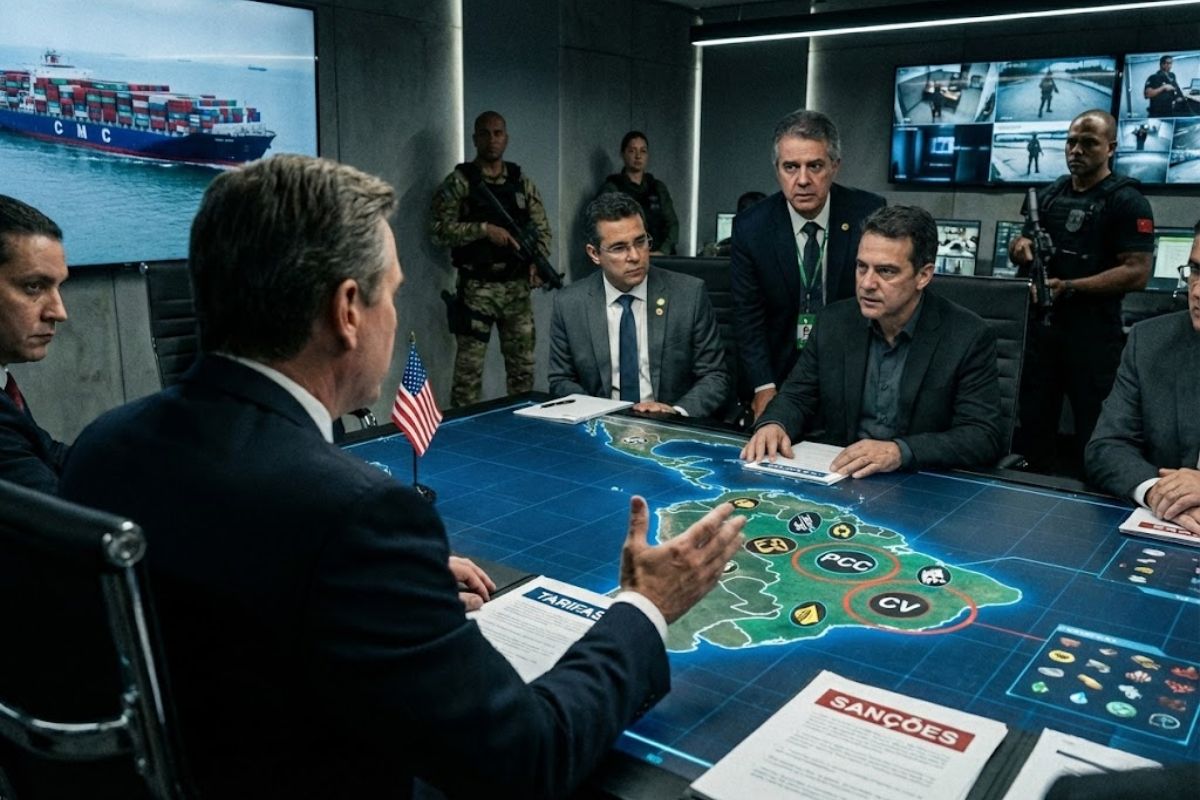
By recentering the strategic focus in the region, Trump’s security plan combines pressure on organized crime and immigration networks, a tacit veto on Chinese expansion in infrastructure and strategic minerals, and a partial relief offer on tariffs and sanctions for those who accept almost automatic political and military alignment.
Since December 2025, when Washington released its new National Security Strategy and repositioned Latin America at the center of its priorities, Trump’s security plan has begun to reorganize the relationship with Brazil around three central axes: combating factions, containing China, and controlling strategic minerals.
On December 2nd, Luiz Inácio Lula da Silva called Trump, offered cooperation against organizations such as PCC and CV, and requested help to detain businessman Ricardo Magro, while in November and on December 12, 2025, he sought to alleviate the 50% tariff on Brazilian exports and reverse sanctions against authorities, in a scenario where security, trade, and geopolitics began to move together.
What’s At Stake With Trump’s Security Plan

The new National Security Strategy is presented in Washington as a reinterpretation of the Monroe Doctrine for the 21st century.
-
Brazilian city bets on the business environment to generate jobs and attract investments in the energy sector — secretary reveals strategy at Macaé Energy 2026.

-
50 viaducts, 4 tunnels, 28 bridges, and 40 kilometers of bike paths: BR-262 in Espírito Santo will receive 8.6 billion reais for the largest engineering project in the state’s history, inspired by the Immigrant Highway in São Paulo.

-
Brazil produces too much clean energy and doesn’t know what to do with it: over 20% of solar and wind capacity was wasted in 2025 while investors flee and 509 renewable generation projects were abandoned in the last year.

-
Piauí will produce a new fuel that replaces diesel without needing to change anything in the truck’s engine and reduces pollutant gas emissions by half: truck drivers from all over the Northeast are already celebrating the news that will arrive later this decade.


Analysts describe it as a “Trump Corollary”, which clarifies the view that the entire Western Hemisphere is part of the United States’ internal security zone.
According to retired Colonel and military analyst Paulo Roberto da Silva Gomes Filho, by placing Latin America as the main focus of U.S. strategic interest, the document signals that Brazil is now considered a relevant piece of U.S. domestic security, and not just a regional partner.
In shaping the plan, the declared target shifts from post-September 11 classical terrorism to include drug trafficking, illegal immigration networks, and transnational organized crime.
The logic is simple: any perceived threat as a risk to U.S. security within the region may justify direct action, including the use of force.
In this context, Trump’s security plan functions as a political and legal umbrella for initiatives ranging from joint intelligence operations to more aggressive diplomatic and economic pressures on governments deemed ambiguous or uncooperative.
Pressure on PCC, CV, and Brazilian Hesitation
One sensitive point for Brasília is the American demand that Brazil classify the Primeiro Comando da Capital and Comando Vermelho as terrorist organizations, something that Argentina and Paraguay have already done after operations in Rio de Janeiro.
So far, the Lula government resists this designation. Government members assess that labeling PCC and CV as terrorist groups could open the door for Washington to invoke Trump’s security plan as a basis for unilateral actions on Brazilian territory, under the pretext of combating drug trafficking and financing organized crime.
Gomes Filho emphasizes that by making explicit the right to intervene to neutralize threats from the region, the new doctrine creates room for targeted operations, directed sanctions, and asymmetric security cooperation, depending on the degree of political alignment of each Latin American government.
Lula tries to calibrate this equation. When he called Trump on December 2, he offered collaboration and cited Ricardo Magro as an example of a priority target, in an attempt to show willingness to cooperate without giving full control over the internal security agenda.
China, Strategic Minerals, and the Influence Dispute
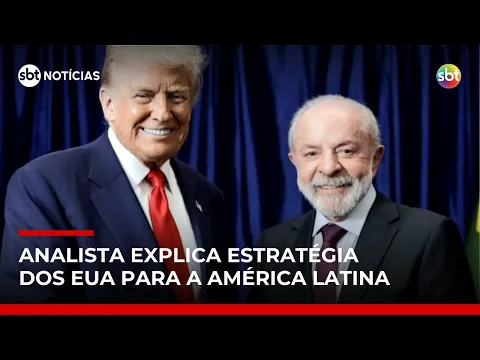

The other central pillar of Trump’s security plan is the containment of China in the Western Hemisphere.
The document rejects military presence, strategic influence, and control of critical infrastructure in the region by extra-hemispheric powers, sending a direct message to Beijing.
The target is not only diplomatic.
The White House aims to monitor and limit Chinese expansion in ports, energy networks, technology, and infrastructure projects, especially in countries with significant stakes in commodities and sensitive industrial chains.
In this scenario, Brazil appears as a high-value geopolitical asset.
The country holds about 23% of the world’s reserves of rare earths and strategic minerals, key inputs for energy transition, batteries, semiconductors, and military equipment.
For economist Adriana Melo, the new version of the Monroe Doctrine introduced by Trump transforms minerals, logistics, and technology into instruments of political control.
According to her, “closing the door” to China in critical sectors has become a prerequisite for broader agreements with the United States.
Melo highlights that Trump’s security plan tends to encourage sole source contracts with American companies in the fields of ports, energy, and data.
In this view, security cooperation ceases to be a diplomatic gesture and becomes currency for excluding Chinese capital from sensitive infrastructures.
Tariffs, Sanctions, and the Use of Economic Pressure
The reconfiguration of security coincides with an economic offensive.
In November, Trump lifted tariffs on several Brazilian agricultural products to combat food inflation in the U.S., a gesture that the Planalto presented as a direct result of political negotiation.
Even so, according to Vice President Geraldo Alckmin, 22% of Brazilian exports to the United States remain subject to surcharges, maintaining the 50% tariff as a pressure tool.
The implicit message is that any progress depends on greater convergence with the priorities of Trump’s security plan.
The use of individual sanctions reinforces this strategy. On Friday, December 12, Washington removed Minister Alexandre de Moraes and his wife, Viviane Barci, from the Magnitsky Act list, arguing that maintaining the sanctions would be incompatible with U.S. foreign policy interests and praising the PL of dosage approved by Congress.
The day before, Under Secretary of State Christopher Landau had already signaled support for the legislative change that tends to reduce the sentence of former President Jair Bolsonaro and other convicts from the events of January 8.
In practice, the White House uses tariffs and sanctions as calibrated instruments of reward and punishment, linking economic gestures to the legal and political convergence of Brasília.
Alignments, Autocracies, and the Risk of Loss of Influence
For economist and doctor in international relations Igor Lucena, the first target of Trump’s security plan should not be Brazil, but regimes considered undemocratic, such as Venezuela, Nicaragua, and Cuba.
Still, Brasília’s position is seen as fragile.
Lucena assesses that the White House tends to seek proximity with Brazil to ensure stable access to minerals and strategic production chains, but will be much stricter with countries that maintain open partnerships with Russia, Iran, and other U.S. rivals.
In this context, Brazil’s rapprochement with undemocratic governments and actors that directly oppose Washington may reduce Brazil’s leadership capacity in Latin America, at a time when the United States has already treated Argentina and Paraguay as preferred allies in security.
At the same time, the Brazilian government’s refusal to label PCC and CV as terrorist groups preserves spaces for internal maneuvering but may be read in Washington as unacceptable ambiguity within the framework of Trump’s security plan, opening the door for additional pressures in multilateral forums, police cooperation, and trade agendas.
What Will Be the Price of Brazilian Repositioning
In this scenario, Brazil finds itself between three vectors of simultaneous pressure.
On one hand, Trump’s security plan creates a framework for possible intervention in the name of combating crime and irregular immigration.
On the other hand, containment of China requires defining clear limits on investment in critical areas. In parallel, tariffs and sanctions become an adjustment variable in the bilateral relationship.
The Brazilian response will require coordination between foreign policy, public security, defense, and economy, as any choice of alignment will have a direct impact on export chains, capital flow, intelligence cooperation, and diplomatic maneuvering with neighbors and extra-regional powers.
In your assessment, should Brazil align with Trump’s security plan to ensure relief on tariffs and investments or preserve its current autonomy, even at the risk of new pressures and American retaliation?









-

Uma pessoa reagiu a isso.