





 Portuguese
  English
  Spanish
  5 min of reading
  0 comments


How Rice Plantations Inspire Urban Solutions Against Floods
Imagine living in a city so prone to flooding that rainfall accumulates faster than the drains can manage. Now imagine solving this by drawing inspiration from something ancient: terrace rice plantations. Sounds unlikely? That’s exactly what’s happening in some of the most vulnerable cities on the planet.
When Childhood Memory Becomes Climate Alert
In 1980s Bangkok, landscape architect Kotchakorn Voraakhom fondly remembers the time she played boat in the floodwaters that overtook her street. “I was so happy not to have to go to school because we didn’t know how to get there,” she told the BBC.
Thirty years later, that same water became a nightmare. In 2011, Thailand faced its worst flood in decades: more than 800 dead and millions displaced. The city where Voraakhom grew up became a symbol of climate collapse, and it was there she decided to take action.
-
These are the drivers who may stop paying tolls on highways in a project that promises to reduce costs for those who live from transportation in Brazil.

-
(Video): Italian pilot lands plane on moving train at 120 km/h and achieves unprecedented feat in aviation, even with a narrow runway and without direct visual contact.
-
It seems to have come out of a science fiction movie: A Brazilian city where it rains almost every day, recording over 4,000 mm per year, driven by climatic factors — a direct result of its strategic location in the Amazon.
-
The water crisis that could change everything this year has already begun; it’s not just about the climate, it affects technology, raises product prices, and can halt entire companies without warning.


The Answer Is in Rice and in the Past
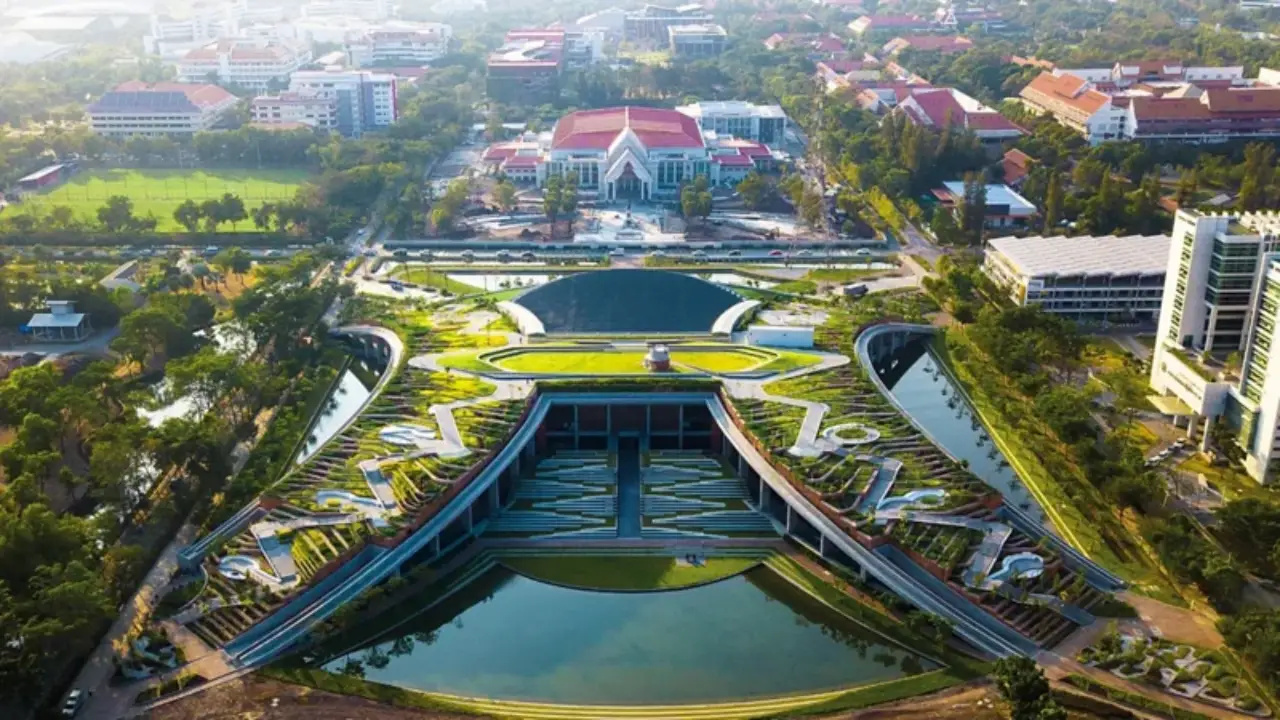
Voraakhom founded the firm Landprocess and has since been designing urban spaces that adapt to water rather than trying to prevent it. One of her most innovative projects is on the roof of Thammasat University in Bangkok. Instead of concrete, there is a true rice plantation spread across terraces that mimic the ancient agriculture of slopes.
This structure not only retains up to 20 times more rainwater than a traditional roof, but also produces food, reduces the internal temperature of the building by up to 4°C, and uses solar panels to pump water back to the agricultural fields on top. The green roof covers 22,000 square meters, of which 7,000 are used for organic farming, the largest urban farm of its kind in Asia.
Sponge Cities: Absorbing Is Better Than Draining
This concept of mimicking nature to coexist with water has also gained traction in China. Architect and professor Yu Kongjian from Peking University argues that the solution to excessive rain is not in pipes or concrete, but in soil and plants.
He created the concept of sponge cities, where parks, green roofs, and riverbanks designed like rice terraces help control floods and recycle rainwater. Since 1997, Yu has been involved in projects in over 500 Chinese cities.
At Yanweizhou Park, for example, the strategy reduced flood levels by up to 63%. At Houtan Park in Shanghai, an area that was once a toxic landfill now purifies up to 800 tons of water per hectare per day, thanks to the use of adapted vegetation and terracing. The treated water there already reaches level 3 quality, enough for aquatic life.
Vietnam and the Philippines: Architecture with Roots in Rice
Other countries are also applying this ancient wisdom. In Vietnam, architect Doan Thanh Ha from H&P Architects built three-story houses with agricultural roofs inspired by rice fields. One of these houses can even float during flood periods, using only bamboo and simple materials.
In the Philippines, similar initiatives are already in use in high-risk areas, helping vulnerable communities face hurricanes and rising sea levels with accessible and resilient structures.
Bangkok: The City Where Green Is Lacking
Despite creativity and tradition, Bangkok still suffers from a lack of green areas. There are only seven square meters per inhabitant, one of the lowest rates in Asia. In a city with 11 million residents and only 1.5 meters above sea level, the problem is urgent.
To change this, Voraakhom created the Chulalongkorn Centennial Park in 2017, designed with a gentle three-degree slope that directs rainwater to underground tanks. The park stores 4.5 million liters of water, equivalent to one and a half Olympic-sized swimming pools.
Sponge Urbanism or Concrete?
The idea of using green infrastructure (like rice terraces) instead of rigid structures (like channels and pumps) has been debated among specialists. For Wang Yuhong, a professor of engineering at the Hong Kong Polytechnic University, both have their place.
In cities like Hong Kong, where the mountainous terrain favors rapid runoff, there has already been investment in giant tunnels to prevent flooding. One of them, inaugurated in 2012, cost the equivalent of R$ 2.8 billion. For Wang, using rooftop gardens may be cheaper and more effective in similar locations.
However, he acknowledges that building green areas in overcrowded metropolises is not always feasible, especially where there is not enough space or resources. Therefore, large cities like Tokyo also invest in underground reservoirs to store stormwater.
Rice as a Symbol of Reconnection
For Voraakhom, rice is not just food: it is a symbol of how Southeast Asian peoples have always lived in harmony with water. And it is precisely this harmony that has been lost with rampant urbanization.
“The best agricultural region in the world is turning into the worst city possible to live in,” she said in an interview, referring to Bangkok. Her hope is that cities stop trying to contain the waters and start to welcome them intelligently.
Cities with a Future That Looks to the Past
Climate change is making rains heavier, summers drier, and sea levels higher. Cities like Jakarta, Ho Chi Minh, and others are already physically sinking, pressured by construction weight and loss of aquifers.
Experts like professor Shao Zhiyu from Chongqing University explain that in the face of extreme events, there is no way to fully control floods — we can only adapt. Urban planning projects are already being designed to redirect water to secondary streets, so main routes remain functional even during severe storms.
Architect Yu Kongjian summarizes this philosophy with a powerful metaphor: “It’s time to be friends with water.” Creating spaces that welcome and absorb rain can be the key to more resilient and sustainable urbanism.
What about you? Have you imagined your city using rice as inspiration to prevent floods? Leave a comment or share this content with someone who needs to rethink the city in a new way. Let’s spread ideas that work — and that come from millennia ago.






Seja o primeiro a reagir!