





 Portuguese
  English
  Spanish
  3 min of reading
  2 comments


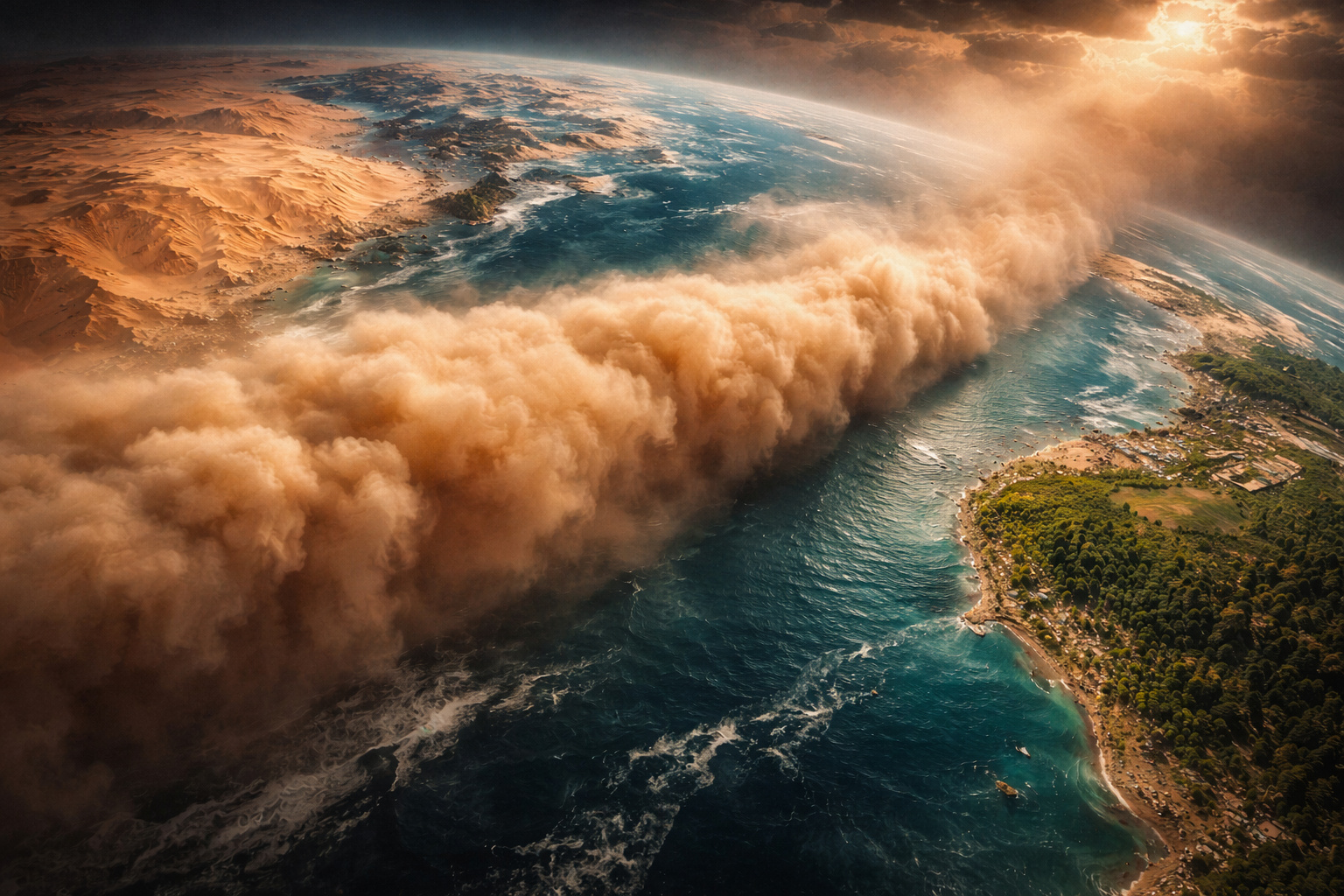


A Mass Of Mineral Particles Crosses The Ocean, Increases The Concentration Of Atmospheric Pollutants, And May Alter Visibility, Clouds, And Sunset In The Coming Days
An extensive mass of Sahel Dust crosses the tropical Atlantic Ocean and moves toward the Northern and Northeastern Brazil, according to weather monitoring released since Monday (23).
The trade winds drive the phenomenon and transport mineral particles from North Africa to the Americas, over more than 5,000 kilometers across tropical waters.
Forecasts indicate a higher concentration between Tuesday (24) and Wednesday (25), with the possibility of persistence until Friday (27), while areas of South America, Central America, and the Caribbean remain in the plume’s path.
-
Submarine cables installed to transmit the internet now also help scientists detect earthquakes.

-
After so many blackouts, a family transforms an electric truck into a power source for their home and shows how a 100 kWh battery can keep everything running for days.

-
Ukraine is already testing, and China has already shown the world, and now the Brazilian Army is developing its own swarm of autonomous drones with artificial intelligence that share data in real time and operate without centralized control, uniting military and universities.

-
Few people know, but the most nutritious part of wheat has been discarded for decades to produce white flour, and the “polyamine” spermidine activates cellular cleaning, reduces mortality, and may slow down memory loss.



Monitoring Indicates Increase In Particles In The Air
Atmospheric maps show an increase in PM10 and PM2.5, suspended particles that directly influence air quality.
The PM2.5 classification identifies particles with a diameter equal to or less than 2.5 micrometers, about 30 times smaller than a human hair.
Because they are extremely fine, these particles penetrate deeply into the lungs and, under certain circumstances, can reach the bloodstream, raising concerns during peak concentration times.
Long-Distance Atmospheric Transport
The Sahel ranks as the largest source of mineral dust on the planet and releases large volumes of particulate material into the atmosphere.
Strong winds lift microparticles from the desert surface and incorporate them into the dominant atmospheric flow at mid-levels of the atmosphere.
As the mass moves over the Atlantic, the lighter fraction remains suspended long enough to cross the ocean and reach the American continent days after leaving Africa.
Impacts On Health And Air Quality
The increase in PM2.5 concentrations temporarily compromises air quality and can cause irritation in the eyes and respiratory tract.
Children, the elderly, and people with chronic respiratory diseases face greater vulnerability during these episodes of higher particle concentration.
Health authorities recommend that these groups reduce outdoor activities during these days and, when necessary, use respiratory protection to reduce exposure.
Effects On Climate And Landscape
The suspended dust also interferes with cloud formation, as the excess particles compete for available moisture in the atmosphere.
This interaction can temporarily alter rain dynamics and modify regional atmospheric processes.
Furthermore, the scattering of sunlight can intensify sunset colors and create different hues on the horizon, temporarily transforming the landscape.
In light of this scenario, do you believe that the arrival of the Sahara dust in Brazil should mobilize more public attention regarding air quality and respiratory health precautions?




Sem está poeira a floresta amazônica nao existiria, ela nutre a floresta a milhares de anos por que agora é uma preocupação para o ar?
Verdade