





 Portuguese
  English
  Spanish
  4 min of reading
  0 comments


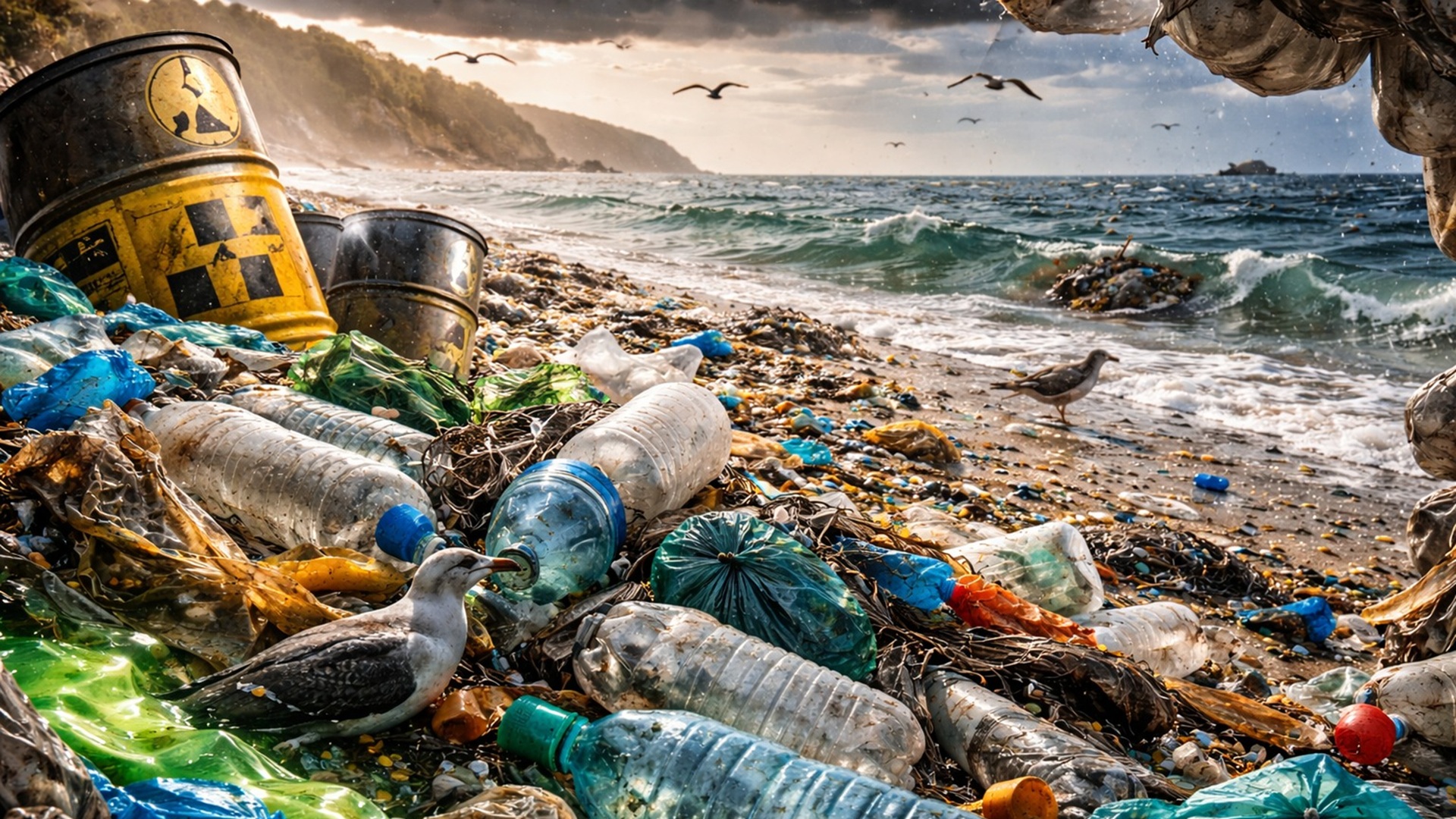
With More Than 19 Million Tons of Plastic Dumped Annually in Rivers, Lakes, and Oceans, PFAS Contamination Above Environmental Limits Pressures Compliance with the Global Goal to Eliminate Pollution by 2030 and Exposes Failures in National Environmental Actions
Plastic pollution is already contaminating the environment, with over 19 million tons dumped annually in rivers, lakes, and oceans, releasing PFAS above limits in freshwater and challenging the elimination goal set for 2030 in the Global Biodiversity Framework.
Plastic pollution has been classified as one of the biggest environmental challenges today, with direct impacts on the environment, biodiversity, and human health. The Kunming-Montreal Global Biodiversity Framework stipulates that plastic pollution must be eliminated by 2030.
Despite the international goal, measures considered capable of making a real difference have not yet been implemented. The problem is not limited to visible waste on beaches but involves chemical contamination in aquatic ecosystems.
-
Motorola launched the Signature with a gold seal from DxOMark, tying with the iPhone 17 Pro in camera performance, Snapdragon 8 Gen 5 that surpassed 3 million in benchmarks, and a zoom that impresses even at night.

-
Satellites reveal beneath the Sahara a giant river buried for thousands of kilometers: study shows that the largest hot desert on the planet was once traversed by a river system comparable to the largest on Earth.

-
Scientists have captured something never seen in space: newly born stars are creating gigantic rings of light a thousand times larger than the distance between the Earth and the Sun, and this changes everything we knew about stellar birth.

-
Geologists find traces of a continent that disappeared 155 million years ago after separating from Australia and reveal that it did not sink, but broke into fragments scattered across Southeast Asia.

Plastic Pollution and Environment Under Increasing Pressure
More than 19 million tons of plastic reach rivers, lakes, and oceans every year. The plastic that reaches the sea and coastal areas does not disappear. It breaks down into microplastics and remains in the environment indefinitely.
This process threatens marine life, birds, terrestrial animals, and consequently, humans. Before it became a crisis, the problem was treated as an environmental challenge, a moment when there was still an opportunity to act.
Volunteers and professional organizations remove large volumes of marine plastic waste from coastal areas. However, new quantities continue to arrive from the sea and are brought ashore by the waves. The cycle repeats year after year.
The scenario has been described as an effect of compound interest on the amount of marine debris. With the current system, neither volunteers nor organizations can manage the volume that is already present or what will continue to be added in the coming decades.
Toxic Legacy Hits Freshwater and Human Health
A study published in the journal Heliyon analyzed marine plastic debris collected in small lakes and ponds of freshwater. The results indicated alarming concentrations of PFAS and heavy metals.
The concentrations recorded in freshwater exceeded the limit values of environmental quality standards. Small lakes and ponds are closed ecosystems, where contaminants have nowhere to go, accumulating over time.
Birds and wildlife are exposed by drinking this water. Humans can also be affected by consuming the meat of animals that grazed on coastal islets, such as sheep.
PFAS are described as forever chemicals. They threaten both the environment and human health. What occurs in these closed systems serves as a warning for similar processes in the oceans, albeit they are slower to detect.
Global Goals and Gaps in National Action
Goal 7 of the Kunming-Montreal Global Biodiversity Framework establishes the elimination of plastic pollution by 2030 to protect biodiversity. The central question remains practically unanswered: why have effective measures not yet been implemented?
The Norwegian government presented targets in White Paper 35 2024-2025 and in the Norwegian Plastic Strategy 2021. The documents address producer responsibility, reduction of production, improved waste management, and combating unmarked fishing gear.
They also highlight the need for a global agreement on plastic pollution and the creation of a panel of experts on chemicals and waste. However, there is no specific national plan to clean the marine debris already present in the environment.
Without long-term funded measures for coastal landscapes, the country remains at a disadvantage. Plastic continues to accumulate while challenges gradually increase.
Reduced Resources and Palliative Solutions
The Norwegian Environment Agency allocated 27.9 million Norwegian kroner for cleaning marine plastic waste in 2025. A few years earlier, the amount was 80 million Norwegian kroner.
The Norwegian Retailers’ Environmental Fund set a goal to clean 55% of the coastline by the end of 2025. The initiatives are considered positive, but there are questions about whether they are sufficient given the magnitude of the problem.
A cleaned area in a given year can become polluted again the following year due to the continuous flow brought by ocean currents from both national and foreign sources. Current measures are described as palliative in the face of a structural crisis.
National Response Model Proposal and Student Pressure
In light of the scenario, a national response model to plastic pollution was suggested, inspired by the spill response system. The proposal envisions a single central organization responsible for prioritizing and implementing measures where the need is greatest.
The model would include clear long-term strategies, guaranteed funding, and defined lines of responsibility. The absence of a coordinated structure is pointed out as an obstacle to the effectiveness of actions.
University students are showing strong concern about the consequences of plastic pollution for the environment and human health. They have presented constructive solutions but emphasize that concrete political action is essential.
Impatience is growing in the face of the prospect of polluting the environment for eternity. Meeting the goals of the Global Biodiversity Framework is now presented as an indispensable condition to avoid worsening the problem.
Declared ambitions are not enough. What will determine the future of the environment is the effective implementation of structural measures, ongoing funding, and clear accountability. Without this, the cycle of accumulation will continue year after year, amplifying already observed impacts.
This article was prepared based on information about the Kunming-Montreal Global Biodiversity Framework, the study published in the journal Heliyon on PFAS and heavy metals in marine plastic debris, and the official data cited regarding goals and investments from the Norwegian government and the Norwegian Environment Agency.







Seja o primeiro a reagir!