






 Portuguese
  Spanish
  3 min of reading
  0 comments


Turkey Inaugurates The Osman Gazi Bridge, The Fourth Largest In The World At 2,682 Meters, Reducing Travel Time From 8 To 4 Hours.
Located between two continents, Asia and Europe, Turkey is a unique transcontinental nation. It is the third most populous country in Europe, trailing only Russia and Germany. The Turkish economy is diverse, covering sectors such as agriculture, industry, and services. In addition, Turkey stands out in engineering, being home to the Osman Gazi Bridge. This impressive structure is the fourth largest suspension bridge in the world and the second longest in Europe, measuring 2,682 meters in length.
Osman Gazi Bridge Has 2,682m Of Extension
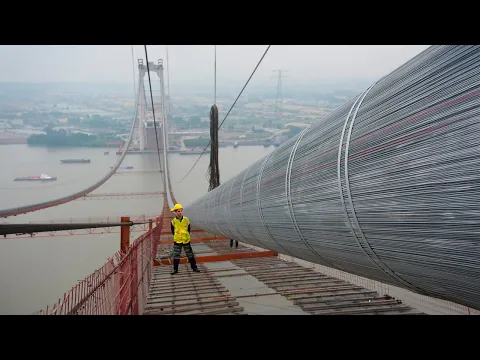

The fourth largest bridge in the world, Osman Gazi, is located on the southern coast of the Mediterranean Sea, also known as the Sea of Marmara. It is a sea that separates the Black Sea from the Aegean Sea, thus separating the Asian part of Turkey from its European part.
It is a suspension bridge that spans the Gulf of Izmit at its narrowest point: 2,620 meters. This incredible structure connects the Turkish city of Gebze to the province of Yalova and carries the O5 highway across the Gulf.
-
The La Galerie Nortis, a real estate launch by developers Cyrela and Nortis in Moema, São Paulo, arrives with apartments featuring 4 suites ranging from 283 to 416 square meters, an estimated gross development value of R$ 765 million, and the proposal to redefine the high standard in the region.

-
Transnordestina sets record by installing 1.69 km of tracks in a single day, reaches 81% completion, and plans to deliver an additional 100 km of railway by the end of June 2026.
-
Instead of plastering the wall, Argentine architects left ordinary bricks exposed, without traditional mortar, without finishes, without paint, and created a perforated pavilion that looks like an art installation.

-
Prefabricated wooden house surprises in Spain with 132 m², two floors, up to four bedrooms, and a price starting from 45,751 euros, while the version with insulation for living can reach 80,059 euros without assembly, installation, and architect included.




The fourth largest bridge in the world was inaugurated on July 1, 2016, and became the longest suspension bridge in Turkey and the fourth longest suspension bridge in the world in terms of the length of its central span, which is 150 m.
The bridge not only has an extension of 2,682 m but also a height of 36 m and towers of 252 m. The Osman Gazi has six lanes, three in each direction, and, along with the Gebze-Izmir highway, connects the cities of Istanbul and Izmir.
Bridge Reduces Distance Between Cities From 8 To 4 Hours
For many years, the president of Turkey, Recep Tair Erdogan, and Yildirim Group, a family conglomerate of mining and maritime transport companies, have advocated for the expansion of the country’s airport and road facilities to achieve better connectivity among the provinces.
In April 2009, an international competition was held for the construction and operation of the bridge in a joint venture formed by five Turkish companies and one Italian construction company. The Osman Gazi Bridge was part of a larger project, a 409 km highway complex between Istanbul, Turkey’s largest city, and Izmir, the third most populous city in the country.
With the construction of the bridge, the distance between these two cities was reduced by approximately 140 km, bypassing the lengthy route around the Gulf of Izmit.
The purpose of the construction was to reduce the travel time between the two cities from 8 to 4 hours. Initially, it was planned for two high-speed railway tracks to cross the center of the bridge, but this idea was abandoned in favor of creating a fourth lane for both directions.
Challenges To Build The Fourth Largest Bridge In The World
The fourth largest bridge in the world was made possible by a highway privatization program that has already invested 7.3 billion dollars in road rehabilitation and construction in the country. In 2010, a contract was signed for the construction of the project, but only on March 30, 2013, was the foundation stone of the bridge laid to begin the works.
The construction of the Osman Gazi Bridge lasted 39 months and involved the dedication of over 8,000 workers, including engineers and specialists from various fields. The pillars and structures that support the bridge’s abutments are made of concrete and the tubes are made of steel. A total of 85,000 tons of steel and 125,000 m³ of concrete were consumed.








Be the first to react!