





 Portuguese
  English
  Spanish
  8 min of reading
  0 comments



Understand How Formula 1 Tires Are Born From Vulcanization And Why Soft Tires, Medium Tires, And Hard Tires Change Traction, Degradation, And Strategy In Each Race.
The Formula 1 tires seem simple at first glance, black, round, smooth, spinning at over 300 km/h. But behind each set is a combination of chemistry, heat, and engineering so extreme that microscopic differences in rubber change the car’s behavior in every curve.
Far from the track, these tires are born in closed factories, with recipes kept secret. Inside, rubber, fibers, silica, sulfur, resins, and carbon black are mixed in millimetric proportions, then molded, baked, inspected by X-ray, and only then released to face 300 km/h, temperatures nearing 200 degrees, and forces of up to 5G in corners.
The Secret Chemistry Behind Formula 1 Tires

Before any form of tire exists, everything starts in something more like a laboratory than a production line. The Formula 1 tire is born in chemistry, in a secret recipe of compounds.
-
The winter of 2026 in Brazil will not be what you expect: meteorologists warn that the season will be warm and rainy at the same time due to the advance of El Niño, which is already warming the Pacific and changing the climate of the entire country.

-
For the first time, humanoid robots will compete in a full half-marathon without any human assistance in Beijing, with over 100 teams from China registering machines that need to complete the course with autonomous navigation on two legs.

-
Submarine cables installed to transmit the internet now also help scientists detect earthquakes.

-
After so many blackouts, a family transforms an electric truck into a power source for their home and shows how a 100 kWh battery can keep everything running for days.


The official supplier of the category keeps its formulas as if they were military documents. Each type of rubber is a specific combination, made of synthetic polymers, fibers, silica, sulfur, resins, and carbon black, the famous Carbon Black that gives it the black color. What changes from a hard tire to a medium or soft one is the chemical balance between these elements.
In the soft compound, the bonds between molecules are more open, which generates enormous grip and quick response, but also accelerated wear.
In the hard compound, the opposite happens. The molecules are denser, the rubber lasts much longer, and better withstands high temperatures, but with less grip.
The medium compound is in between, strong enough to last well, with still very good grip.
It’s like using the same flour to bake three types of bread. From small variations in water, salt, and baking time, the flavor and texture change completely. In Formula 1 tires, the base material is similar, but the result on track is completely different.
From Raw Mass To Skeleton That Withstands 5G
Once the chemical recipe is defined, the rubber arrives at the factory in large pressed blocks, appearing hard, dry, and shapeless. The first industrial stage is to crush and mix.
In enormous cylinders spinning under high pressure, the mixture undergoes heat, compression, and continuous kneading. The result is a homogeneous, smooth, and shiny mass, which is literally the soul of the tire.
This mass is prepared separately for each type of compound. While the soft tire requires more elasticity and lower rolling resistance, the hard tire needs maximum structural stability to run for 40, 50, or 60 laps without falling apart.
However, pure rubber can’t hold a Formula 1 car. Every tire needs an internal skeleton to support absurd forces.
We’re talking about lateral forces reaching up to 5G in corners and loads approaching a ton per wheel during hard braking.
To this end, textile fibers and steel belts come in, acting like muscles and tendons. They distribute the forces, prevent extreme deformations, and ensure that the tire doesn’t simply explode.
This internal structure, known as the carcass, is assembled first, layer by layer. It’s like building the body before putting on the skin.
Only after comes the tread, the part that actually touches the asphalt. The tire is then pressed under heat and pressure until the final shape begins to appear.
Vulcanization, The “Oven” That Gives Life To Formula 1 Tires
At this point, the tire is practically assembled but still raw. It has shape but lacks the properties it needs to run at 300 km/h. It’s like cookie dough before going into the oven; it looks ready, but if you try to use it, it falls apart.
This is where vulcanization comes in, the most critical step in manufacturing Formula 1 tires. The tire goes into a giant metal mold, where it receives controlled heat and pressure.
It’s like putting waffle batter in a hot machine. The heat opens the pores, the molecules bond differently, and the rubber becomes rigid, elastic, and resistant at the same time.
The surface texture, internal design, curvature, and fit on the rim are born in this stage. Each type of tire has its own combination of time and temperature for vulcanization.
The soft tire spends less time in the “oven” and at a lower temperature, to maintain a light and grippy rubber. The hard tire receives more heat and more pressure, making the compound more resistant and stable.
After vulcanization, the tire becomes a single piece, with the internal carcass and tread ready to face the track.
Why Are Formula 1 Tires Smooth And So Different From Street Tires
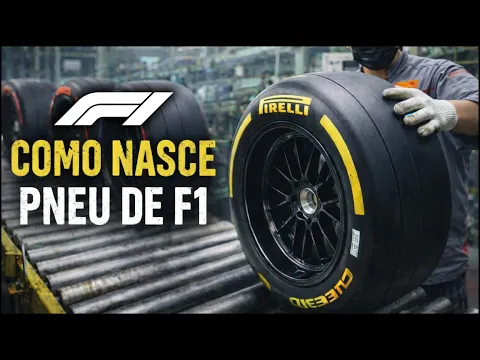

One detail that surprises many people is that Formula 1 tires come out of the factory completely smooth, without grooves or patterns. This is intentional.
On a dry track, the smoother the tire surface, the larger the contact area with the asphalt. It’s like putting your whole hand on the table instead of just your fingertips.
More contact means more grip. In Formula 1, this grip allows for later braking, much faster cornering, and earlier acceleration out of each corner.
If you compare a street tire with a Formula 1 tire, the difference is almost unfair. The street tire needs to last for months, face rain, heat, potholes, and an unpredictable routine. On the other hand, the Formula 1 tire sometimes lasts only 40 minutes at maximum pace.
It’s like comparing a high-performance running shoe with a daily-use shoe. Each was born for a completely different purpose.
Pressure, Temperature, And X-Ray: The Extreme Quality Control
Another little intuitive detail: Formula 1 tires leave the factory with much lower pressure than what is used on track.
This happens because, during the race, the tire heats up so much, nearing 200 degrees, that the internal air expands.
If it were already at the correct pressure inside the factory, it could explode when reaching racing temperature.
Therefore, teams adjust the pressure considering the gain that will come with real track heating. The rubber heats up, the air expands, and the pressure rises to the ideal value set by the engineers and race director.
Before being released, all Formula 1 tires undergo X-ray inspection, as if they were in a hospital.
The machines map every internal layer, looking for bubbles, microscopic failures, or assembly defects. It’s like looking inside the tire with superhero X-ray vision.
If a tire is a few grams or millimeters off ideal, it is simply discarded. Each tire is treated as if it were a technical gem.
Once approved, it is cleaned, polished, balanced, weighed, measured millimetrically, and receives barcodes, chemical identification, date, batch, and classification.
This way, any failure detected in a race can be traced back to the shift and exact point of manufacturing.
Hard, Medium, And Soft: Three Personalities In The Same Race

On the track, Formula 1 tires are not all the same. The hard, medium, and soft compounds behave like three different personalities within the same race.
The soft tire is the fastest. It reaches the ideal temperature very quickly, offers maximum grip and a feeling of the car “glued” to the asphalt, but wears out in a few laps, especially on very hot tracks.
The medium tire is the compromise. It is neither the fastest nor the most durable, but delivers excellent balance between performance and consistency and is usually the safe choice when there is uncertainty about weather or degradation.
On the other hand, the hard tire is the survivor. It takes time to heat up, provides less grip at the beginning of the stint, but lasts many more laps, handles heat better, and is often decisive in long strategies, when the team wants to stop fewer times or protect itself from unexpected safety cars.
Besides chemistry, there is another essential point, the thickness of the outer rubber layer. In the soft tire, this layer is thinner, heats up quickly, and grips the track in a few laps, but wears out like chocolate melting in your hand.
In the hard tire, the layer is much thicker, takes longer to reach the ideal window, but delivers significantly greater durability. The medium tire falls between these two extremes, balancing heating, grip, and wear.
It’s the same tire concept, but with fine adjustments that create three completely different racing strategies.
Degradation, Blistering, And Graining: The Monsters Of Rubber
On the actual track, the tire does not live in a controlled environment. It faces fuel changing weight, asphalt at 80 degrees, aggressive curbs, loose rubber remnants, and limit braking.
The rubber literally leaves pieces behind, like giant cookie crumbs coming off the tread.
Two phenomena keep engineers and drivers awake at night. The first is blistering, when the tire overheats and forms internal bubbles. Visually, it resembles a liquid that boils too much and creates an irregular foam.
The tire loses grip, the surface becomes irregular, and the car starts to behave as if it’s driving on soap.
The second is graining. In this case, the tire surface creates small grooves, and bits of old rubber stick to the tread. It’s like putting tape on a wall and ripping off the paint along with it.
The driver feels this in the steering wheel, in the vibration of the car, and even in their body. The steering becomes imprecise, the rear slides, and the race pace drops dramatically.
In the end, Formula 1 tires are designed to be fast, not eternal. They behave like sophisticated fireworks, deliver a peak of performance, shine for a short time, and then disappear.
When Formula 1 Tires Become Heroes Or Villains
In many races, Formula 1 tires stop being just components and become protagonists. Explosions on final laps, unlikely stints with hard tires, spectacular recoveries after punctures, or unexpected degradation have changed the course of entire championships.
A wrong compound choice, a stop made at the wrong lap, or a misreading of temperature and wear can turn the best car on the grid into a mere supporting role.
On the other hand, a perfect tire strategy can allow a theoretically inferior car to beat faster rivals. Many historic victories stemmed more from tire decisions than pure speed.
In the end, the tire is the first component to suffer and the last to be remembered by the public. But without it, there is no grip, no curves, no Formula 1.
And you, after understanding what happens inside Formula 1 tires, which compound seems most decisive to you in a long race: hard, medium, or soft, and why?








-

5 pessoas reagiram a isso.