





 Portuguese
  English
  Spanish
  5 min of reading
  12 comments




Researchers Discover How Roman Concrete Self-Repaired and Defies Time — Revealing Secrets That Could Revolutionize Modern Construction.
The Roman concrete is famous for its extreme durability. Structures like the Pantheon of Rome or the Aqueduct of Segovia have stood for over 1,500 years.
For over two millennia, structures made with Roman concrete have withstood time, the elements, and even earthquakes. While modern concrete structures crumble after a few decades, buildings like the Pantheon and ancient aqueducts remain standing.
This has intrigued engineers for a long time. After all, what makes Roman concrete so durable? Researchers from MIT believe they have found the answer.
-
Scientists have captured something never seen in space: newly born stars are creating gigantic rings of light a thousand times larger than the distance between the Earth and the Sun, and this changes everything we knew about stellar birth.

-
Geologists find traces of a continent that disappeared 155 million years ago after separating from Australia and reveal that it did not sink, but broke into fragments scattered across Southeast Asia.
-
Samsung launches cordless vertical vacuum cleaner with up to 400W of suction and relies on AI to automatically recognize corners, carpets, and different surfaces.

-
The lost continent beneath Europe: separated from North Africa about 240 million years ago, comparable in size to Greenland, Greater Adria was crushed over 40 million years and left geological marks from the Alps to the Balkans.


Concrete That Self-Regenerates
For centuries, scholars have tried to understand how Roman concrete withstands so much.
A common hypothesis was the use of specific volcanic ashes, like those from the Pozzuoli region in the Bay of Naples.
This substance, known as pozzolana, was widely used in the Roman Empire. But a new study suggests that the secret goes beyond that.
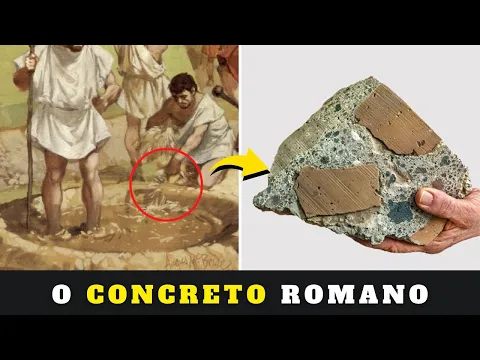
The starting point was the analysis of white fragments, visible in ancient concrete samples. Known as “lime clasts,” these white spots were considered mixing failures.
However, Professor Admir Masic from MIT always suspected otherwise. If the Romans were so careful with their works, why would they allow such visible mistakes?

Hot Mixing: The Hidden Differential
With high-resolution imaging techniques and chemical mapping, researchers discovered that these fragments are not failures.
They are made of various forms of calcium carbonate and were exposed to high temperatures. This indicates the use of a process known as hot mixing, where quicklime is added directly to the concrete.
This process, according to Masic, yields two advantages. The first is the formation of chemical compounds that would not arise with hydrated lime.
The second is the acceleration of concrete curing, making construction faster.
More importantly, these lime clasts function as a self-repairing system.
When cracks form, they pass through the clasts, which react with water to become calcium carbonate crystals. The result: the cracks close on their own.
Test Proves Self-Repair
To prove the hypothesis, the team created samples with quicklime, inspired by ancient formulas.
These samples were cracked and placed in contact with water. In two weeks, the cracks disappeared, and the water stopped seeping.
In contrast, samples made without quicklime did not regenerate. Water continued to seep through, and the cracks remained.
This confirmed that the use of hot mixing is the main factor behind the durability of Roman concrete.
Environmental Impact Can Be Reduced
According to Masic, incorporating this type of formulation into modern concrete could enhance its durability and reduce the environmental impact of the construction industry.
Cement production accounts for about 8% of global greenhouse gas emissions.
A concrete that lasts for centuries, without the need for frequent maintenance, could help reduce this impact. Moreover, Masic’s lab is also studying concrete capable of absorbing CO₂ from the air.
Barriers to Modern Use
Despite the advancements, Roman concrete is still not viable for large-scale modern construction. There are several main reasons for this.
Curing: The first is the curing time. Roman concrete cures slowly, sometimes taking months or years.
Meanwhile, modern concrete is designed to harden quickly, meeting the demands of tight schedules.
Lack of Ingredients: The second is the difficulty of sourcing the ingredients. The pozzolana from the Pozzuoli region, essential for the performance of Roman concrete, is not available everywhere. This limits the global use of the technique.
Different Structural Requirements: The third factor is the difference in structural needs. Roman concrete was used in massive constructions without steel reinforcements.
Modern constructions, on the other hand, require materials compatible with metal reinforcements, with resistance to both compression and tension.
Lack of Standardization: The fourth point is the lack of standardization. Although it is durable, Roman concrete did not follow a fixed recipe. The mixtures varied by region and builder. This complicates standardization and quality control, which are essential in modern engineering.
Current concrete is designed to be cheap and quick. It can be molded, transported, and applied swiftly. Roman concrete, however, requires more time-consuming processes, which increase costs and delay construction.
Planned Obsolescence: Planned obsolescence can be seen as an obstacle to the use of Roman concrete today, especially when viewed through the lens of the current market logic, which prioritizes products with a shorter lifecycle and frequent replacements.
Planned obsolescence occurs not only in electronic products. In the construction sector, it manifests in:
- Materials that deteriorate faster.
- Projects with a limited lifespan.
- Lack of incentives for structural longevity.
This discourages the use of older and more durable technologies, like Roman concrete, as they do not generate recurring demand for new materials, renovations, and replacements.
Ancient Concrete, New Ideas
Nonetheless, the study of Roman concrete inspires new solutions. The idea of a material that self-repairs is gaining traction.
In times of environmental concern and the quest for efficiency, a formula that lasts for centuries could revolutionize engineering.
The research group involved in the study includes scientists from MIT, Harvard, Italy, and Switzerland. They published their findings in the journal Science Advances and are developing commercial versions of the new lime-based concrete.
The Archaeological Museum of Priverno in Italy also participated in the work, providing support and samples for analysis.
Tests with 3D-Printed Concrete
Another exciting possibility for researchers is the application of self-repairing concrete in 3D-printed constructions.
This technique is growing and facing challenges related to durability. Incorporating self-repairing properties could make constructions safer and more durable.
For Masic, inspiration from Ancient Rome could help shape a more sustainable future for the construction industry.
Roman Concrete Still Surprises
The Pantheon, built in 128 AD, remains a landmark of Roman engineering. With the largest unreinforced concrete dome in the world, it shows that the Romans knew what they were doing.
Today, we know that the durability of this type of construction is not just a fluke. It is the result of an intelligent combination of materials, techniques, and knowledge. And much of this went unnoticed for centuries.
Thanks to modern science, these techniques are being rediscovered. Hot mixing and lime clasts reveal that there was purpose in what once seemed like a mistake.
The Future Can Look to the Past
Even if Roman concrete does not become the standard for modern construction, its principles can guide new advancements. The idea of creating materials that last longer and require less maintenance is valuable in any era.
Researchers have shown that looking back can bring solutions to today’s problems. Instead of reinventing everything from scratch, perhaps the secret lies in relearning from those who already did it well — two thousand years ago.
After proving the efficiency of concrete inspired by the Romans, scientists are now working to bring it to market in an attempt to blend ancient durability with modern needs.







No mundo todo existem centenas de depósitos de cinza vulcânica com milhões de toneladas disponíveis, não seria o caso de se fazerem pesquisas para ver alguns desses depósitos serviriam para compor a mistura do concreto romano
Excelente Artigo, por favor publiquem mais assuntos a respeito de construções antigas. Principalmente Romanas.
Muito obrigado. Eu sempre faço matérias come esse tipo de conteúdo de muita qualidade.
sensacional e ha muito mais a rever desse povo diferente e vitorioso