





 Portuguese
  English
  Spanish
  7 min of reading
  0 comments


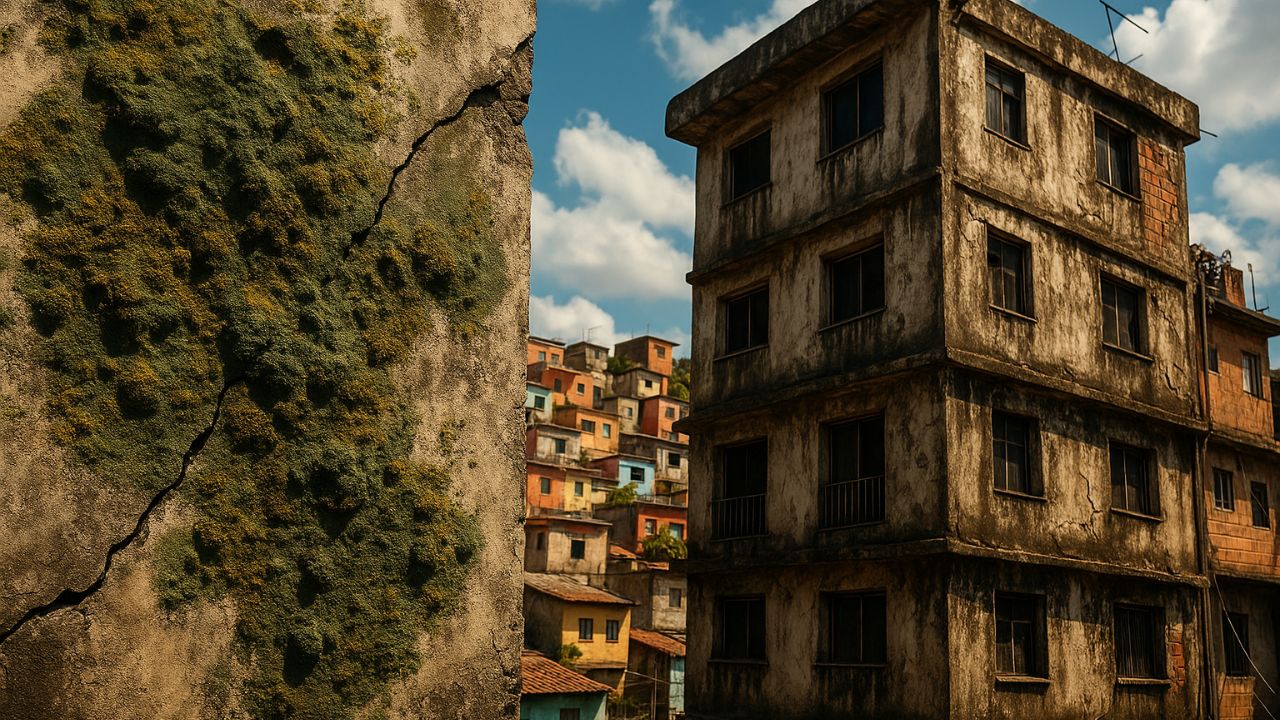
Understand How Serious Construction Failures Turn Mold on Walls Into Signs of Moisture on Walls, Weak Building Standards, and Social Housing Collapse.
If you see mold on the walls of your house and think it’s just dirt, lack of ventilation, or “bad luck,” in practice, you are facing signs of serious construction failures. These serious construction failures don’t come out of nowhere: they are connected to moisture on walls, permissive building standards, and a city model that pushes the problem inside homes, especially in areas of social housing.
More than a visual nuisance, mold is the microscopic portrait of a macro crisis. Each dark spot tells a story of cheap materials, rushed work, loose standards, real estate speculation, and urban inequality. Understanding why mold appears is understanding why a huge part of the Brazilian population lives in damp, sick, and unhealthy environments.
When Mold on Walls Denounces an Entire System
At first glance, mold seems like a simple household problem: clean the wall, apply a product, and move on. But if you zoom in on that wall, you will find not only fungi and spores but the tip of a system combining real estate speculation, permissive building standards, and a model of urban development that accepts precariousness as the norm.
-
The section of Serra da Rocinha on BR-285 is now open in Timbé do Sul: 50 m tensioned curtains and top-down technique stabilize the slope, with a stairway duct controlling the water.

-
Scientists use sawdust mixed with clay to create a lighter brick, promising efficient thermal insulation and impressing by transforming waste into a solution for construction.

-
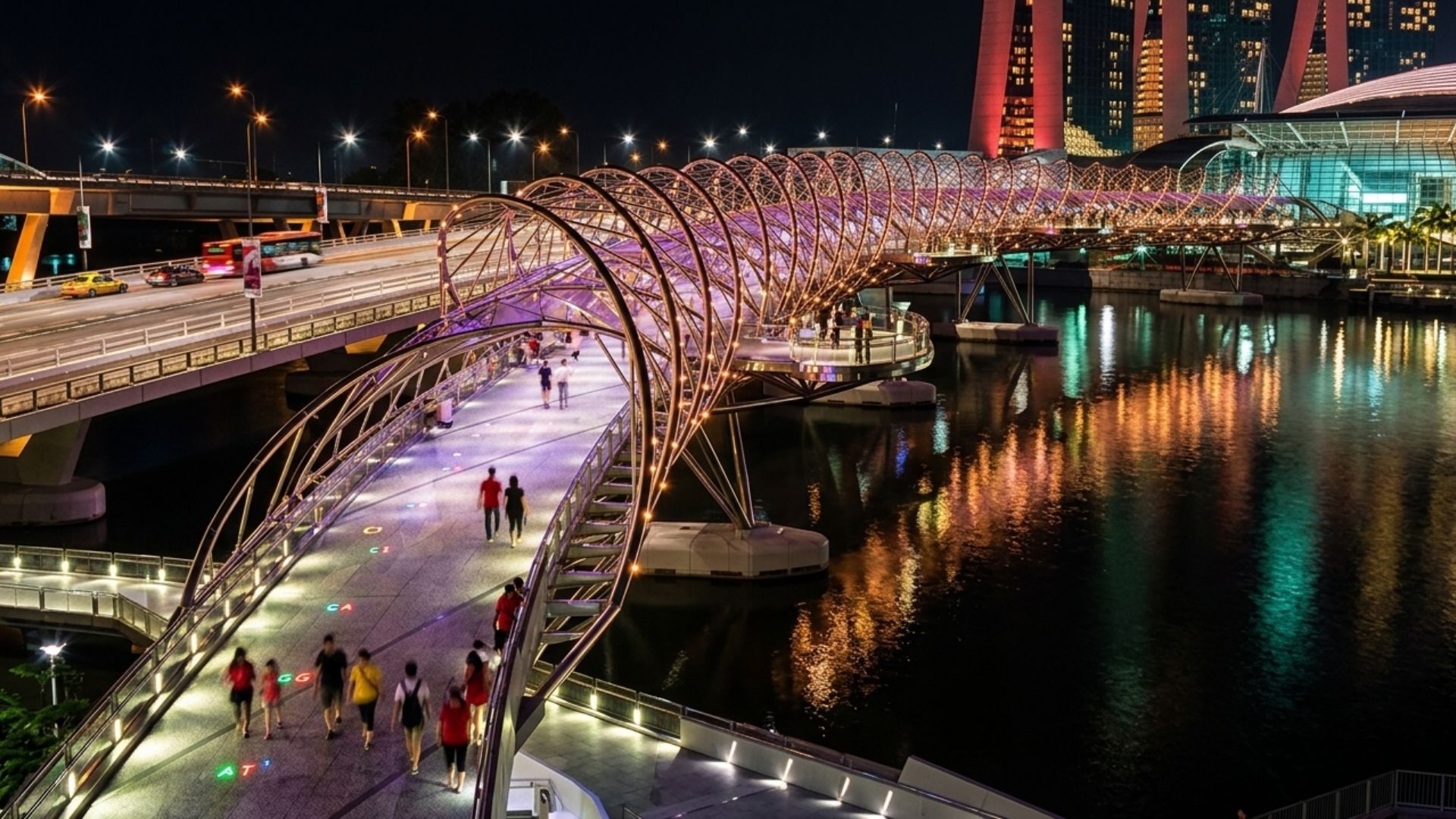
With a DNA shape, this bridge in Singapore draws attention in modern architecture and surprises tourists by transforming a simple crossing into an unforgettable visual experience in the urban heart.
-
Giant underwater pipeline begins to take shape with a R$ 134.7 million project at the Port of Santos: the 1.7 km structure uses 12-meter and 700 mm pipes to supply water to 450,000 people in Guarujá.


Mold on walls appears where there is moisture on walls and a surface prepared for it. And that surface is not neutral. The way we paint, plaster, and waterproof buildings today creates the perfect environment for fungi to grow. It’s not just a lack of cleaning or closed windows: it’s design, material, and economic decision.
From Acrylic Paint to Portland Cement: The Technique That Feeds Moisture on Walls

For a long time, walls were coated with lime and more porous, breathable inorganic materials. Lime acted like a “lung” of the construction: it allowed vapor to escape and helped balance moisture on walls.
Today, the rule is different. Most homes receive latex or acrylic paint based on organic polymers. Initially, these paints are loaded with biocides and fungicides that protect the surface inside the can and in the first months after painting. After that, these compounds degrade, evaporate, or lose their effectiveness.
What remains? An organic resin film over a base that is often moist. For many fungi, this film is literally food. Instead of “dirtying” the paint, mold starts to devour the paint itself. If there is damp gypsum, wood, drywall paper, or soaked plaster behind that layer, moisture on walls gets trapped, and the fungus finds an open buffet.
The replacement of lime with cement also has significant effects. Portland cement-based mortars are denser and stiffer. They cure quickly, provide high initial strength, and please the logic of fast, cheap work. But, from a hygrothermal standpoint, they act like a lid. Water enters through natural micro-cracks in the cement and then gets trapped between brick, plaster, and finishing.
As a result, serious construction failures manifest as a “sandwich of moisture” that no one sees. On the outside, a seemingly firm wall. On the inside, moisture on walls, peeling paint, migrating salts, mold, and recurrent flaking.
Thermal Bridges, Cold Surfaces, and the Invisible Map of Serious Construction Failures
Where mold appears is not random. Upper corners, areas behind furniture, regions around windows, and junctions of slabs and columns are classic points. These locations reveal what are called thermal bridges: sections of the building where heat passes more easily and interior surfaces get colder.
When internal air, loaded with water vapor generated by bathing, cooking, and breathing, touches a colder region of the wall, the local temperature drops below the dew point. The vapor condenses, forming microfilms of water. This film is what turns the wall into an ideal ground for mold on walls.
In typical structures in Brazil, thermal bridges emerge when concrete, beams, columns, or slabs cross insulation or meet thin masonry. Even in homes with some care, this construction detail can undermine overall performance. The fungus is simply outlining on the surface what physics has already dictated inside the wall.
When air conditioning is added without a well-thought-out vapor barrier, the serious construction failures compound. The interior gets cold, the facade remains hot and humid, and the wall acts like a sponge: pulling warm vapor from the outside, condensing in the middle of the thickness, and feeding moisture on walls from the inside out.
Economy, Profit, and Serious Construction Failures


From an economic perspective, serious construction failures are not an isolated accident but part of a housing production model. Real estate is treated first as a financial asset, then as shelter. This changes everything.
When the goal is to raise the greatest number of units in the shortest time and with the lowest cost, every inch of wall, every layer of insulation, every ventilation or thermal protection solution becomes an “extra.” Thinner plaster, cheaper tiles, slabs replaced by lightweight ceilings, minimal waterproofing. What weighs on the spreadsheet gets cut out.
Social housing programs highlight this pattern. The housing deficit decreases, but developments emerge with leaks, cracks, chronic mold, and poor thermal performance. On paper, the project “delivers the key.” In practice, it delivers a house that is already vulnerable.
The construction economy balances out; the resident pays the price. They bear the costs of repairs, chemical products, medical consultations, loss of furniture and clothing, and often the impossibility of keeping the environment dry.
Permissive Building Standards and Diluted Responsibility
In this scenario, building standards should act as a minimum barrier to protect people’s health. However, when they are permissive in thermal and hygrothermal performance, they end up legalizing precariousness.
By accepting walls with low thermal resistance, thinness, and almost no insulation, building standards allow buildings that overheat in the sun and cool down quickly at night. This fluctuation leads to internal and external condensation, amplifying moisture on walls and opening the door for fungi.
The result is paradoxical: serious construction failures continue within the law. If the minimum requirement is low, just meeting the minimum is enough for the project to be approved, financed, and sold. When mold on walls appears, the discussion often shifts to an individual level: the resident’s fault, “poor usage,” or closed windows.
Proving that the problem is structural, originating from design rather than behavior, requires expert reports, inspections, and lengthy processes. In theory, the consumer is protected. In practice, they face weak building standards, bureaucracy, and an industry trained to transfer responsibility.
Mold, Social Housing, and Urban Inequality

Mold does not distribute evenly across the city. It concentrates precisely where the urban fabric is weakest: peripheries, social housing complexes, areas with high density, little green space, and a lot of concrete.
In poorer layers, it is common to find houses with thin fiber cement roofing, no thermal mat, inadequate ventilation, and rigid cement plaster. In dense regions, the very nature of occupation blocks wind, reduces natural shading, and aggravates the microclimate. Moisture on walls ceases to be the exception and becomes the rule.
Meanwhile, higher-income neighborhoods tend to have tree cover, setbacks, cross ventilation, and higher-performing materials. The same city offers completely different climates for different social groups.
In gentrified central areas, the aesthetic of ruin is even fetishized: exposed brick, peeling concrete, “industrial” texture. But there, the ruin is controlled, dry, and safe. On the urban edges and in social housing, the degraded wall is a real problem: cold, heat, mold on walls, clothes smelling of mildew, and respiratory diseases.
Health, Dignity, and the Invisible Cost of Mold on Walls
Medical science is clear: living surrounded by moisture on walls and mold on walls increases the risk of asthma, respiratory infections, allergic rhinitis, dermatitis, and exacerbations of chronic diseases. Children, the elderly, and people with comorbidities suffer more.
But it’s not just the body that pays. The psychological impact is also strong. Living in a place that smells of mold, stains clothes, and doesn’t improve even with cleaning generates a permanent feeling of failure, helplessness, and shame. The smell of moisture becomes a social marker that follows the person on the bus, at school, and at work.
When the public health system treats respiratory crises related to poor housing conditions, it is practically subsidizing serious construction failures and negligent maintenance. The profit from cheap construction and the rental of deteriorated properties goes to owners and builders; the sanitary and emotional costs are socialized.
What Could Be Different in a Country With Fewer Serious Construction Failures
Mold is not inevitable. It is the result of accumulated choices. Other choices are possible.
More breathable materials, roofs and coverings with better thermal performance, proper detailing of frames, external solar protection, cross ventilation, projects that take into account the actual climate of the place, stricter standards for performance, and effective oversight could drastically reduce the problem.
In social housing, this is even more urgent. It is not enough to deliver a roof; it is necessary to provide a healthy environment. If the minimum standard for design and building standards rises, serious construction failures tend to decrease, and with them, moisture on walls and mold on walls.
Until then, each stain on the wall continues to remind us that the building did not fail alone. The city model, the type of financing, the rules we accepted, and the way we tolerate living have also failed.
To close, tell me in the comments: what was the most complicated situation with mold on walls that you have ever faced in your home or your social housing?








-

-

-

3 pessoas reagiram a isso.