





 Portuguese
  English
  Spanish
  5 min of reading
  3 comments


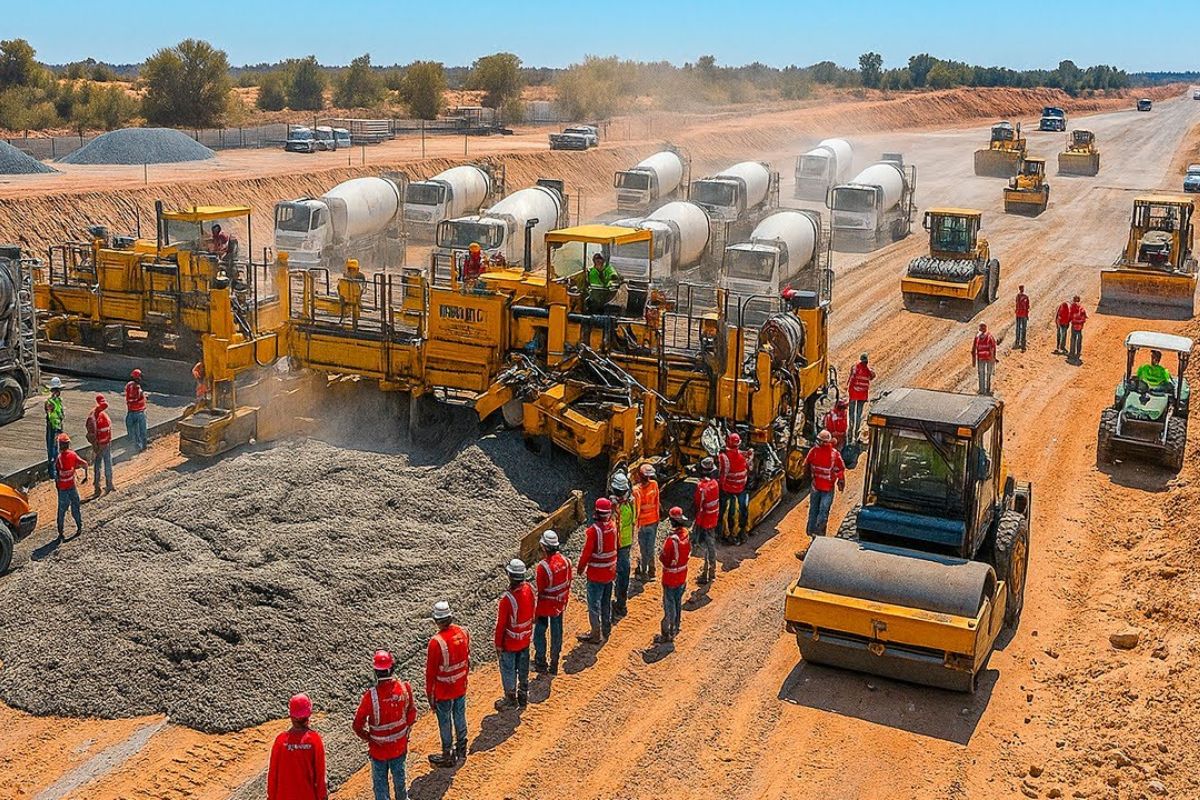


From Bellefontaine in 1891 to the Interstate Highway System of the 1960s, concrete pavement accumulated more than a century of testing, gained space over asphalt, prolonged the useful life of highways, reduced repair frequency, and became an ally against extreme heat and urban flooding in several cities.
Since the first street strip in Bellefontaine, Ohio, paved in 1891 under the leadership of George Bartholomew, concrete pavement has ceased to be a local experiment to become the protagonist of North American highways. In just over a century, the technique evolved, was tested under different conditions, and began to support everything from historic streets to strategic sections of the federal network.
The consolidation of this technology gained scale starting in 1956, when President Dwight Eisenhower sanctioned the Interstate Highway System project, a network of about 66 thousand kilometers that connected the United States from coast to coast. More than half of these roads were executed in concrete pavement, in a design that prioritized durability, standardization, and less need for interventions over the decades.
How Concrete Pavement Came Out of the Experiment to Dominate Highways

The trajectory of concrete pavement begins on a small scale.
-
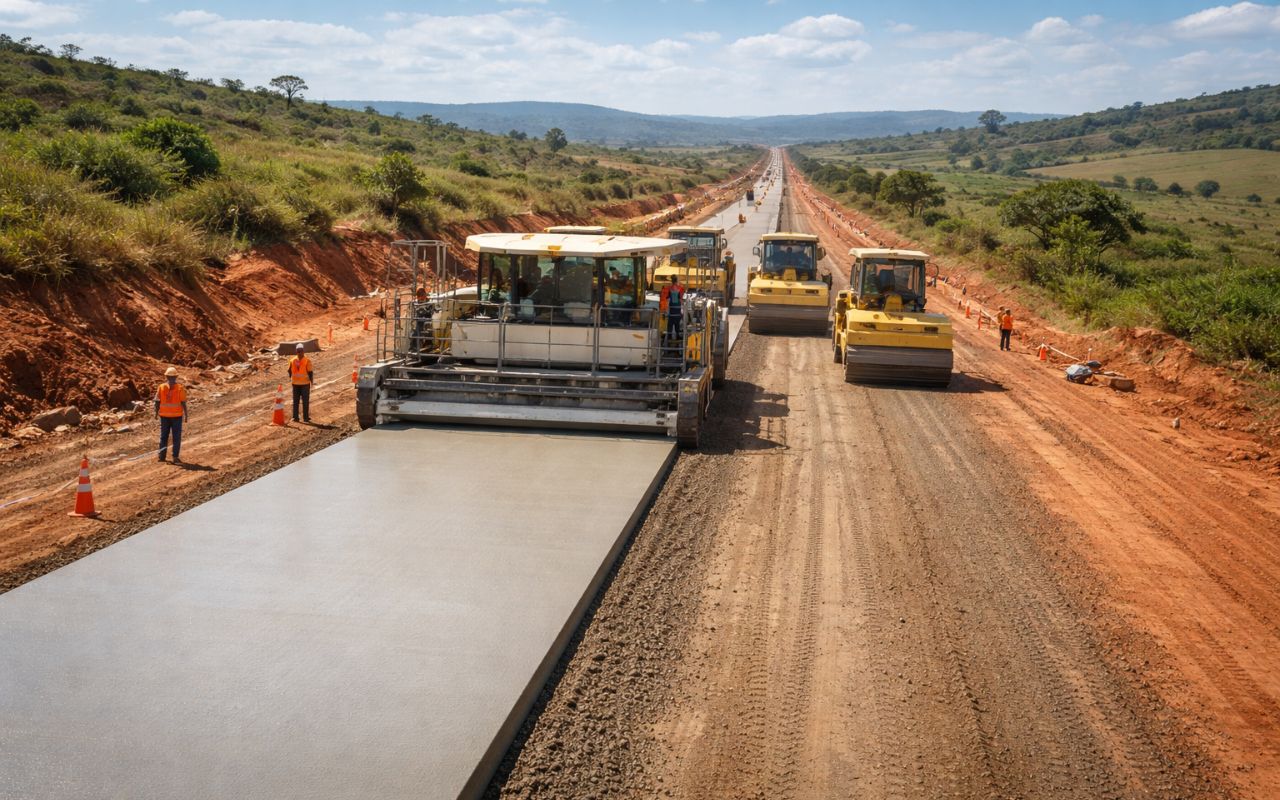
New CCR concrete paving technology promises roads up to 3x more durable, less maintenance, and cost reduction in Brazil.
-
Made from recycled plastic, plastic wood is gaining space in the construction industry because it does not rot, resists moisture, and reduces maintenance costs over the years.

-
Florianópolis will receive a million-dollar BRT that will begin construction in 2026 with nearly 400 million in funding from the federal government and the Inter-American Development Bank, and the map already shows the routes for the exclusive bus corridors.

-
Without a blueprint, without an engineer, and using scrap from the dump, a father spends 15 years building an 18-room castle for his daughter, featuring tram tracks, 13 fireplaces, and over 700 m², which may now be demolished.


In Bellefontaine, a strip about 2.5 meters wide was executed as a pilot project in 1891.
The experience was so clearly successful that, two years later, the inventor was authorized to expand the solution around the city courthouse and won an award for innovation in paving materials at the World’s Columbian Exposition of 1893.
At the beginning of the 20th century, the expansion was still timid.
By 1916, the country had approximately 10 thousand vehicles, most running on unfinished roads.
In some sections, three-meter-wide strips of concrete pavement were built alongside dirt roads so that drivers could practically test the difference in comfort and safety compared to unpaved surfaces.
The structural leap came in 1956 with the creation of the Interstate Highway System.
The decision to execute more than 50 percent of the network in concrete pavement was backed by tests like the AASHO Road Test, conducted by the American Association of State Highway and Transportation Officials, which measured the behavior of different types of pavement under known moving loads.
From then on, the concrete solution became standard in large logistical corridors.
Technical and Economic Advantages of Concrete Pavement Over Asphalt
Over the decades, highway agencies in the United States have accumulated evidence that concrete pavement offers a rare combination of robustness, performance, and cost predictability.
In many cases, the lanes support not only heavy traffic but also aircraft landings in adapted sections, reinforcing the structural capacity of the system.
From an economic point of view, concrete and asphalt have similar deployment costs in the North American context. The difference lies in the life cycle.
Concrete pavement allows for working with thinner bases and sub-bases, reducing material volumes and soil movement without compromising final strength.
Additionally, it is designed for a lifespan of around two decades, about double that of conventional asphalt pavement.
In practice, this means longer intervals between major interventions, lower accumulated spending on patching and resurfacing, and more efficient preservation of the road asset over time.
In scenarios with increasing traffic, rigid concrete pavement offers extra structural safety margin, reducing the need for premature structural reinforcement.
Resilience in Decades of Use and Examples Over 100 Years
Historical examples help illustrate the resilience of concrete pavement.
An emblematic case is a section of U.S. Route 20, a highway about 5,400 kilometers long that connects Oregon on the West Coast to Massachusetts on the East Coast.
In the area near the city of Moville, Iowa, a segment constructed in 1922, about 20 centimeters thick and with no expansion joints, has received minimal maintenance in over 100 years and remains in reliable usable condition.
Another example is Interstate 70 in Colorado.
A section of approximately 17 kilometers in concrete pavement, constructed in 1976, has undergone few interventions over 46 years, even with population growth in nearby cities like Rifle and consequent expected traffic increases.
These cases show how, when well-designed, concrete pavement sustains decades of operation with consistent performance.
The technology has also been used as a solution for recovering originally asphalt surfaces.
On US 69 in Pittsburg County, Oklahoma, a segment with stability problems received, in 2001, a layer of concrete between 10 and 15 centimeters over the existing pavement.
The reinforcement transformed a critical highway into a more stable platform, combining recovery efforts with a leap in structural performance.
Concrete Pavement, Heat Islands, and Urban Floods
In recent years, the discussion about concrete pavement has ceased to be purely technical and has begun to include sustainability.
The choice of the system has been associated with two relevant effects in cities: greater fuel efficiency and mitigation of heat islands.
Compared to deformed surfaces or those more susceptible to ruts, concrete tends to maintain a more stable geometry and texture, which reduces rolling resistance and improves vehicle efficiency.
In climatic terms, light-colored concrete pavement reflects more solar radiation than dark coatings, helping to moderate local heating and, in some cases, alleviating the phenomenon of heat islands in highly paved areas.
In addition, the system offers good response in projects dealing with critical drainage and frequent flooding.
An example is the Riviera Beach area in Florida, where residents faced recurring flooding due to the neighborhood’s location.
The streets were rebuilt with concrete pavement sloped at 2 percent and accompanied by new drainage systems.
The solution was chosen based on performance studies over time, and the expectation is that the roads will not require significant new repairs for the next 15 years, even under adverse rain and runoff conditions.
In this logic, rigid concrete pavement ceases to be just a structural option and becomes a tool for urban adaptation, helping to address both extreme heat and recurring flooding events in vulnerable areas.
What the American Experience Signals for Future Infrastructure Projects
With more than a century of documented use, thousands of kilometers executed, and examples of roads over 100 years in operation, concrete pavement has established itself as a reference technology in North American highways.
The combination of long life, spaced maintenance, competitive costs, and additional gains in energy efficiency and climate resilience places the system at the center of the debate on durable infrastructure.
For roadworks managers and urban planners, the experience of the United States suggests that the choice between asphalt and concrete cannot be made solely based on the initial cost of the paved kilometer.
What determines the best investment is the cost over the life cycle, the ability to withstand decades of traffic, and the response to extreme events like intense heat and flooding.
Given this, looking at the reality of the streets and highways in your city, do you think it would make sense to prioritize concrete pavement in new road projects, or does asphalt still seem the most suitable solution for what you see day-to-day?










A propina com asfalto deve ser maior…
Impossível ser implantado aqui. Prefeituras, governos estaduais e federais movimentam a máquina da corrupção entregando asfalto de péssima qualidade que precisa ser trocado a cada ano arrancando dinheiro do cidadão.
No Estado do Ceará temos vários trechos de rodovias estaduais em concreto, alguns tem pouco mais de três anos, mas entre um período chuvoso e outro, a manutenção foi zero, diferente das vias com asfalto que precisam de manutenção a cada ano, depois do período anual de chuva.