





 Portuguese
  English
  Spanish
  7 min of reading
  0 comments


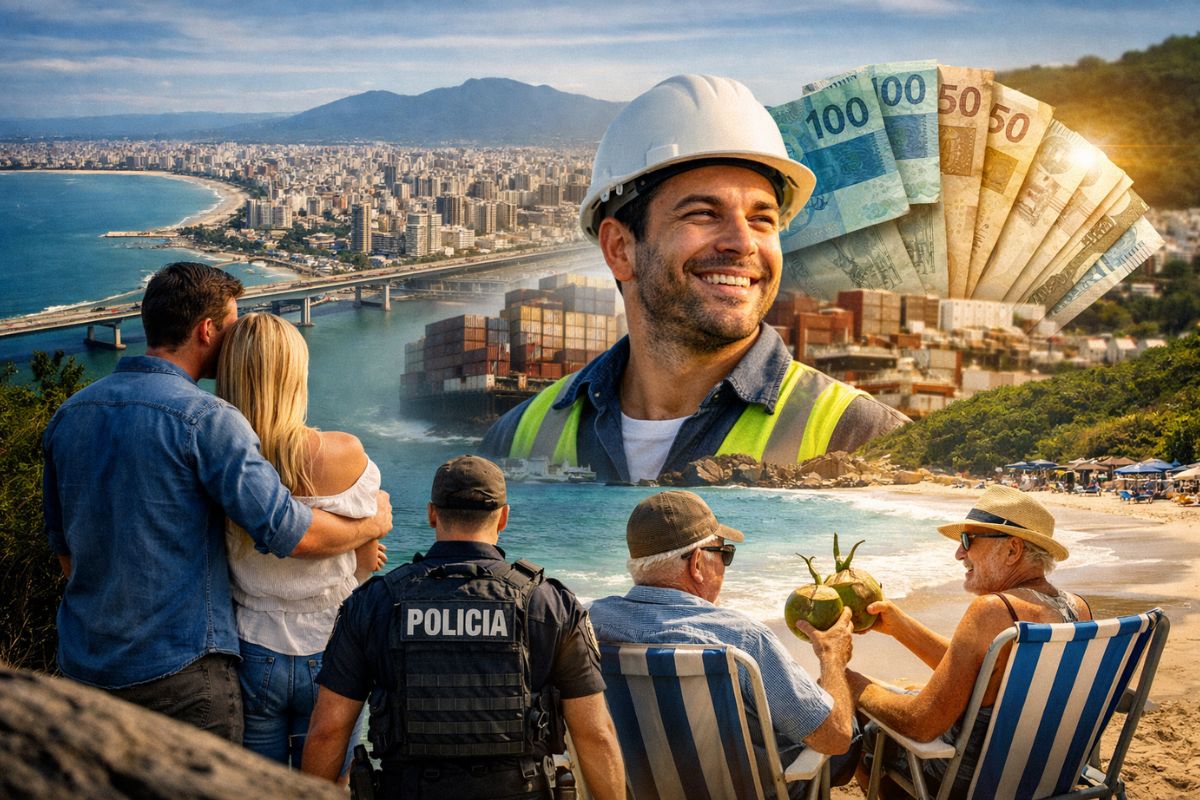
With a Positive Migration Balance of 354 Thousand Between 2017 and 2022, Santa Catarina Attracts Young Families and Retirees by the Job Market With Lower Unemployment, More Formality, and Higher Average Salary, Besides Lower Violence Indices and Coastal Climate, but Requires Planning in the Face of Cost of Living and Housing.
Santa Catarina appears, for many, as the place where life “happens”: more chance of employment, more security and a daily life that combines work with the coast. This movement is not abstract: it has a face, accent, and routine, of those who arrive with luggage, children, resumes, expectations, and sometimes a support network that was formed even before the move.
At the same time, Santa Catarina does not work as an automatic promise. Arriving usually comes with a silent calculation: how much it costs to rent, eat, commute, and support the household while the job opportunity doesn’t appear. Opportunities exist, but the path to them is not always simple, especially when there is a lack of qualification, planning, and local references to start from scratch.
What Draws So Many People to Santa Catarina and What the Numbers Reveal

The main driver pointed out for migration towards Santa Catarina is the “attraction factor”: the combination of a heated job market, security, and coastline. In this logic, “who” moves is not a unique group. There are entire families, solo workers, youngsters looking for their first job, and elderly people choosing the coast to age with more comfort and tranquility.
-
New 100% clean fuel produced in Brazil could retire diesel.

-
Plastered walls become a trend and end up being the perfect choice for finishing; the secret of the 2 coats that prevent waste in painting.

-
With 333 meters and equivalent to a 20-story building: China launches a supertanker that transports 2 million barrels, has 540,000 m² of area, and saves $5 million per year.

-
Brazil becomes a beacon of hope for ending plastic waste by leading a global plan that could prevent millions of tons from entering the oceans.


This flow is strongly reflected in the positive migration balance between 2017 and 2022, when Santa Catarina had the highest result in the country, with a difference of 354 thousand between arrivals and departures. In practice, this helps explain why the capital, Florianópolis, almost quadrupled in 50 years, and why coastal regions and urban hubs have begun to cope with a constant rhythm of new residents, new businesses, and new demands for services.
Santa Catarina and the “Magnet” of Work: Less Unemployment, More Formality, Higher Average Salary

When describing the attraction of the job market in Santa Catarina, three characteristics emerge as key: the state maintains the lowest unemployment rate in Brazil, has high formality (or, put directly, lower informality), and records the highest average salary in the job market. This combination creates a showcase effect, especially in a country that is undergoing deindustrialization and losing part of the appeal of the old major industrial cities.
In everyday life, this translates to doors slamming every day: employers report people continuously looking for jobs, including in small and medium businesses, especially in tourist and service areas. At the same time, the same narrative that sees growth also points out the bottleneck: there is a lack of labor, but there is also a lack of qualification for a portion of those who arrive. Those who land unprepared can get stuck between high costs and income that takes time to turn into stability.
Where New Residents Come From and How Support Networks Accelerate Migrations

It is common to imagine migration as an individual decision, but it operates as a network. Those who arrive first help create “paths” for those who come after: they suggest neighborhoods, tell where there are job openings, guide about documents, lend a sofa, provide the first contact.
Today, this gains speed with social networks and the very circulation of information among families and friends, which explains why distant states manage to form large communities in Santa Catarina.
The result is a heterogeneous migration: there are reports of people from Pará, Bahia, Maranhão, Rio Grande do Sul, Paraná, and Rio de Janeiro coexisting in neighborhoods and businesses, side by side with Argentinians, Cubans, and Venezuelans.
In places like Florianópolis, the feeling is of a permanent mix: accents intersect in job lines, at commerce counters, and on the beach, and the city becomes a meeting point of very different trajectories.
The Coast as a Life Project: Safety, Climate, and the Movement of Retirees

Besides employment, Santa Catarina attracts due to relative safety and climate, especially along the coast. This factor is strongly present among the elderly and retirees, who seek a routine with sun, brightness, a “calmer” city, and a sense of tranquility to walk, use transportation, and circulate without the same daily worries about violence.
However, the coast also imposes an economic filter. There is a clear perception that valued cities, such as Balneário Camboriú, require financial reserves: it is not enough to want to move; it is necessary to be able to sustain the choice.
What happens, then, is a natural selection of profiles: some manage to adapt and stabilize; others try, realize the weight of rent and cost of living, and either return or migrate again within the state in search of balance.
International Migration in Santa Catarina and the Mismatch Between Education and Occupation
Migration to Santa Catarina is not just internal. There is a presence of Haitians and Venezuelans in different regions (especially in the Midwest and the West), focused on work in industries and agribusinesses.
There is also a significant migration from Mercosur countries such as Uruguay, Argentina, Paraguay, and Chile, in addition to a recent cycle of Cubans arriving, attracted by reports of opportunity.
Even when the job door opens, a less visible problem arises: the underutilization of qualifications. There are reported cases of migrants with higher education, specialization, and even postgraduate degrees occupying basic-level jobs.
This does not mean a lack of capability but rather a hard adjustment between diploma, validation, networks of contacts, and the urgency to pay bills. Added to this is the need for cultural integration: some migrants feel welcomed in work and commerce but also identify caution and, in some cases, prejudice.
The Other Side of the “Magnet”: Cost of Living, Housing, Public Services, and Tensions of Rapid Growth

The intense movement of arrival also pressures the urban structure. A recurring alert is the housing impact: the Demographic Census indicated growth of slums in Santa Catarina between 2010 and 2022, particularly in coastal areas, such as the micro-region of Florianópolis and the micro-region of Itajaí. When the population grows faster than the supply of affordable housing, the deficit appears where it can: occupations, overcrowding, and vulnerability.
In social assistance, the picture is equally complex. There are reports of people arriving unplanned, without a support network, and without knowing municipal services, seeking shelter, guidance, support, and the first chance of work.
This overloads health, education, and assistance services, which need to be resized to deal with a diverse public, from those arriving with resumes and financial reserves to those who disembark weakened and without documents or formal ties.
At the same time, some residents attribute to the influx challenges such as heavier traffic and more tense coexistence. Real growth almost always comes with real costs, and the public debate begins to revolve around how to organize the house without turning migration into conflict.
Where This Points: Balance, Saturation, and the Need for Planning in Santa Catarina

There is a reading that, without strong planning intervention, the process tends to continue until a point of balance or saturation of these “good conditions.”
In other words: Santa Catarina remains attractive as long as employment, formality, and income continue to be differential, but quality of life depends on how housing, mobility, public services, and social integration keep pace with the rhythm of arrivals.
In practice, the state becomes a kind of laboratory for Brazil: people from all over the country trying to start anew, employers trying to fill vacancies, cities trying to absorb demand for rentals and schools, and communities trying to recognize themselves amid the mix.
It’s not just about changing addresses; it’s about reconstructing routine, belonging, and stability and this requires more than courage: it requires strategy, qualification, and functioning support networks.
Santa Catarina has become a “magnet” by gathering work, formality, high average income, relative safety, and coastline, but the same flow that opens doors also demands organization: cost of living, housing, public services, and cultural adaptation enter the equation for both newcomers and those already living there.
The change can be a life turnaround or a shock depending on the preparation and the place one tries to occupy in this new map of opportunities.
And in your experience, is Santa Catarina seeming more like an “open door” or more of a “test of resilience”? What weighed the most for those you know who moved: employment, security, climate, already established family, or the desire to start anew?
And what was the biggest shock after arriving: rent, traffic, lack of required qualifications, or the difficulty of forming new connections?






-

-

2 pessoas reagiram a isso.