





 Portuguese
  English
  Spanish
  3 min of reading
  0 comments


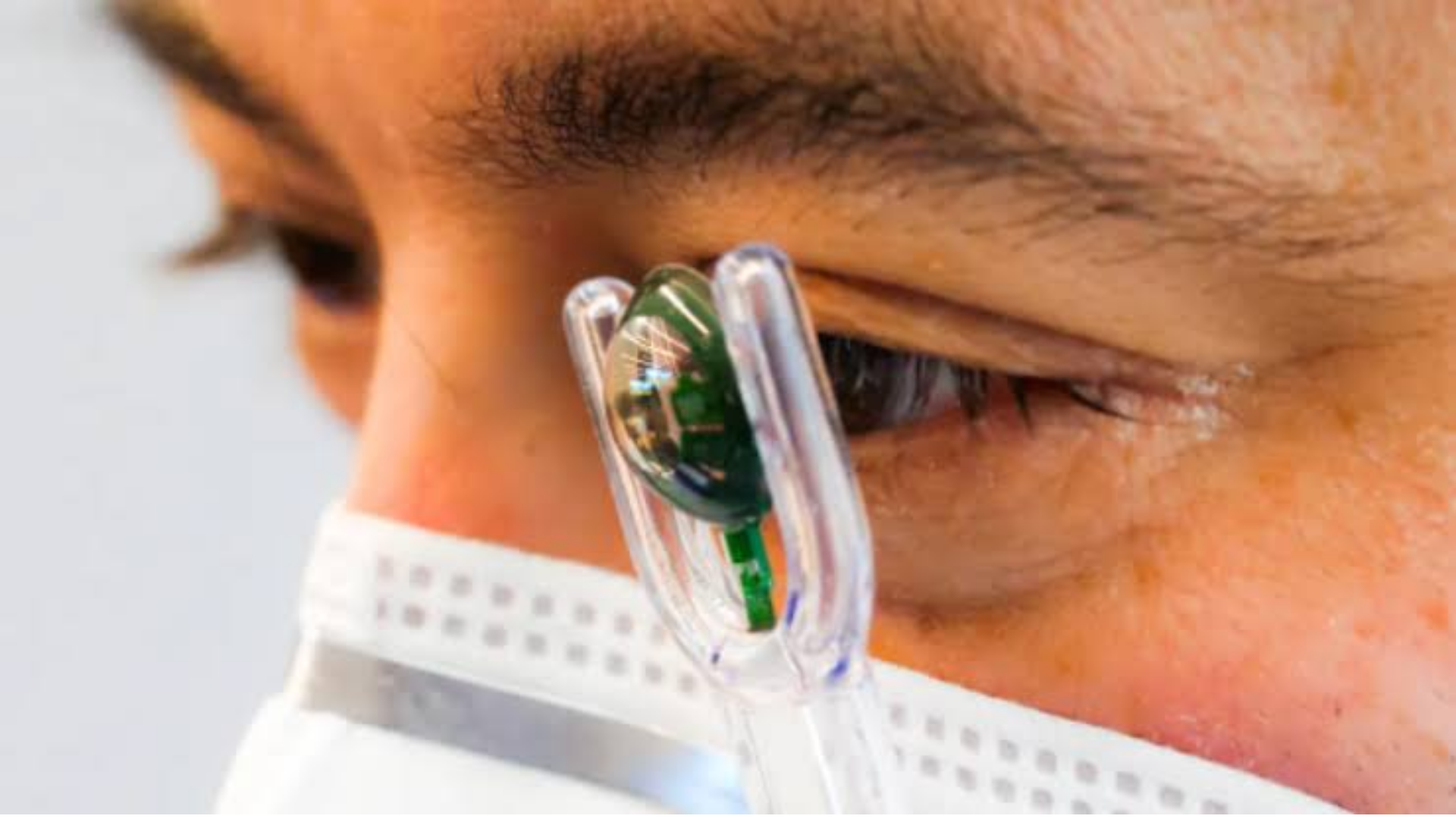
New Technology Uses Nanoparticles to Transform Infrared Light into Visible Light, Expanding Human Visual Capacity!
Scientists in China have developed an innovative contact lens that promises to give humans the ability to see infrared light, a breakthrough that approaches what could be called “super vision,” according to g1/globo. This revolutionary technology is based on upconversion nanoparticles, which have the ability to absorb infrared light and transform it into visible light, allowing the lens to extend the natural range of human vision, which typically varies from 400 to 700 nanometers.
How Does the Technology Work?
In the tests conducted, volunteers were able to identify Morse code signals emitted by an infrared LED, something that would be impossible without this technology. This capability is particularly interesting for military and security applications, where infrared detection can be crucial. Have you ever imagined what it would be like to see in the dark or identify objects that are beyond our normal perception?
The contact lens not only expands visual perception but also brings the expectation of future adaptation to assist people with color blindness and other visual limitations. Color blindness affects a significant percentage of the population, and the possibility of developing a solution that helps these individuals perceive colors more accurately is a remarkable advancement. Do you know anyone living with this condition? How do you think technology could improve the lives of these people?
-
Motorola launched the Signature with a gold seal from DxOMark, tying with the iPhone 17 Pro in camera performance, Snapdragon 8 Gen 5 that surpassed 3 million in benchmarks, and a zoom that impresses even at night.

-
Satellites reveal beneath the Sahara a giant river buried for thousands of kilometers: study shows that the largest hot desert on the planet was once traversed by a river system comparable to the largest on Earth.

-
Scientists have captured something never seen in space: newly born stars are creating gigantic rings of light a thousand times larger than the distance between the Earth and the Sun, and this changes everything we knew about stellar birth.

-
Geologists find traces of a continent that disappeared 155 million years ago after separating from Australia and reveal that it did not sink, but broke into fragments scattered across Southeast Asia.

Comparison with Existing Devices
Unlike traditional night vision goggles, which allow for the visualization of infrared radiation, the new lenses are compact, do not require batteries, and offer multicolored images, in contrast to the characteristic monochromatic green hue of these devices. This feature makes the lenses much more practical for everyday use, without the need for heavy and complicated equipment.
The estimated price for this technology is approximately US$ 200, which is equivalent to about R$ 1,1 thousand. This cost is affordable compared to other night vision devices, and the possibility of use in contact lenses makes the technology even more attractive to the average consumer.
The Future of Human Vision with the New Contact Lens
Although the technology is still in testing phases, it opens new possibilities for how we perceive the world around us. Animals such as birds, bees, and reindeer already possess the ability to see invisible light wavelengths, such as ultraviolet, and now, with this innovation, humans may come closer to that ability. Research on visual perception continues to advance, and each new discovery brings the promise of improving quality of life.
Finally, the new contact lens represents an important step in research on vision and promises to revolutionize the way we interact with the environment, becoming a valuable tool both for daily life and for correcting visual deficiencies.
And you, what do you think of this innovation? Do you believe these lenses could change the way we see the world? Share your opinion in the comments!






-

Uma pessoa reagiu a isso.