





 Portuguese
  English
  Spanish
  4 min of reading
  1 comment


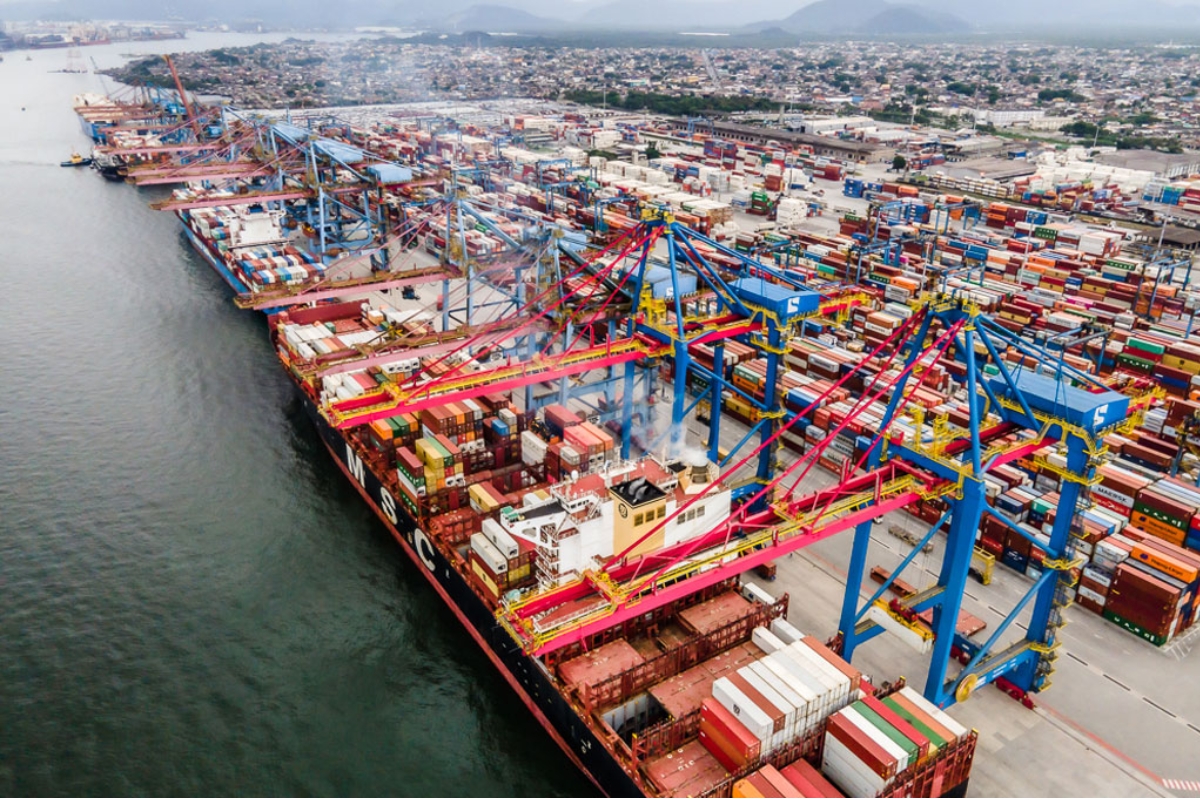

In Santos, the Ministry of Ports and Airports Authorized Expansion of 17.2 Million m² and Structured a R$ 6.4 Billion Auction to Increase Capacity to Up to 9 Million TEU Per Year, Creating Strong Expectations in the Port and Logistics Sector
The Port of Santos reached in 2025 the highest cargo volume in its history. There were 186.4 million tons in a single year. This growth solidified the complex as the largest port terminal in Latin America and raised a clear alert: the current infrastructure is beginning to operate at its limits.
The response came with a robust territorial expansion package and the advancement of the megaterminal Tecon Santos 10, a project that promises to increase the port’s container capacity by about 50 percent.
However, what seemed like just another concession project gained national strategic significance.
-
The government requests the Federal Revenue Service for a new system to automate the income tax declaration, reducing errors, time, and bureaucracy for millions of Brazilians.

-
Pix in installments, international Pix, and contactless payment without internet: the Central Bank revealed the new features coming to the tool that is already used by almost every adult in Brazil.

-
Mercado Livre has just started selling medications with delivery in up to three hours to your door, and this move could completely change the way Brazilians buy medicines on a daily basis.

-
In Dubai, rising tensions from the war in the Middle East are causing super-rich individuals to leave the Gulf and direct their fortunes to a new financial refuge in Asia.


Historical Record in 2025 Exposes Operational Limit and Pressures Expansion
The year 2025 ended with 186.4 million tons moved, surpassing the previous record of 179.8 million set in 2024. The increase was 3.6 percent.
Meanwhile, the container sector played a central role in this growth. The port moved 5.9 million TEU (a standardized measurement for the maritime sector worldwide), totaling 62.3 million tons, a rise of 3.9 percent.
In solid bulk, the volume reached 94.5 million tons. Soy alone accounted for 44.9 million. Pulp reached 9.9 million tons. The figures are impressive and show a continuous growth trend.
Tecon Santos 10 Promises to Increase Capacity by 50 Percent and May Lead Port to 9 Million TEU Per Year

The megaterminal Tecon Santos 10 is set to become the largest auction in the history of the Brazilian port sector. This estimated investment revolves around R$ 6.4 billion. The concession will have an initial term of 25 years, with the possibility of extension.
The terminal will have an area of over 620,000 m², with four berths prepared for large vessels. The estimated capacity is up to 3.5 million TEU per year.
Combined with the existing terminals, the port could reach around 9 million TEU annually. The direct impact is an approximate 50 percent increase in container movement.
The auction is expected to take place between March 30 and April 20. The criterion will be the highest bid value, with a minimum floor of R$ 500 million.
Territorial Expansion Adds 17.2 Million m² and Allows Construction of Up to Eight New Terminals
In addition to Tecon 10, the port will double in size. This is because the Ministry of Ports and Airports authorized the inclusion of 17.2 million m² of land areas and spaces for anchorage and dredging waste disposal.
Only in land areas, where port infrastructure already exists, the growth will be 56 percent. The area will increase from 9.3 million to 14.5 million m².
In practice, this allows for the construction of at least eight new terminals, with a size similar to that of major operators already installed in Santos.
The first auctions for these new areas are expected to start in 2027.
Revenue of R$ 1.4 Billion and R$ 4 Billion in Cash Strengthen Plan to Double Capacity in Up to 30 Years
The Port Authority of Santos ended 2025 with a net revenue of R$ 1.4 billion and R$ 4 billion in cash.
The expectation is for an increase of at least 20 percent in financial volume in three to four years, driven by the expansion.
Currently, the port has 65 berths. With the new configuration, it should gain at least another 15 by 2030.
The strategic goal is to double cargo handling capacity in up to 30 years. With the new projects, this timeframe may be shortened.
Change of Cruise Terminal and New Areas in Cubatão, São Vicente and Santos Expand Logistics Horizon
Other areas are still under analysis at the Ministry of Ports.
Among them, lands in Cubatão, São Vicente, and in the city of Santos itself.
One of the spaces is the current cruise passenger terminal, covering 42,000 m², considered the main one in the country. The change was authorized by the National Agency for Waterway Transportation in January but depends on funds that should come from the Tecon 10 auction.
Once transferred, the space could be used for cargo handling, further enhancing operational capacity.
The Port of Santos is experiencing a decisive moment. Historic records, unprecedented territorial expansion, and a billion-dollar auction place the complex at the center of Brazilian logistics. The scale draws attention and could redefine Brazil’s role in international trade in the coming years.
And you, do you believe this expansion will elevate the Port of Santos to another global level? Share your opinion in the comments.









Olá. Eu acho que tem tudo pra dar certo. Só depende da vontade e seriedade das pessoas envolvidas. Se misturar política e jeitinho brasileiro, pode esquecer. Não sai do papel.