





 Portuguese
  English
  Spanish
  7 min of reading
  67 comments


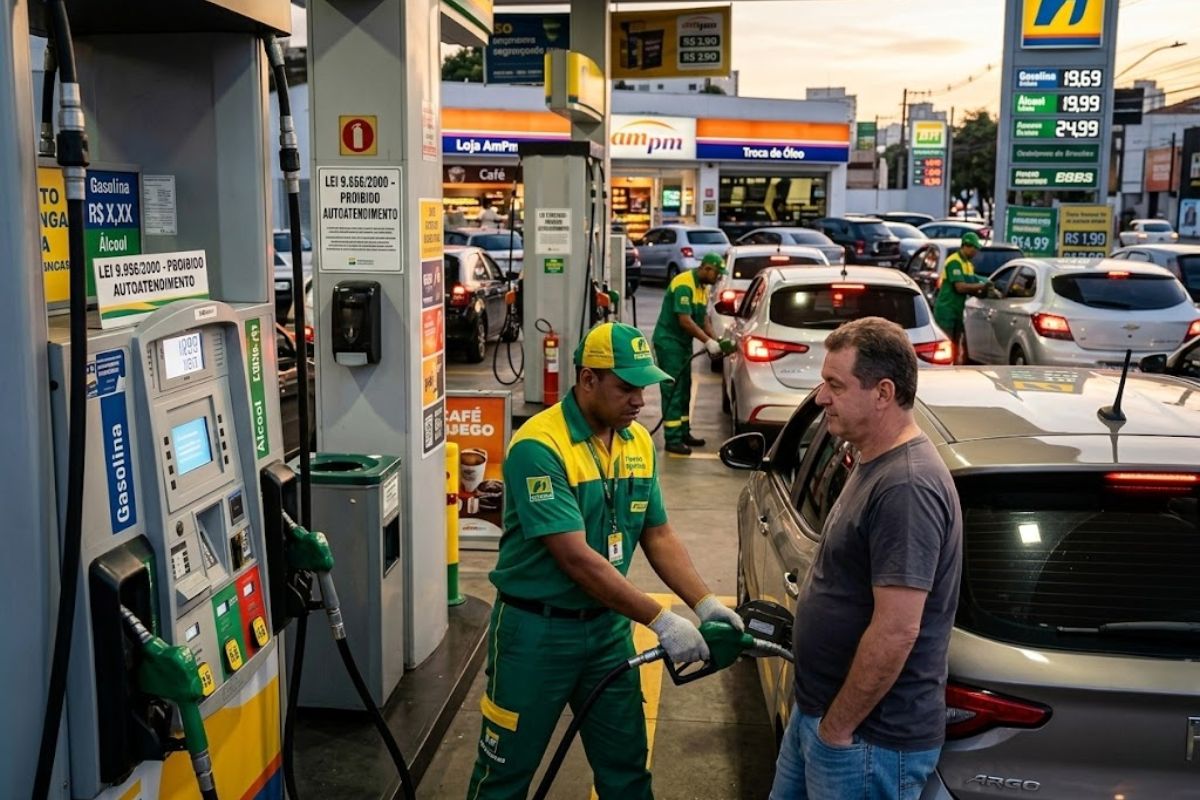


Fueling Your Own Car Is Banned by Law in the Country for More Than Two Decades, in a Rule Created to Preserve Jobs for Attendants, but Which Continues to Divide Businesses, Unions, Specialists, and Consumers About Real Cost, Operational Safety, Freedom of Choice, and Actual Impact on the Final Price of Gasoline in the Market.
Fueling your own car remains prohibited in Brazil under Law No. 9,956, enacted in 2000, with the official justification for maintaining the restriction always being straightforward: to preserve jobs for attendants in a sector that, at that time, was said to be threatened by the advancement of self-service at gas stations.
More than two decades later, the rule remains at the center of a dispute that mixes market, cost, safety, productivity, and freedom of choice. The most sensitive point is that the law protects a specific occupation, but does not end the discussion about who pays for this protection and what effect it really has at the pump.
How the Ban Emerged and Why Brazil Continued Against the Grain
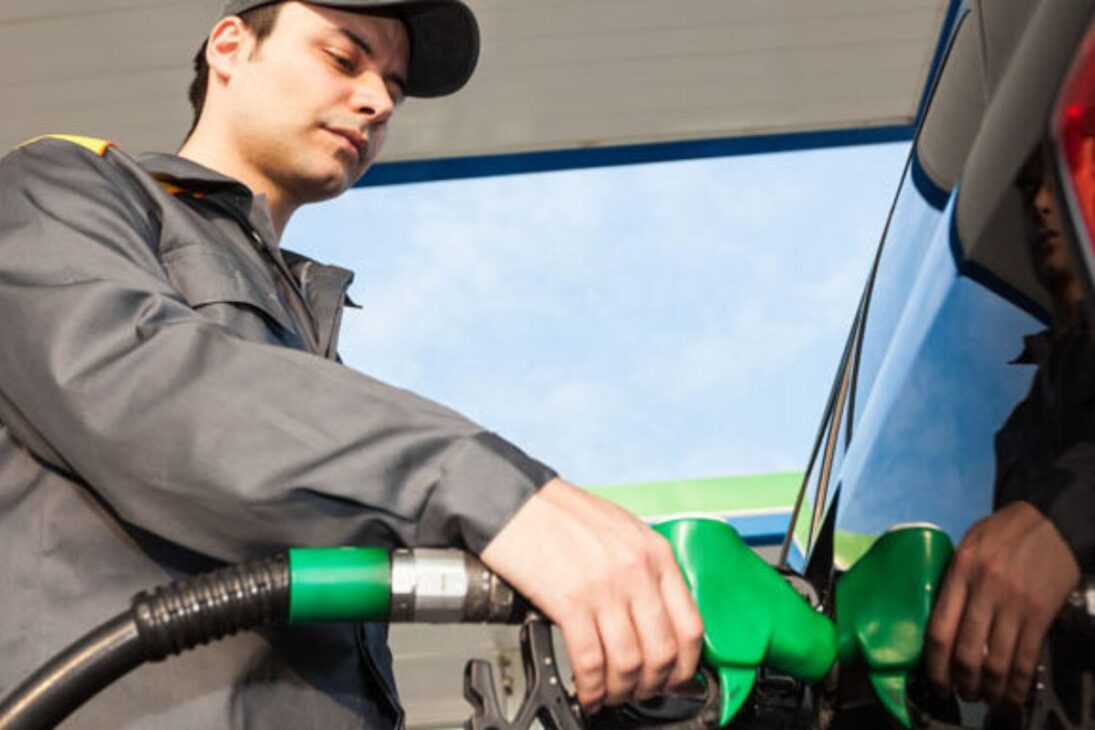
The profession of attendant emerged in Brazil back in 1912, when oil companies began to export gasoline and kerosene in cans and drums to the country.
-
Brazil became 18 square kilometers smaller in the new official update from IBGE, which redrew the boundaries of 784 municipalities in 13 states and even changed the names of cities that you might know, such as Açu, which is now called Assú.
-
Stephen Hawking said that the worst enemy of knowledge is not ignorance but the illusion of knowledge, and he dedicated his entire career to proving that science dies when people act as if they already have all the answers.

-
A man gathered Styrofoam, PET bottles, sand, and cement to build a recycled block using a mold made from an old board and a 50mm pipe to easily raise walls.

-
Man uses technique to save plaster with 20mm polystyrene panels, promises efficient thermal insulation and impresses with low cost in the construction.


For decades, this model was simply the national standard: the driver would arrive, the attendant would handle the fuel, and the operation would proceed as a natural part of the service.
Meanwhile, the United States began to change. In 1964, a remote activation system was introduced there, where the customer paid at the cashier and the attendant released the pump.
In 1973, the so-called pay at pump feature appeared, with a card machine attached to the pump, and self-service gained momentum in the following decades.
By the 1980s, 48 U.S. states had already changed their laws to allow this model, while only New Jersey and Oregon maintained the prohibition.
Brazil chose the opposite path. Instead of opening up space for the market to decide, it approved a national ban on fueling your own car.
The law was enacted by Fernando Henrique Cardoso, and its author, Deputy Aldo Rebelo, maintained that the measure had preserved around 300,000 jobs for attendants in that context.
This data helps to understand the spirit of the regulation. The priority was not efficiency, convenience, or automation, but the containment of mass layoffs in a sector that viewed self-service as a direct threat to employment.
What Do Those Who Defend the Maintenance of Attendants Say
Proponents of the ban argue that the attendant is not just a labor cost, but part of the service provided to the consumer.
Ernesto Pousada, executive director of Vibra, one of the largest distributors in the country, dismisses the adoption of autonomous stations and argues that the presence of the attendant represents a positive differentiator in the customer experience, including the ability to offer other products and services.
There is also the safety argument. Handling fuel involves flammable and toxic substances, and unions assert that the average consumer does not receive training for this.
Eusébio Pinto Neto, from SINPOSPETRO-RJ and the National Federation of Attendants, claims that self-service would increase insecurity for both the user and the business itself, as the station is seen as a dangerous and unhealthy environment.
Another line of defense lies in daily operation. According to Fecombustíveis, an attendant takes an average of 2 minutes and 40 seconds to fill an empty tank.
In self-service, this time would increase to 10 minutes. To maintain the same flow, gas stations would need to multiply pumps and invest in payment autonomy machines, each estimated to cost around R$ 60,000, which would result in an average investment of R$ 180,000 for each eliminated employee.
In this reasoning, allowing fueling your own car would not mean just replacing one person with a pump.
It would mean redesigning the entire operation of many urban stations, which often do not even have the physical space for it.
What Do Those Who Want to Liberalize Self-Service Say
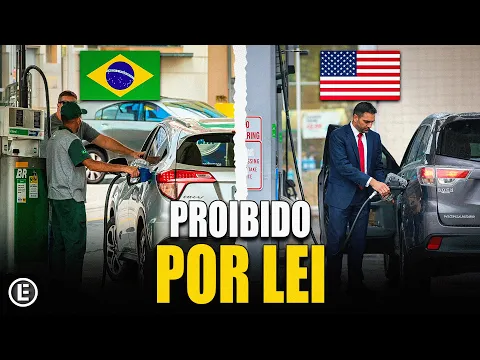

Those in favor of liberalization come from a different logic. For Roberto James, who works in the sector, the decision should lie with the consumer, not the government, unions, or resellers.
The comparison he makes is simple: just like there are self-service and à la carte restaurants, the market could allow different formats for gas stations, letting customers choose how they want to be served.
Ricardo Pires, a businessman in the technology field for gas stations, argues that the ban itself creates operational difficulties.
According to him, the sector faces a labor shortage, and some establishments are operating with incomplete schedules, especially on weekends and holidays.
In more extreme cases, some resellers prefer not to open on certain days due to insufficient staff to cover the pumps.
In the political arena, Deputy Vinícius Poit introduced Bill 2302/19 to repeal the 2000 law and allow fueling your own car again.
His defense combines economic freedom with the idea of retraining workers for better roles less exposed to benzene, sun, rain, and harsh conditions.
The debate has even reached the judiciary. In 2022, the Mime chain in Santa Catarina obtained authorization from the Federal Court to implement self-service at its stations, with the promise of giving customers the choice between an attendant and a self-service pump.
However, the decision was overturned three weeks later by the Regional Federal Court of the 4th Region, which considered that allowing the change for just one chain would create unfair competition and legal insecurity.
Would Prices Really Drop or Is the Discussion Aiming at the Wrong Target
The most popular promise in favor of self-service is cheaper gasoline. But the numbers presented in the debate itself weaken that expectation.
A study by DIEESE, conducted in 2021 at the request of the federations of attendants, calculated that the labor cost of these professionals represented only 1.72% of the total value of gasoline and diesel sales in 2019. In a liter of gasoline costing R$ 7.00, that would correspond to about 12 cents.
Cade itself acknowledged in 2018 that the distributor’s share in the price is small and that the liberalization of self-service would likely have limited impact on the final price of the fuel.
In other words, the presence of an attendant matters, but it matters little compared to the more decisive components of the equation.
These components are more substantial. Taxes account for, on average, between 32% and 34% of the final price of gasoline, adding up ICMS and federal taxes.
Since 2023, ICMS has been charged on an ad rem basis, with a fixed value per liter, and in 2026 it is R$ 1.57 per liter of gasoline in the country.
Additionally, the so-called Petrobras share, which includes production, refining, and investment costs, usually represents around 35% to 40% of the value paid at the pump.
There is also an additional problem, less visible but decisive. Investigations by the Public Ministry and Cade have already identified signs of cartel formation among gas stations in certain regions, with prices artificially aligned.
In these cases, even if there is some cost saving from allowing fueling your own car, nothing guarantees that the reduction would be passed on to the consumer.
Between Job Protection and Freedom of Choice, There Is a Middle Ground
The discussion ends up being squeezed between two extremes. On one side, the preservation of jobs and the defense of assisted service. On the other, the promise of freedom of choice, more automation, and potential gains in competitiveness.
Neither side alone solves the main problem of fuel in Brazil, because the final price depends much more on taxes, market structure, Petrobras, logistics, and real competition.
Therefore, the intermediate proposal presented by Boris Feldman draws attention. The idea is simple: to maintain pumps with attendants while also allowing self-service pumps.
Those who want convenience would pay for that comfort. Those who prefer to save a few cents or value autonomy could choose to fuel their own car.
This mixed model tries to shift the debate from absolute prohibition to regulated choice. It does not eliminate the attendant by decree, but it also does not prevent the consumer from deciding. What it does is return to the station and the driver a margin of choice that the law currently blocks entirely.
In the end, the remaining question is not just whether self-service should or should not be allowed. The more uncomfortable question is whether the current legislation truly protects what it claims to protect or merely froze an outdated model while the rest of the economy changed around it.
The ban on fueling your own car remains in effect, but the controversy surrounding it is far from over.
Brazil maintains a rule that preserves jobs and supports safety arguments, but also restricts freedom of choice and leaves open whether the real problem of gasoline prices is being addressed in the right place.
In your view, should the country maintain the prohibition as it is, fully liberalize self-service, or adopt a mixed model where the consumer chooses how they want to fuel?





Concordo que o modelo hibrido é a melhor solução. Alias o que deve acontecer quando o volume de carros hibridos e eletricos alcançarem um percentual expressivo? O que vai acontecer ao modelo de negócio. Já que o sistema atual de recarga eletrica é praticamente self service. a comparação irá acabar acontecendo. Na europa o sistema self service funciona bem. E lá a questão de segurança é levada a sério.
Bom dia. Prefiro eu abastecer meu carro. Por algumas vezes o frentista arranhou a pintura do carro e fez aquela cara de que não ia poder pagar o arranhão….uma vez ele deixou a mangueira escapar com o gatilho travado ligado e jorrou gasolina por cima da tampa da mala!! Eu que tive que orientar ele no que fazer…
Resumo: democracia é ter a opção. Quem quer com frentista que pague mais caro.
Essa lei inútil tinha que ser obra de um POLÍTICO DE DIREITA (Aldo Rebelo). Nunca ví um deputado de direita criar uma lei que preste