





 Portuguese
  English
  Spanish
 5 min of reading
  4 comments


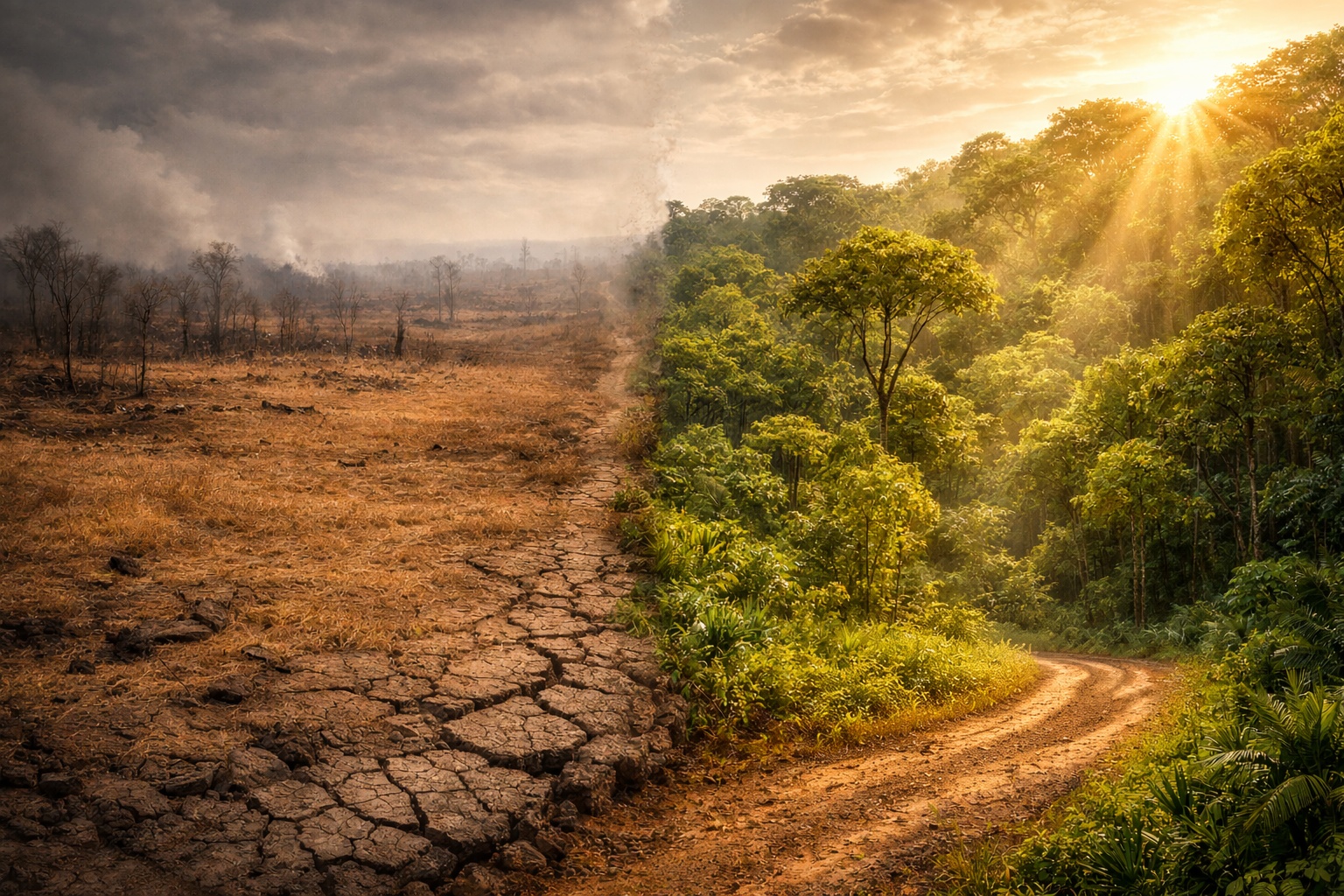


Peugeot Funded Project That Recovered 2 Thousand Hectares of Degraded Pasture in Mato Grosso, Planted 2 Million Native Trees, and Transformed Area in the Deforestation Arc into a Reference for Reforestation.
In 1999, French and Brazilian organizations joined forces to tackle the advance of pasture and monoculture along the edges of the Amazon. The chosen site for the experiment was an old cattle ranch completely degraded in the municipality of Cotriguaçu, in the northwest of Mato Grosso, in the heart of the Deforestation Arc, the region where the Amazon rainforest is under the greatest pressure from destruction. Twenty-five years later, the Peugeot-ONF Forest Carbon Well Project has become one of the most studied and successful cases of reforestation in the Brazilian Amazon, combining environmental restoration, carbon sequestration, and large-scale biodiversity recovery.
A Car Manufacturer Funding Forest Restoration in the Amazon
The project was born from a strategic partnership. On one side, Peugeot, a French automotive giant, interested in offsetting part of its emissions through concrete environmental initiatives. On the other, ONF (National Forestry Office), a French state-owned company specialized in forest management and sustainable practices.


Together, the institutions acquired the Fazenda São Nicolau, a rural property of 10 thousand hectares almost entirely deforested for extensive cattle ranching. The landscape was marked by dry pastures, compacted soil, and a near-total absence of native vegetation — a typical portrait of degradation associated with the advance of the agricultural frontier.
-
Friends have been building a small “town” for 30 years to grow old together, with compact houses, a common area, nature surrounding it, and a collective life project designed for friendship, coexistence, and simplicity.

-
This small town in Germany created its own currency 24 years ago, today it circulates millions per year, is accepted in over 300 stores, and the German government allowed all of this to happen under one condition.

-
Curitiba is shrinking and is expected to lose 97,000 residents by 2050, while inland cities in Paraná such as Sarandi, Araucária, and Toledo are experiencing accelerated growth that is changing the entire state’s map.

-
Tourists were poisoned on Everest in a million-dollar fraud scheme involving helicopters that diverted over $19 million and shocked international authorities.


The initial goal was to test the concept of “forest carbon well”, under the Clean Development Mechanism outlined by the Kyoto Protocol. The target was to restore 2 thousand hectares of degraded pasture through the planting of native trees capable of capturing CO₂ from the atmosphere. Over time, the project exceeded its climatic dimension and became a benchmark in ecological restoration.
Two Million Native Trees Planted in Degraded Area
Between 1999 and the following years, local teams planted approximately 2 million seedlings, selecting about 50 native Amazonian species, such as cedar, ipê, chestnut, and jatobá.
The selection followed ecological and technical criteria: fast-growing species to capture carbon in the early years, fruit-bearing trees to attract seed-dispersing fauna, and high-value timber species for potential sustainable future use.

The main strategy adopted was the Assisted Natural Regeneration (ANR), a technique that combines targeted planting with encouragement of spontaneous regeneration. After the initial planting, the area was managed with low intervention, allowing seeds brought by the wind and fauna to naturally colonize the land.
A smaller portion, about 150 hectares, received teak planting. Subsequent studies showed that this species exhibits allelopathic behavior, reducing plant diversity around it, which reinforced the importance of prioritizing native species in Amazonian restoration.
Biodiversity Recovery in the Deforestation Arc
Scientific studies published over the past decade have shown that, in just 10 years, the reforested area already had levels of biodiversity much closer to that of native forest than to the original degraded pasture.
Surveys recorded:
- 346 species of birds
- 45 species of amphibians
- 44 species of snakes
- 41 species of mammals
Twelve of these species are officially listed as threatened with extinction. Camera traps confirmed the presence of large mammals and seed dispersers, essential for ecological balance.
The reforestation also allowed the formation of ecological corridors, connecting isolated fragments and re-establishing natural flows of biodiversity.
Carbon Sequestration: Nearly 400 Thousand Tons of CO₂ Captured
By 2022, the project had officially sequestered 394,400 tons of CO₂, stored in the biomass of the trees — trunks, branches, leaves, and roots. This volume is equivalent to removing approximately 85 thousand vehicles from the roads for a year.
The project received certification from Verra, one of the leading global entities for carbon credit validation. Independent auditors conducted biomass measurements and confirmed the effectiveness of carbon sequestration.
Currently, the credits are traded on international platforms, generating resources for the maintenance of the area and continuity of monitoring. The goal is to reach 1 million tons of CO₂ sequestered by 2038.
Fazenda São Nicolau Became a Scientific Laboratory for Reforestation
The area has become a true open-air laboratory for research on:
- Forest Growth Dynamics
- Carbon Sequestration
- Biodiversity Recovery
- Nutrient Cycling
- Economic Modeling of Restoration
Institutions such as the Federal University of Mato Grosso and French research centers conduct ongoing studies on the farm. One of the main findings was that different species exhibit distinct growth and carbon capture rates, essential information for optimizing future projects.
Environmental Education and Social Impact in Cotriguaçu
In addition to environmental restoration, the project developed a strong environmental education program in the Mato Grosso Amazon. Annually, around 400 students participate in educational activities on the farm.
Guided tours, workshops, theater, and lectures bring young people closer to the reality of the restored forest. Family farmers also receive training in agroforestry systems and sustainable management.
Over 10 thousand people from the region have participated in the activities over the years, increasing the social impact of the project.
Replicable Reforestation Model in the Amazon
The project demonstrated that it is technically feasible to restore degraded areas on a significant scale. The 2 thousand hectares reforested — equivalent to almost 4 thousand soccer fields — allowed for the testing of techniques at a real operational level.
Among the main lessons:
- Combining multiple restoration strategies is more effective.
- Native species ensure greater ecological diversity.
- Assisted Natural Regeneration reduces costs and accelerates recovery.
- Continuous scientific monitoring is essential.
Today, the model developed at Fazenda São Nicolau inspires similar initiatives in other Amazonian countries.
The Peugeot-ONF Forest Carbon Well Project has established itself as an international reference in reforestation in the Amazon, uniting carbon capture, biodiversity recovery, and social impact.
By transforming 2 thousand degraded hectares in the Deforestation Arc into functional forest, the project proved that, with adequate funding, correct technique, and long-term commitment, it is possible to restore Amazonian ecosystems on a significant scale.










Parabéns pela iniciativa privada e pelas pessoas que participaram dessa conquista no meio ambiente.
Parabéns Peugeot e CPG!! é uma pena que aqui no Brasil a maioria dos meios de comunicação só dão notícia ruim. Precisa divulgar mais o que acontece de bom.
Restaurar a floresta sempre é uma iniciativa válida, não importa quem faça, o brasileiro tem muito que aprender ainda sobre conservação, tanto da nossa história quanto da nossa riqueza em biodiversidade.