





 Portuguese
  English
  Spanish
  7 min of reading
  7 comments


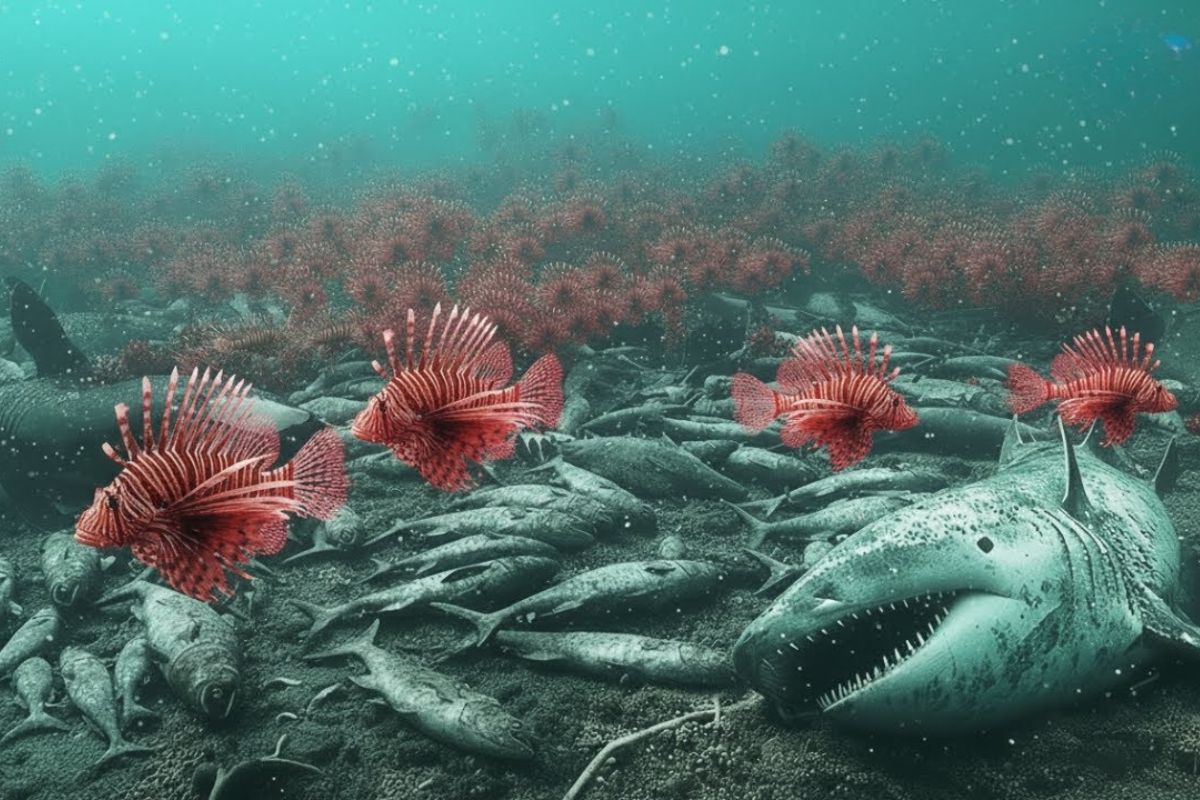


In The Caribbean Reefs, The Lionfish From The Indo-Pacific Spread From Few Individuals, Hunts More Than 50 Species, Swallows Prey Continuously, Survives Months Without Food And Reduces Fish Biomass By Up To 95% In Two Years, Suffocating Corals And Local Economies While Humans Try To Hunt, Trap, Cook.
The reefs of the Caribbean are being eroded by a plague that seems too beautiful to be taken seriously at first glance. The lionfish, with its vibrant stripes and fan-shaped fins, has become an invasive predator capable of cleaning entire areas like a living vacuum cleaner.
The advance occurs quickly, quietly, and with brutal numbers: the population has grown 1,000 times in 15 years, its consumption affects dozens of species and the cascading effect starts with the fish, passing through algae and ending with corals, with a direct impact on fishing and tourism.
The “Pretty” Invader That Turned Into A Nightmare On The Reefs

The lionfish is considered one of the most aggressive invasive species in the Western Atlantic and the Caribbean.
-
The coldest seawater ever recorded in Earth’s history was hidden under extreme ice 717 million years ago and reached an impressive -15°C.
-
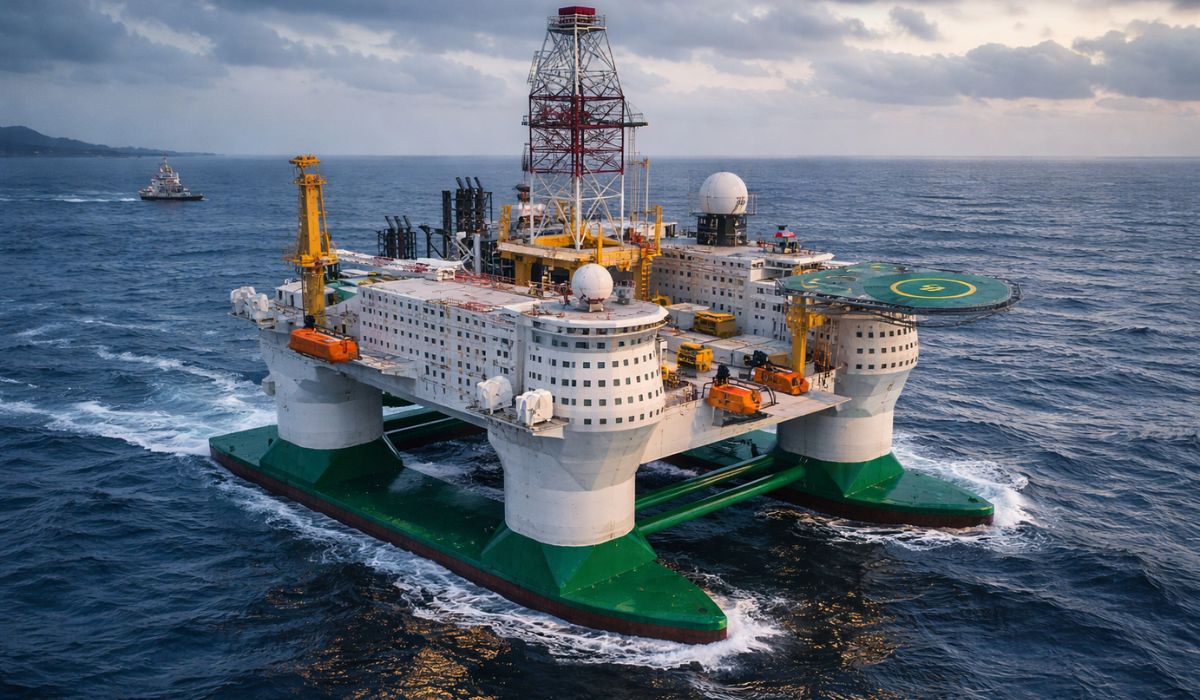
China has launched the world’s first floating artificial island, a scientific structure designed to face open seas, test equipment weighing hundreds of tons, and reach depths of 10,000 meters.
-
China accelerates global science and may surpass the United States in 2 years with increased public investment, continuous growth, and direct impact on the global technological competition.

-
Scientific studies indicate that drought may be strengthening a much greater silent threat: more resistant superbugs.

It is not small: when adult, it measures on average between 35 and 47 cm, larger than many common reef fish, and there have been records of individuals weighing 1.4 kg.
What makes it even more problematic is its arsenal. An adult carries 18 venomous spines, consisting of 13 dorsal, 3 anal, and 2 pelvic, connected to venom glands.
An accidental touch injects venom immediately, causing intense burning pain, nausea, and severe muscle spasms. It is not usually fatal, but the pain is described as extreme.
There is also a curious detail that reinforces how adaptable it is: some deep-water lionfish species can achieve bioluminescence, producing their own light, which is associated with communication and attracting prey in the ocean’s dark depths.
How Few Individuals Turned Into Millions In The Caribbean

A central point of the disaster is that the lionfish in the Caribbean share a common origin from fewer than 10 original individuals, according to genetic data cited in the material.
The most accepted hypothesis links the onset to an event in 1992, when Hurricane Andrew, a Category 5 storm, destroyed an aquarium facility in Biscayne Bay and released six lionfish into the ocean. Six seems low, but the lionfish compensates with absurd reproduction and egg dispersion scale.
Another hypothesis points to aquarium owners’ behavior: from the late 1980s to the early 2000s, tens of thousands of lionfish were imported from Indonesia and the Philippines for sale. When they grew too fast or became dangerous, some of these animals would have been released into the sea.
There is also the less likely, but considered possible, possibility of eggs being transported in the ballast water of cargo ships.
The eggs have a protective gelatinous coating, float in the water column, and can survive for days, enough time for long journeys.
In a decade, the lionfish had already appeared along more than 7,000 km of coastline, from North Carolina to Venezuela, consolidating a rapid expansion.
The Predator That Eats Almost Everything And Does Not Stop

The list of what lionfish consume in the reefs is broad: over 50 species of fish and invertebrates, including butterflyfish, damselfish, juvenile surgeonfish, shrimp, and crabs.
The appetite is sustained by an absurd physical capacity: the stomach can expand up to 30 times its normal size.
This allows it to swallow prey repeatedly, without a “break,” and there are reports of a single individual consuming 20 small fish in a few minutes.
When food becomes scarce, it may resort to cannibalism, with larger individuals eating the smaller ones.
And, paradoxically, it can also endure long periods without feeding: it can survive for 3 months without food, losing only about 10% to 12% of body weight.
The Collapse Of Fishing And The Domino Effect In The Reefs
The predatory capacity has been associated with drastic declines. In just 2 years after the lionfish arrives at a reef, the biomass of commercial fish can drop by 65% to 95%.
In regions like the Bahamas, catches of snapper and grouper, described as valuable sources for fishermen, have fallen by up to 70%.
In Belize and Honduras, economic losses have been estimated at 20 to 40 million dollars per year, not including rising fuel costs, as fishermen need to go further to find areas that are not yet “cleaned.”
And the most profound impact is ecological. When fish that control algae are decimated, algae grow unchecked and suffocate the corals layer by layer, reducing light, preventing photosynthesis and leading to reef death.
A cited 2020 study brings an aggravating factor: the lionfish also consumes juvenile corals before they settle on the rock, attacking not only the present but the future of the ecosystem.
There is also another shocking number: an experiment attributes to a single lionfish the ability to reduce juvenile fish populations by 79% in 5 weeks.
Tourism Down When The Reef Loses Life
The economic consequence extends to tourism. A healthy reef can generate 1 million dollars per square kilometer per year from diving tourism. When the reefs die, the drop in visitors can range from 30% to 90%.
In Bonaire, described as a diving paradise of the Caribbean, annual revenue can drop by up to 24 million dollars.
And the regional impact is projected to be enormous: estimated losses of 200 to 350 million dollars per year, with projections reaching 1 billion dollars in 10 to 15 years if the invasion is not controlled.
Why Humans Try And Fail To Control The Lionfish
The human response has not been the absence of action, but the inadequacy in the face of the invader’s pace.
The most common approach is hunting by divers using simple tools like short spears and hand spikes. This requires a license and training, both to avoid breaking corals and to deal with the 18 venomous spines.
The limit is depth. Divers are effective at around 20 to 30 meters, but there have been recorded populations at 305 meters. In practice, hunting occurs in the “shallow” part while many lionfish remain much deeper.
Competitions aim to scale the effort. In 2023, a large hunt recorded 24,699 lionfish removed in 2 days, with 144 divers, and an elite diver capturing 60 in a single dive.
However, a reef can harbor between 1,000 and 5,000 lionfish, making the effort impressive but small in the face of the stock.
Traps have been tested, but they predominantly captured native species and ended up abandoned for causing more damage than benefits.
Robots have also been tested, with unit costs between 50,000 and 200,000 dollars, yet still faced limitations.
Absurd Reproduction: The Engine That Sustains The Invasion
Reproduction is at the center of the disaster. A female needs only 2 to 4 days between spawns. Each batch has 10,000 to 30,000 eggs. In a year, this can amount to 2 million eggs per female.
The eggs are enveloped in a lightweight gelatinous membrane, which drifts for hundreds of kilometers. The larvae stay in the water column for 25 to 30 days, long enough to use currents to spread widely, linking regions and multiplying reach.
This mechanism explains why it is impossible to hunt eggs and larvae in the open sea with the same ease as hunting an adult in the reef.
Why In The Pacific It Is Not A Disaster And In The Caribbean It Turns Into Collapse
In the Pacific, where lionfish are native, they are a normal part of the ecosystem and do not cause collapse because predators and prey have evolved together. Predators learn to attack from safer angles and to handle risk.
In the Caribbean, the scenario is reversed. Without prepared natural predators, small fish do not recognize danger and are quickly caught, a phenomenon associated with the so-called naïve prey syndrome.
Sharks exist, but they almost never intentionally bite lionfish. There is a cited data point from prolonged observation in which, over 10,000 hours, there were only two cases of bites, and in both instances, sharks spat them out afterward.
A Thread Of Hope: Predators Begin To “Learn” In Some Places
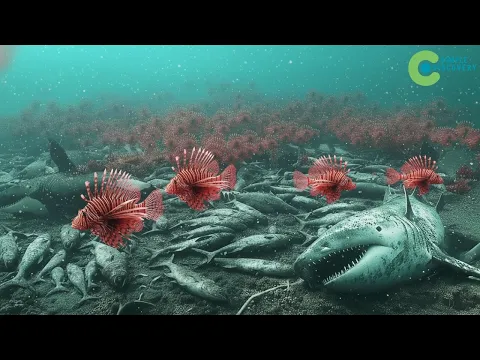

In areas with a frequent presence of divers, there have been reports of sharks attacking live lionfish without bait after repeated indirect feeding situations, but this is localized and fragile, not a solution for the entire Caribbean.
There are also isolated signs involving groupers: a cited 2012 study observed giant groupers over 1 meter consuming lionfish in the Bahamas, in areas where conservation laws helped recover predator populations.
The frequency was low, about 1% to 2% of observations, but it marked a first sign of adjustment.
Another cited sign involves trumpetfish, which reportedly began to ambush juvenile lionfish in reefs with high density of native species, targeting the most vulnerable stage before the spines fully develop.
And there is a structural point: reefs with high biodiversity can be damaged 40% to 60% more slowly than simple and uniform reefs because more fish that eat algae reduce coral suffocation, and more complexity creates refuges and makes hunting difficult.
The overall picture is an unequal race. The lionfish hunts a lot, eats almost everything, endures scarcity, spreads through currents, and produces millions of eggs.
Humans can remove thousands in concentrated events, but most of the problem may be out of immediate reach, either in depth or in the invisible phase of eggs and larvae.
Meanwhile, reefs that should be vibrant mosaics of life can turn into coral graveyards in months, with chain effects hitting fishing, tourism, and the very survival of native species.
In your opinion, can the Caribbean save the reefs by hunting and consuming lionfish, or has this invasion already been changing the ocean forever?








O Estado tem que implementar espécies predadoras do pacífico, e caça intensiva até equilibrar com os predadores a solução está em estudar peixe leão, no pacífico ,depois no Atlântico,até que o próprio ambiente restabeleça o equilíbrio porque eliminar o peixe leão até a cota 0 , é impossível!
Talvez, a solução seja controle genético que provoque a infertilidade, como realizado com o Aedes aegypti, e soltar predadores naturais onde há maior concentração desse peixe.
Teria que fazer uma mudança genética nas fêmeas para produzirem apenas macho estéril, e isso acabaria com a reprodução desenfreada