





 Portuguese
  English
  Spanish
  6 min of reading
  1 comment


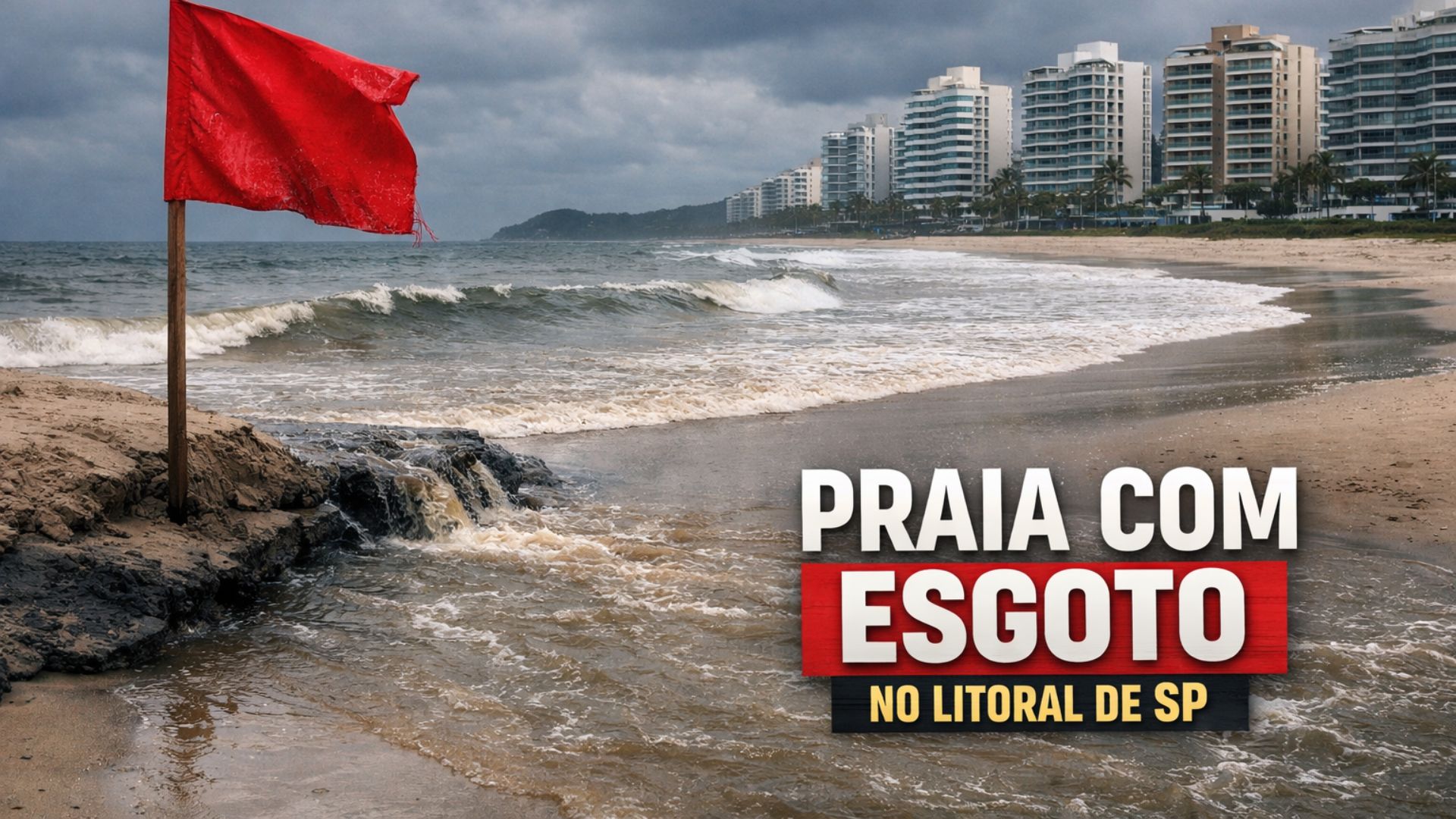


The Stretch of the São Paulo Coast Registers Sewage Contamination Again in the Height of the Season, Exposes Old Structural Failures, Mobilizes Residents and Authorities, and Raises Questions About the Impacts of Incomplete Sanitation in a Shore Marked by Million-Dollar Developments and Unequal Systems.
A stretch of São Lourenço beach, in Bertioga, on the São Paulo coast, has once again shown signs of sewage contamination during the peak of the summer season, reigniting health alerts in one of the region’s most valued areas.
The situation worries residents, bathers, and families who frequent the shore where apartments are valued at over R$ 10 million, especially due to the recurrence of similar episodes in recent years.
The problem gained greater visibility after Cetesb raised a red flag in front of Jardim São Lourenço, indicating water unsuited for swimming at a sensitive point on the beach.
-
Spain surprises the world by erecting 62 artificial dunes, mixing sand with natural remains of posidonia, and causing the structure to lose only 1.4% of its volume in 1 year.

-
With 16 Bulava missiles, improvements in acoustic stealth, and a design focused on silent patrols, Russia’s nuclear submarine was born to ensure Moscow’s invisible retaliation and has become one of the pillars of its maritime strength.

-
‘Populous’ city in Rio among the worst in Brazil in national ranking and exposes silent development crisis.
-
Couple buys house in the South Zone of São Paulo, opens a hidden door in the garage, and finds a secret wine cellar with dozens of old wines forgotten since the 1970s.

Days later, the Bertioga City Hall fined Sabesp R$ 100,000 for a sewage leak that, according to residents, affected the stormwater drainage system and eventually discharged into the sea.
Red Flag Exposes Sanitary Risk on the Beach
In a short stretch of the shore, two neighborhoods with distinct realities share the same strip of sand, but not the same infrastructure.
On one side is Riviera de São Lourenço, a planned high-standard neighborhood that operates a private sanitation system often cited as a model.
Right next door, Jardim São Lourenço has been grappling with sanitation and drainage failures for decades, problems that have been associated with successive episodes of seawater contamination.


The classification of water as unsuitable for swimming follows technical criteria defined based on weekly collections conducted at the same points.
The warning is issued when elevated levels of enterococci, a bacteria indicator of fecal contamination and risk to bathers’ health, are detected.
Among the parameters considered are the presence of more than 100 colonies per 100 ml in at least two of five weeks, or above 400 colonies per 100 ml in a single measurement.
In the first week of January, a period of peak tourist concentration, the red flag was installed a few meters from the stream that marks the boundary between the two neighborhoods.
Although monitoring follows fixed points, the behavior of ocean currents does not respect administrative boundaries, heightening the concerns of those who frequent other parts of the beach.
As a result, residents fear that the load of fecal coliforms recorded near the stream may spread along the shore.
Concern increases with a significant operational factor.
There is no official monitoring point of the environmental agency immediately in front of Riviera de São Lourenço.
Thus, even with the signaling concentrated in Jardim São Lourenço, uncertainty remains about the actual extent of contamination on the beach.
R$ 100,000 Fine and a History of Sewage Failures
On Saturday (24), Bertioga City Hall imposed a R$ 100,000 fine on Sabesp due to a sewage leak registered in the sewage network.
According to residents, the overflow affected the storm drainage network and was directed straight to the sea.
In a statement, the company reported that it was a “one-off occurrence.”
Sabesp attributed the problem to obstruction of the pipeline caused by irregular waste disposal and stated that emergency maintenance had regularized the system.
Still, the episode reinforces a history of complaints about overflows during heavy rainfall.

Reports also mention irregular sewage connections linked to stormwater galleries.
Since these structures have the ocean as their final destination, any failure ends up functioning as a direct shortcut to beach pollution.
Chlorine in the Stream Highlights Palliative Solution
In light of the recurring problems, Riviera installed a hose under the bridge of the stream separating the two neighborhoods.
The equipment began to pour chlorine into the water before it reaches the sea, in an attempt to reduce the contaminant load.
Although the initiative is preventive in nature, the measure highlighted the tension between the planned neighborhood and the neighboring area facing old structural deficits.
In the summer of 2025, the situation reached a critical point.
During that time, the beach section remained unsuitable for swimming for seven consecutive weeks.
The scenario coincided with the advance of new real estate developments in the region, amplifying the contrast between real estate appreciation and deficient infrastructure.
“I have been visiting this beach for 30 years and have never seen anything like it,” said resident José Carlos Maduro Júnior, 39.
According to him, urban growth occurred without resolving longstanding issues.
“Infrastructure issues were left unresolved, and with the growth of the neighborhood, problems arose,” he stated.
Missing Lifting Station Creates Structural Bottleneck
The main technical knot of the impasse lies in the infrastructure planned to accommodate the real estate expansion of Jardim São Lourenço.

The first major condominium buildings in the neighborhood were constructed in the early 2010s by Camargo Corrêa Desenvolvimento Imobiliário, Phoenix, and SRW.
An agreement made between construction companies, Sabesp, and the city hall conditioned new developments on the expansion of the sanitation system.
The commitment included the implementation of drainage networks, sewage collection, and three lifting stations.
These structures would be responsible for pumping waste to a treatment station.
However, one of the stations was never built.
In practice, part of the network began to collect sewage without a defined final destination, creating a chronic bottleneck.
On rainy days, when the system operates under greater pressure, the result is overflows and improper discharges.
Deficiencies in urban drainage and irregular connections further exacerbate this situation.
Disputed Responsibilities and the Role of Public Authority
Wilson Roberto da Silva, president of the Jardim São Lourenço and Itaguaré Association, attributes the delay of the project to the lack of land release.
He is also the owner of the SRW construction company, responsible for the pending lifting station in partnership with Phoenix.
According to Silva, the release of the land by the city hall occurred only in October 2025.
The director claims there is no conflict in holding both positions.
Bertioga City Hall informed that the construction of the lifting station is a condition for granting the Habite-se of a new development by SRW.
Sabesp claims that the work is essential for the functioning of the system. However, the company states that the responsibility for execution does not lie with them.
Meanwhile, the Public Prosecutor’s Office of São Paulo reported that it is conducting a procedure under secrecy.
The investigation addresses the unsuitability of the beach due to sewage and drainage issues in Jardim São Lourenço. The agency has also requested Sabesp to provide a schedule of works.
Residents’ Mobilization Increases Institutional Pressure

The community’s dissatisfaction has advanced to the institutional and legal field. Engineer Heverton Faria, a resident of the region, leads a petition on the subject.
“What happens there is absurd. One pushes to one side, another pushes to the other, and things remain as they are,” he said.
He stated that he intends to contact Gaema, from the Public Prosecutor’s Office of São Paulo. The initiative gathers more than a thousand visitors to São Lourenço beach.
The petition mentions Sabesp, Cetesb, the city hall, and the involved builders. The pressure resulted in a meeting held on the 19th.
The meeting brought together Mayor Marcelo Vilares (União), representatives from municipal departments, Sabesp, residents, and entrepreneurs.
According to participants, there were promises to address the structural issues.
These failures directly affect Jardim São Lourenço and, indirectly, Riviera de São Lourenço.
Maduro Júnior believes that the repercussions hastened responses from public authorities.
“Without a doubt, the residents’ pressure had an effect, and they started to take action. Moreover, the red flag is something very impactful, which this time circulated on social media through influencers,” he said.
He added that, though without presenting evidence, he has the impression that Riviera also exerted institutional pressure.
According to him, the high-standard neighborhood has great influence in the region.
If the beach is the same and the sea mixes everything, what is still lacking for swimmable conditions to stop depending on makeshift solutions?







Desviar todo dejeto humano para reflorestamento ,e plantio de eucalipitos para celulose e carvão .para produçao de cana para etanol.NADA PARA CONSUMO HUMANO.A