





 Portuguese
  English
  Spanish
  7 min of reading
  1 comment


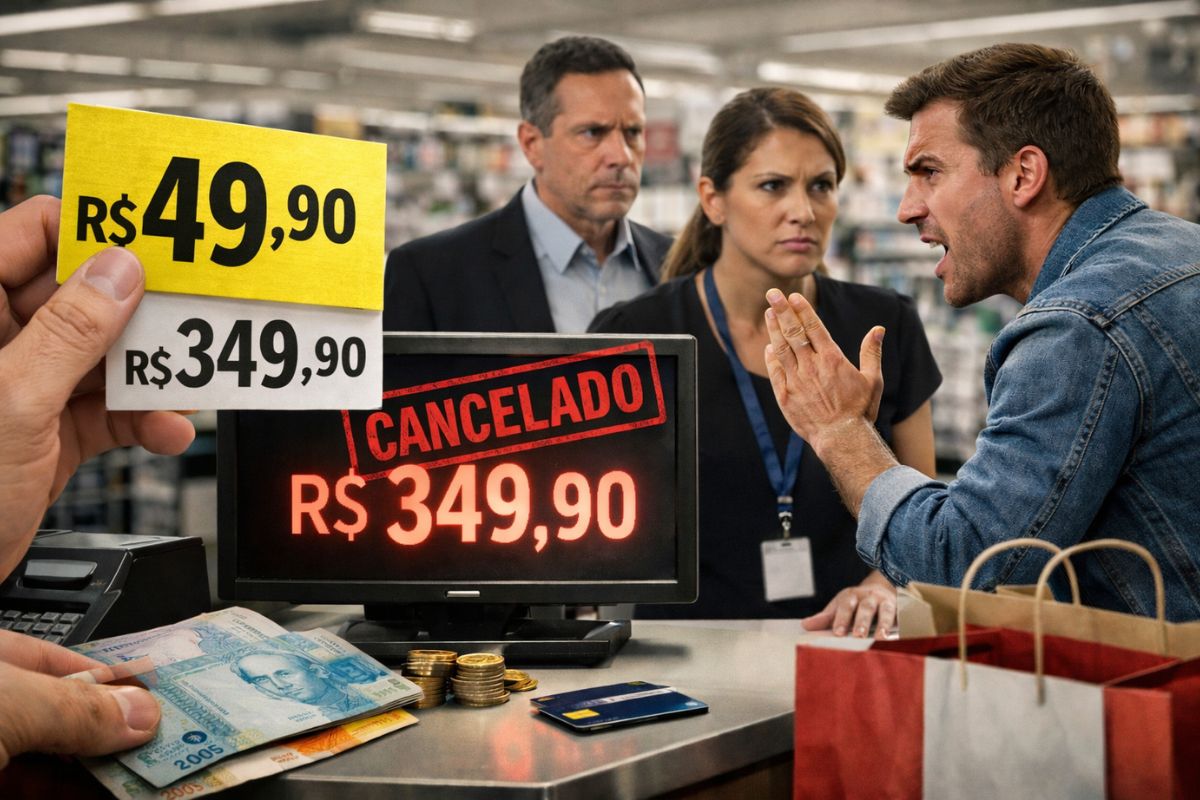


In Sales, The Announced Price Can Turn Into A Dispute: Shelf, Reader And Cash Register Do Not Always Match. According To The CDC, The Offer Is Binding, But The Trade Can Argue Gross Error Or Excessive Demand. It Can Also Set Limits Per Customer, Provided It Warns In Advance. Proof And Calm Decide At The Time And Avoid Pain Later.
A flashy promotion usually gives the same feeling: the price seems irresistible, the consumer rushes to secure it, and the cash register should be the end of the story. However, in practice, the price is where many conflicts begin, especially when the tag, reader, and system do not match the same value.
The issue came back to the center of debate after a case that went viral in Boa Vista: a supermarket refused to deliver more than R$ 16,000 in beer purchased by a customer, even with the price displayed, checked by the electronic reader and payment approved. The situation escalated and ended with the manager detained, reigniting the question that always returns: after all, which price is valid?
When The Announced Price Becomes An Obligation For The Store
The central rule of consumer law is straightforward: the announced price is part of the offer and, in general, must be honored. The logic behind this is that advertising and “sufficiently precise” information are not embellishments: they become part of the contract, even if no one signs any paper at the moment of purchase.
-
Havan buys historic football land in Blumenau for a million-dollar amount protected by a confidentiality clause and is already planning to change even the layout of streets to build a megastore in half-timbered style costing 80 million reais.

-
Mercado Livre “opens the vault” and announces a record investment of R$ 57 billion in Brazil in 2026, a value 50% higher than the previous year, with an expansion plan that includes 14 new logistics centers, totaling 42 units in the country and hiring an additional 10,000 employees.

-
How investment in technology can revolutionize the national economy and enhance industrial gains, according to a study that highlights the direct impact on productivity, innovation, and wealth retention within Brazil.

-
The largest food company on the planet, JBS, has just opened a 4,000 square meter laboratory in Florianópolis to develop customized proteins that modulate muscle mass gain, immune response, and metabolic performance.


In practice, the announced price tends to be considered valid when the consumer can identify three points effortlessly: what the product is, what the price is, and under what conditions it is paid. This applies to tags on shelves, posters, brochures, windows, websites, and apps. If the information is clear and does not depend on “interpretation,” the trade is typically bound by what it has disclosed.
Which Price Is Valid When Shelf, Reader And Cash Register Diverge
The most common conflict arises from an irritating detail: the price on the shelf says one thing, the electronic reader confirms another, and the cash register charges a third value. For the consumer, it seems like a trap; for the store, it often seems like an operational failure. However, regardless of the reason, the discrepancy opens an obligation to correct it.
When the difference appears within the same shopping environment, the most common guidance is that the lowest announced price prevails, as long as it is displayed in a verifiable manner.
This is where evidence comes into play: a photo of the tag, a video showing the poster, and, if possible, the record from the electronic reader. Without this, the discussion turns into “my word against yours,” and the price ceases to be an objective data point.
The “Gross Error” That Can Nullify The Price Obligation
There is, indeed, an important loophole: the so-called gross error (or crass error). This occurs when the announced price is so far outside the norm that anyone can see there is a mistake. It is not a “good discount”; it is an “impossible value.” In this case, the courts usually disregard the obligation to fulfill the offer to avoid unjust enrichment.
The decisive point is evidence of the error. Strong promotions exist, stock clearances exist, and some brands really lower prices to move merchandise.
Thus, the store’s argument gains strength when the price is “shouting” and loses strength when the price is plausible within a real promotion.
If the store wants to sustain the refusal, it must demonstrate that there was a justifiable failure and that there was no strategy to attract the consumer with a price it did not intend to honor.
The Store Can Limit Quantity Per Customer In Promotion
Another classic headache arises when the price is too good and the consumer tries to take “too much”: can the store impose a limit per CPF? Can it say “one unit per customer”? As a rule, it can, provided there is justification and, mainly, prior notice. Hidden limits are not rules: they are surprises.
The principle behind this is transparency. If trade decides to limit quantity to protect stock, prevent immediate resale, or expand access to more people, it must make the rule visible alongside the product before the consumer decides to purchase.
The limitation cannot arise “after the cash register” as an excuse to undo a sale that has already been accepted.
“Manifestly Excessive” Demand And The Stock Argument
Aside from the limit per customer, there is the argument of manifestly excessive demand: the supplier can refuse service when the order goes beyond reasonable limits, especially if the purchase threatens to deplete stock and prevent others from having access.
This reasoning frequently appears in resale cases when the volume indicates commercial intent rather than final consumption.
But there is a detail that changes the game: if the store received payment and authorized the sale, it weakens its own justification.
Therefore, the safest conduct for trade is to set limits before the purchase, not to try to turn quantity into a reason after the transaction has already occurred.
Label In Dollar Or Euro: Why The Price “One By One” Does Not Exist
When a label appears in foreign currency (like “US$ 100”), many people imagine they could pay “R$ 100” and that’s it.
It’s not like that. The price must be in the national currency and with clear information; otherwise, the trade may commit an administrative infraction for failing in the duty of information.
The point here is not to “convert as the consumer wishes,” but to require the store to display the price comprehensibly.
If there are two prices in the same context (for example, a poster with one price and the tag with another), the practical rule returns: document and demand consistency, because the divergence cannot become a tool to confuse the consumer.
When The Payment Has Been Approved And The Store Wants To Cancel
This is the most irritating situation: the price went through, the card was approved, the receipt was issued, and yet the store tries to cancel, not deliver, or undo the purchase.
As a rule, if the payment was accepted and processed, the purchase is concluded and the consumer relationship is consolidated. From that point on, the supplier cannot “go back” for convenience.
What can change this logic is, again, an evident gross error or a very strong context of bad faith.
Aside from that, insisting on unilateral cancellation tends to be seen as an abusive practice. Depending on the case, the consumer may seek fulfillment of the offer and reparations, and situations of undue charges may lead to more severe consequences.
Point Error Or False Advertising: Why This Changes Everything
Justifiable error and false advertising may seem alike on the surface, but the legal impact and social gravity are different.
In justifiable error, the failure is usually punctual: a typo, a tag swap, an outdated system, a mismatch between shelf and cash register. The store makes a mistake, identifies it, and corrects it.
In contrast, in false advertising, the price becomes bait: something is announced that misleads the consumer, or essential information is omitted, and then obstacles arise to prevent compliance.
The supplier’s behavior weighs heavily here. Maintaining incorrect advertising, contradicting versions, trying to “erase evidence” in front of the customer, or embarrassing the consumer can aggravate the case and push the discussion to more serious levels.
What To Do At The Moment To Avoid Losing The Price, And Not Losing Your Mind
In practice, the best “power” of the consumer is proof. A photo of the tag, a video of the poster, a screenshot of the announcement with date and time, an invoice, and proof of payment make the price a fact. Without this, the conversation becomes emotional, and the solution gets harder.
If the refusal persists, it is possible to file a formal complaint with the store and seek consumer protection agencies, such as Procon, in addition to evaluating the Special Court when the case requires it.
The goal is not to fight for the sake of fighting: it’s to transform the announced price into a verifiable obligation. And, when the error is clearly glaring, common sense also helps to avoid frustration: the more impossible the price, the greater the chance that the store has support for not complying.
A promotional price should be a relief, but it often turns into a test of patience: shelf, reader, and cash register can diverge; the offer can become a commitment; and the trade may try to escape with “gross error” or impose a limit per customer when it did not warn in advance.
In the end, the price that counts is almost always the price you can prove and what was communicated transparently before the purchase.
Have you ever gone through a situation where the price on the shelf was one and at the cash register was another? Did you insist at the time, let it go, or file a complaint? In your opinion, what limit per customer makes sense in a promotion without becoming abuse: 1 unit, 2 units, or “reasonable quantity” depending on the product?








Sim já passei por isso algumas vezes. Certa vez produtos em vlr X em uma cx bem na entrada do supermercado vários produtos com mesmo vlr anunciado no cartaz.. peguei o q me interessei . E ao passar no caixa um deles n estava entre o vlr anunciado no cartaz . Reclamei com a caixa. Chamou gerente . E ela me disse q tal produto n fazia parte da promoção . Falei pois vai vlr. Fomos até a tal cx com os produtos e mostrei a gerente. Esta aqui junto com os outros. E nisso fui filmando o cartaz e produtos dentro da cx. . Ela disse. Algum cliente folocou aqui no meio dos outros , eu disse n seria possível porque tinha vários do mesmo produto q foi recusado ao vlr X . Sei q bati o pé. Ela foi tirando os produtos da cx e eu filmando. Sei q dps de muito bate boca . Gerente cabou cedendo pelo vlr X… . Viu q eu estava irredutível e n aceitava outro vlr a não ser o anunciado …enfim erro deles não meu.