





 Portuguese
  English
  Spanish
  5 min of reading
  0 comments


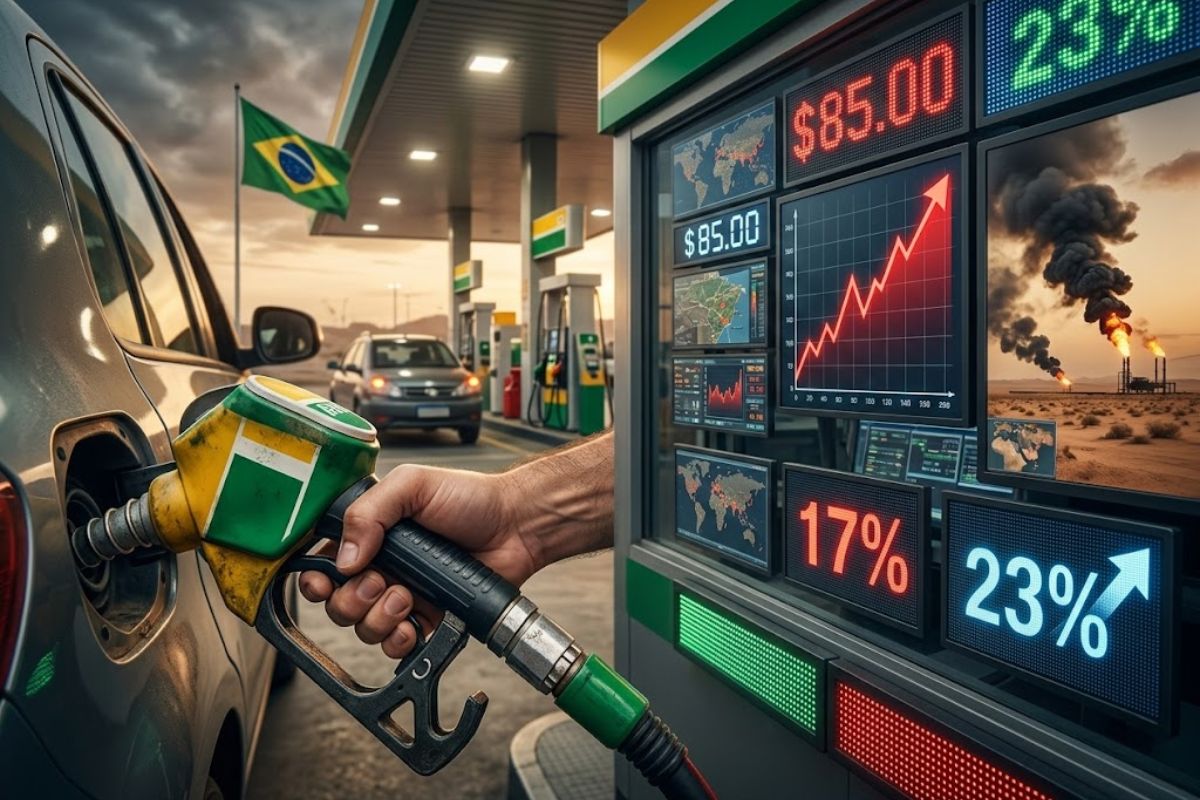
Gasoline Prices React to Brent’s Surge After Attacks in the Middle East, Exposing a Growing Gap at Petrobras’ Refineries in a Brazil That Still Imports a Significant Portion of Diesel and Gasoline and May Feel New Pass-Throughs if Oil Remains Between $75 and $85.
The price of gasoline has returned to the spotlight in Brazil after attacks in the Middle East pushed Brent to around $85. This movement increases pressure on a market already facing lagging Petrobras refineries and relies on imports to balance internal costs.
At the center of this pressure are two numbers that summarize the current imbalance: 17% lagging in gasoline and 23% in diesel at Petrobras refineries. Since Brazil imports about 30% of diesel and 10% of gasoline, any rise in Brent or a new geopolitical aggravation is likely to reach internal costs faster.
How the Middle East Repositioned Brent at the Core of the Equation
The escalation of the conflict between the United States, Israel, and Iran immediately changed the perception of risk in the international oil market.
-
Brazilian city bets on the business environment to generate jobs and attract investments in the energy sector — secretary reveals strategy at Macaé Energy 2026.

-
50 viaducts, 4 tunnels, 28 bridges, and 40 kilometers of bike paths: BR-262 in Espírito Santo will receive 8.6 billion reais for the largest engineering project in the state’s history, inspired by the Immigrant Highway in São Paulo.

-
Brazil produces too much clean energy and doesn’t know what to do with it: over 20% of solar and wind capacity was wasted in 2025 while investors flee and 509 renewable generation projects were abandoned in the last year.

-
Piauí will produce a new fuel that replaces diesel without needing to change anything in the truck’s engine and reduces pollutant gas emissions by half: truck drivers from all over the Northeast are already celebrating the news that will arrive later this decade.

When there are attacks in the region, the almost automatic reaction is the appreciation of the barrel, as operators begin to factor in the likelihood of interruptions, rising logistical costs, and greater instability in global supply. It was this movement that pushed Brent to the range of $75 to $85.
This level is still below a more critical threshold, cited at $100 per barrel, but the problem is not just the absolute number.
What matters is the speed of the increase and the timing of its occurrence. When Brent rises amid an already tense scenario, the impact is no longer just international and starts to exert pressure on domestic structures that were partially settled, as is happening now in Brazil.
This is why the debate over fuels is no longer just a discussion about a distant war. Brent serves as a central reference for importers and for the formation of expectations in the sector.
If tension persists, the trend is that the pressure on gasoline and diesel will continue to renew day after day, even without an immediate physical disruption in supply.
Where Petrobras’ Lag Appears and Why It Is So Troubling
The last adjustment made by Petrobras occurred in January 2026, when prices were reduced. Since then, the international landscape has changed, and the gap between the prices practiced at refineries and the external market has reopened.
Today, this gap is described as 17% for gasoline and 23% for diesel, which puts the state-owned company back at the center of the discussion on adjustments.
This lag matters because Petrobras does not operate in isolation from a globalized market. Even with significant domestic production, Brazil still needs to bring fuel from abroad to meet its demand.
When the refinery holds prices for too long while Brent rises, the costs do not disappear. They merely accumulate. At some point, the imbalance pressures importers, distributors, and the very logic of supply.
The price of gasoline does not rise automatically with every fluctuation in Brent, but the persistence of this disconnect increases the likelihood of correction down the line.
The same reasoning applies to diesel, with an added complication: since its lag is greater, the pressure on the productive sector tends to be even more sensitive. This chain reaction transforms an external increase into a concrete domestic risk.
Why Brazil Feels This Kind of Shock Even While Producing Oil
The idea that Brazil would be shielded by being an oil producer does not hold against the real structure of the fuel market. The country depends on imports to meet about 30% of diesel demand and 10% of gasoline.
This means that a significant part of supply continues to be linked to international sentiment, Brent prices, and exchange rates.
In practice, this makes the country vulnerable to two simultaneous movements. The first is the increase in the barrel itself. The second is the need to align internal prices with the cost of bringing product from abroad.
When these two factors intersect, the room to hold off adjustments becomes slimmer. That is why the pressure on Petrobras’ refineries eventually spreads throughout the entire chain.
Diesel assumes an even more strategic role in this scenario because it underpins freight transport and much of the circulation of goods in the country.
Meanwhile, the price of gasoline directly impacts family budgets and the immediate perception of consumers. Ultimately, gasoline and diesel target different audiences, but converge at the same point: both can accelerate pass-throughs across the entire economy.
What Could Change for Consumers and the Brazilian Economy
If Brent remains pressured and the lag persists, the effect will not be restricted to the pumps. The rising costs of gasoline and diesel are likely to increase expenses related to transport, logistics, and distribution.
This affects everything from daily commuting to the pricing of food, industrial products, and services. Expensive fuel does not just stop at the pump. It spreads throughout the entire chain.
This process also alters important macroeconomic variables. The trade balance, inflation, and even the interest environment can feel the impact when oil and exchange rates simultaneously pressure costs.
In the Brazilian case, the risk does not arise solely from the volume imported, but from the difficulty of managing an internal market that needs to respond to external references without triggering an immediate shock in consumption.
The price of gasoline stands out because it is the most visible thermometer of the crisis for the average consumer, but diesel has an even broader transmission potential. Therefore, the discussion does not revolve solely around a specific adjustment by Petrobras.
It involves the question of how far the country can absorb Brent’s rise without turning tension in the Middle East into direct pressure on inflation, freight, and income.
Between the War Abroad and the Bill Here
At this moment, the scenario is still one of rising pressure, not definitive explosion.
The Brent barrel fluctuates between $75 and $85, below the most critical point, but high enough to amplify the lag at Petrobras’ refineries and reignite expectations of adjustments.
Brazil enters this equation with an objective fragility: part of the demand depends on imported fuel.









Seja o primeiro a reagir!