





 Portuguese
  English
  Spanish
  5 min of reading
  0 comments


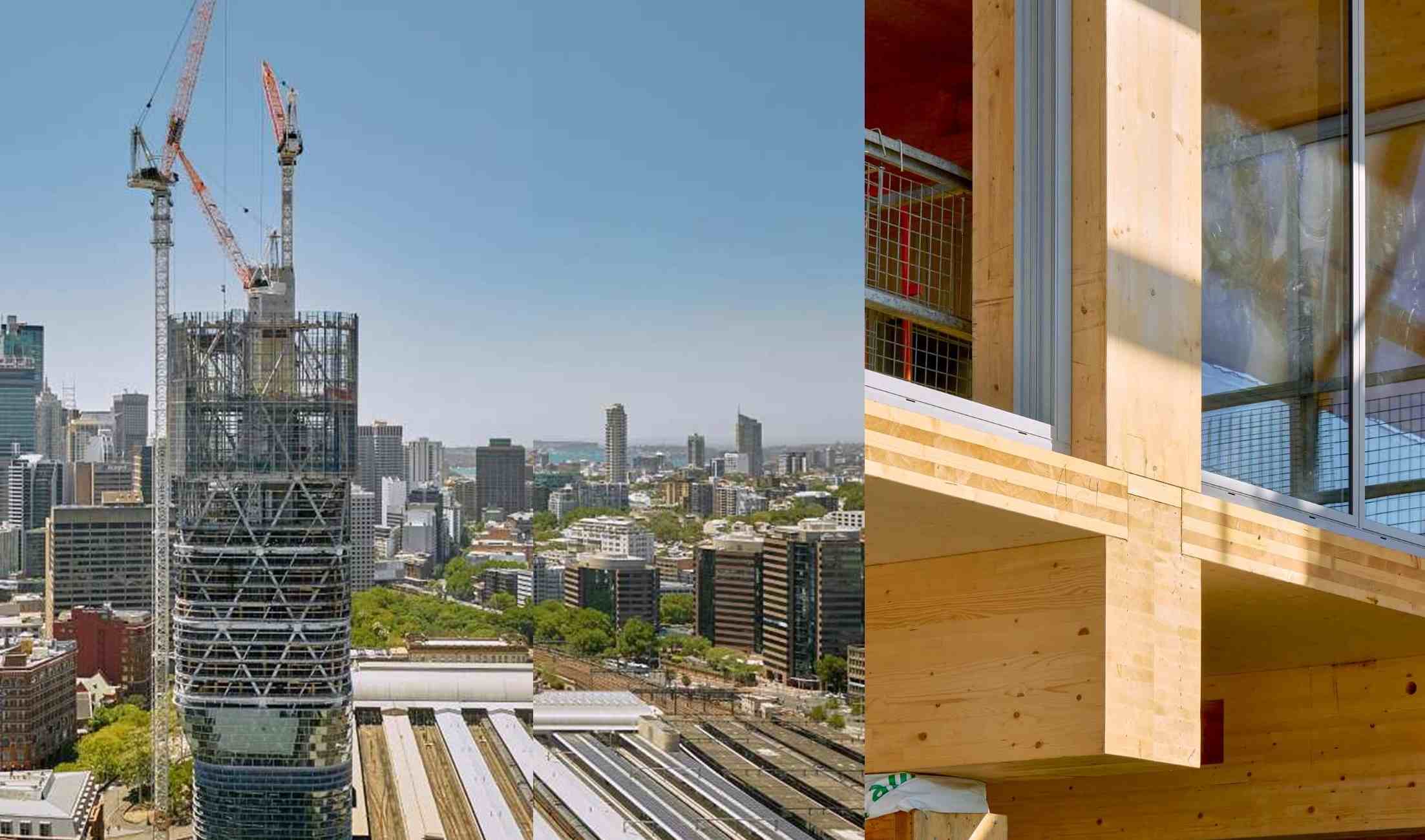
With 183 Meters in Height and 39 Floors in the Center of Sydney, the Timber Building Atlassian Central Utilizes About 10,000 m³ of Structural Timber in a Hybrid System with Steel and Concrete, Incorporating Natural Ventilation, Automated Climatic Facade, and Green Terraces Integrated into the Project
The Atlassian Central project, with 183 meters in height and 39 floors in the center of Sydney, consolidates the tallest timber building in the world by combining structural timber, steel, and concrete in a hybrid tower designed to redefine urban construction models.
The construction of Atlassian Central marks a new milestone in urban engineering by establishing a global record for timber building. Located in downtown Sydney, the building reaches 183 meters in height spread over 39 floors, configuring the tallest skyscraper in the world with a significant use of structural timber.
The project arises at a time of transformation in urban architecture. For over a century, skyscrapers have primarily been built with steel and concrete, but new structural solutions have begun to expand the use of timber in large-scale buildings.
-
Nikola Tesla said that intelligent people tend to have fewer friends, and now science partially confirms this: a study with over 15,000 people showed that for the more intelligent, socializing too much can even reduce life satisfaction.

-
A superyacht worth US$ 17 million is delivered in impeccable condition, sets out to sail, and hits a bridge in the Bahamas just two hours later.

-
Residents of Australia woke up to a sky completely red like blood before the arrival of Cyclone Narelle, which hit the coast with winds of 250 km/h, tearing off roofs and lifting iron dust in a scene they described as apocalyptic.

-
New 100% clean fuel produced in Brazil could retire diesel.


Global Height Record for Timber Building
The Atlassian Central nearly doubles the previous record associated with a large-scale timber building. The Ascent building, located in Milwaukee, United States, has a height of 86.6 meters, while the new tower reaches 183 meters.
The difference highlights the recent advancement in structural timber engineering. The scale jump demonstrates how the development of new materials and construction techniques has allowed for significantly taller buildings with this type of structure.
Hybrid Structure Combines Timber, Steel, and Concrete
The timber building Atlassian Central was designed by the BVN and SHoP Architects firms. The tower is part of a large urban regeneration operation taking place in downtown Sydney.
The structure combines structural timber, steel, and concrete in a hybrid system that allows for great heights while maintaining stability. This combination was adopted to balance structural performance, weight, and construction efficiency.
At the core of the project is the use of glued laminated timber, known as glulam, and cross-laminated timber, referred to as CLT. These materials are formed by the union of layers of solid wood and have structural strength comparable to concrete.
In total, the timber building will use approximately 10,000 cubic meters of structural timber. This is a significant volume for a building of this scale, reflecting the project’s magnitude.
The structural cores and some critical elements still utilize concrete and steel. The office spaces are organized around structural timber modules, a solution that reduces the weight of the structure and speeds up the construction process.
Internal Organization Creates Vertical Habitats with Vegetation
The architectural project organizes the interior of the timber building into seven structural modules of four floors each. These units function as small internal sections that the architects describe as vertical habitats.
Each module has open areas, landscaped terraces, and access to natural ventilation. The proposal is to create within the building conditions similar to natural environments, with ample light, air, and vegetation.
This design follows principles of what is called biophilic design, a growing trend in corporate architecture. The concept aims to bring built environments closer to nature to enhance working conditions inside buildings.
Studies conducted in professional environments indicate that vegetation, natural lighting, and organic materials can reduce stress levels. These factors are also associated with improvements in comfort and productivity of space users.
Climatic Facade Allows for Controlled Natural Ventilation
Another central element of the timber building is its advanced climatic facade. Instead of relying solely on artificial climate control systems, the building utilizes controlled natural ventilation and solar panels.
The system includes automation that regulates temperature and airflow within the tower. This mechanism adjusts the building’s operation according to external weather conditions.
The automation was developed by EBSA, a company specialized in climate control for large commercial buildings. The technology serves as a second skin for the building that reacts to environmental variations.
When external temperatures rise, the system increases shaded areas. In favorable wind and weather conditions, natural ventilation is intensified to reduce the need for mechanical cooling.
Urban Integration Includes Existing Building in the Project
The development of the timber building also includes the preservation of an existing structure on the site. Instead of demolishing the previous building, the project chose to restore it and incorporate it into the complex.
The restored structure will be integrated into the main lobby of the new tower. The reuse of existing buildings reduces demolition waste and avoids emissions associated with the production of new materials.
In the tower’s lower levels, an urban hostel will be installed. The remaining floors will primarily be used as office spaces.
The Atlassian Central was conceived as the headquarters of the technology company Atlassian. However, the building will also house other work areas and public spaces.
Return of Timber to Modern Urban Construction
For centuries, timber was the primary material used in urban constructions. However, urban fires in the 19th century and the advancement of reinforced concrete led to the progressive replacement of this material.
The timber building Atlassian Central represents the return of this resource in a new technological form. Industrialized structural timber exhibits properties such as high strength, dimensional stability, and predictable behavior in fire.
Another relevant factor is the weight-to-strength ratio of these materials. Structural timber provides high strength with less weight compared to concrete or steel.
Additionally, timber stores carbon throughout the lifespan of a building. Each cubic meter can retain approximately one ton of equivalent carbon dioxide, depending on the type and processing of the timber.
Civil Construction and Carbon Emission Reduction
Civil construction is responsible for about 37% of global carbon emissions, according to data from the United Nations Environment Program. A large part of these emissions is associated with the production of cement and steel.
The use of certified structural timber can help reduce this environmental impact. The production of this material requires less energy compared to the manufacturing of steel or cement.
Another factor is the growth of forests used to provide timber. Sustainably managed forests capture carbon during tree growth.
When this timber is used in durable buildings, the carbon remains stored for decades or even centuries. Furthermore, construction with timber allows for greater use of industrial prefabrication.
This process reduces construction waste, material transportation, and construction time. In the case of Atlassian Central, the structural timber used in the timber building comes from sustainably managed forests in Europe.






-

-

-

-

13 pessoas reagiram a isso.