





 Portuguese
  English
  Spanish
  5 min of reading
  0 comments


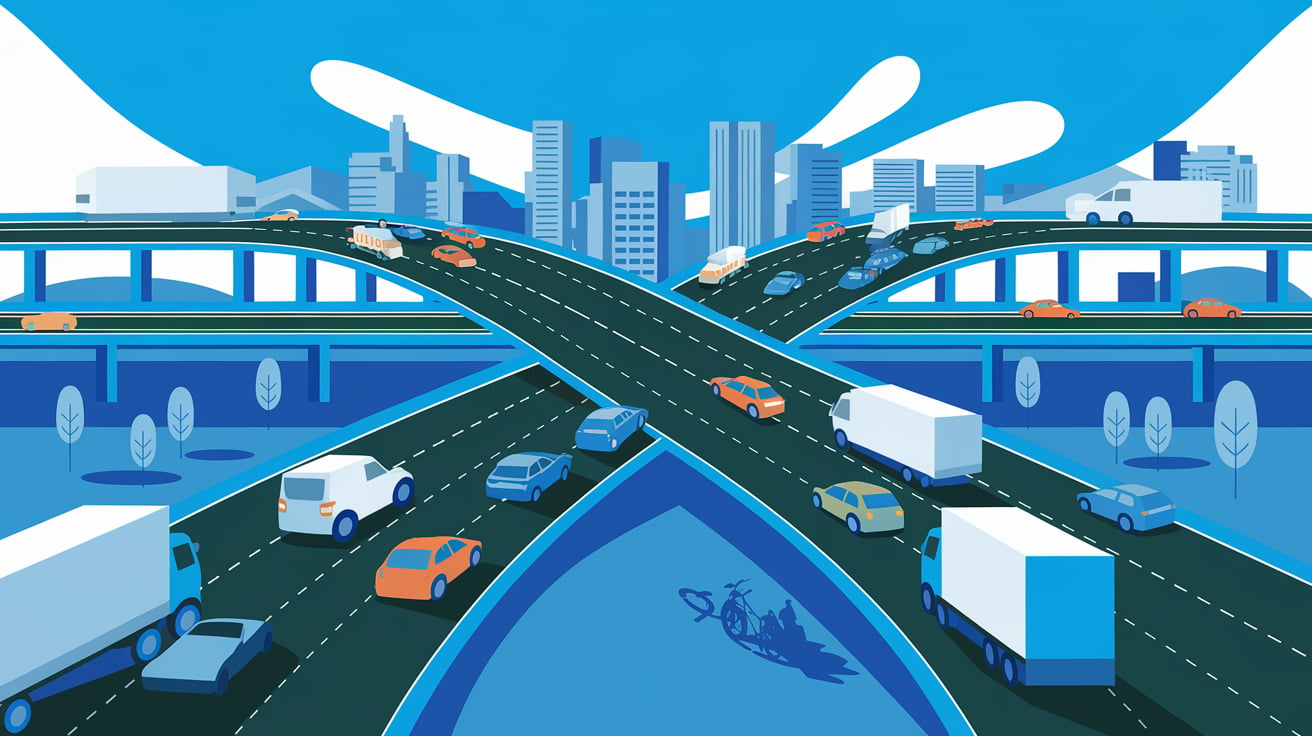
City Launches Innovative Project for BR-101, Proposing the Implementation of the DDI, Intersection System That Promises to Reduce Congestions and Transform Urban Mobility.
In a bold move that promises to change the traffic dynamics on one of the busiest highways in Brazil, the City Hall of Itajaí has just presented a revolutionary project for the BR-101 interchange.
This proposal not only aims to improve traffic flow but also serves as a turning point for urban mobility in the country.
The plan is to implement the Diverging Diamond Interchange (DDI), an innovative solution that has already achieved success in other parts of the world but has never been applied on Brazilian soil.
-
Brazilian city bets on the business environment to generate jobs and attract investments in the energy sector — secretary reveals strategy at Macaé Energy 2026.

-
50 viaducts, 4 tunnels, 28 bridges, and 40 kilometers of bike paths: BR-262 in Espírito Santo will receive 8.6 billion reais for the largest engineering project in the state’s history, inspired by the Immigrant Highway in São Paulo.

-
Brazil produces too much clean energy and doesn’t know what to do with it: over 20% of solar and wind capacity was wasted in 2025 while investors flee and 509 renewable generation projects were abandoned in the last year.

-
Piauí will produce a new fuel that replaces diesel without needing to change anything in the truck’s engine and reduces pollutant gas emissions by half: truck drivers from all over the Northeast are already celebrating the news that will arrive later this decade.

What lies behind this solution, and how can it change the lives of thousands of drivers and residents?
The Impact of the New Project for BR-101
On the last Friday, December 27, 2024, the Itajaí Traffic Coordination (Codetran) submitted the project to the concessionaire Arteris, responsible for managing BR-101.
The proposal foresees the implementation of the DDI at the interchange that connects the highway to Avenida Dr. Reinaldo Schmithausen and Rodovia Jorge Lacerda.
The project comes after nearly two years of intense negotiations involving a number of agencies and entities, such as the National Department of Transport Infrastructure (DNIT), the Federal Highway Police (PRF), and the National Agency of Land Transport (ANTT).
The goal is to transform this critical point, often saturated with vehicles, into a reference for road safety and traffic efficiency.
What Is the Diverging Diamond Interchange (DDI)?
The DDI, or Diverging Diamond Interchange, is an advanced traffic intersection model that alters the traditional design of crossings.
Its main feature is the change in vehicle flow, especially at curve points, which eliminates direct conflicts and reduces the number of accidents.
The main innovation of this model lies in the reconfiguration of traffic lanes, which causes drivers to cross the intersection on the left instead of following the right side, as is traditionally done.
The DDI is designed to increase safety and traffic flow, especially in areas with very high vehicle volumes, as occurs at the BR-101 interchange.
Furthermore, the model has the ability to reduce congestions and, consequently, optimize drivers’ travel times.
Studies conducted by Codetran indicate that the average waiting time at the interchange, which currently reaches an impressive 30 minutes, will be reduced to a mere 3 minutes, thanks to the implementation of this innovative system.
Impressive Results with the Implementation of the DDI
Codetran led a series of technical analyses and traffic simulations to ensure the effectiveness and safety of the DDI.
The result of these simulations confirmed that the DDI is the most efficient solution for reducing the existing bottlenecks at the site and increasing traffic flow.
The drastic reduction in waiting time – from 30 minutes to just 3 – represents a significant improvement not only for drivers but also for the quality of life of the local population, which suffers from daily congestion.
Moreover, the implementation of the DDI comes with reduced costs compared to other road solutions.
Its structure, although modern and effective, offers a more sustainable and economically viable alternative, allowing the municipality to optimize its resources without compromising the quality of the infrastructure.
The traffic coordinator of Itajaí, Michel Vieira Duarte, emphasized that this change “is a turning point for urban mobility in Itajaí and reaffirms our position as a reference in efficient and innovative traffic solutions in the municipality.”
The Future of the Project: Analysis and Approval
With the protocol formalized with Arteris, the project now proceeds for analysis and approval by the responsible agencies.
The expectation is that construction will begin soon, transforming the BR-101 interchange into an example of efficiency and road safety.
In addition to the direct benefits for traffic, the DDI will bring a positive impact on the economic development of the region, improving logistics and connectivity between different parts of Itajaí and other cities.
The implementation of this project also consolidates Itajaí’s role as a city at the forefront of urban mobility solutions.
The city does not only solve a critical congestion problem but also positions itself as a reference for other municipalities in the country facing similar challenges.
Impacts on Mobility and Quality of Life
The implementation of the DDI at the BR-101 interchange brings benefits not only for drivers but also for the general population.
The project has the potential to transform urban mobility, making traffic more efficient, fast, and safe.
In addition, by reducing waiting time at the interchange and decreasing the number of accidents, an improvement in the quality of life for residents is expected, with less stress in daily routines and less time wasted in congestions.
The local community is also closely following the development of the project with great anticipation.
Residents and drivers, who face the chaotic traffic of the interchange daily, are eagerly awaiting a solution that transforms the reality of traffic in the region.
The impact will be significant for those who rely on the highway for their daily activities, whether for work, study, or any other task.
A Model for Brazil
The initiative of the Itajaí City Hall, by presenting the DDI project for the BR-101 interchange, places the municipality in a leading position in the search for efficient and innovative solutions to urban problems.
If the project is successful, it will serve as a model for other Brazilian cities facing congestions and similar challenges in urban mobility.
By implementing the DDI, Itajaí not only improves local infrastructure but also reinforces its commitment to economic development and improving the quality of life for its residents.
The city positions itself as a reference for the application of new technologies in traffic and promises, with that, a more efficient and safe future for all.
Do you believe that the DDI in Itajaí will be a viable solution for other Brazilian cities facing traffic problems? Leave your opinion in the comments!






-

-

6 pessoas reagiram a isso.