





 Portuguese
  English
  Spanish
  7 min of reading
  1 comment


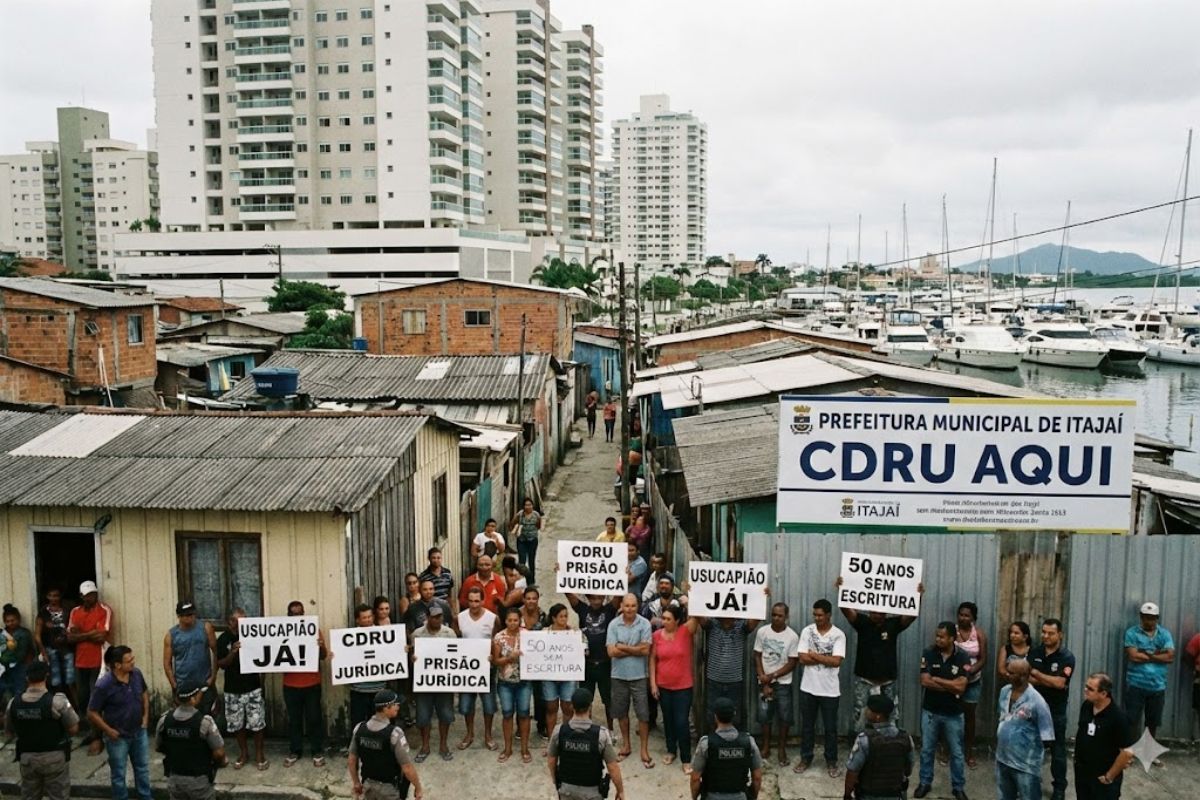


After The Justice Denied 57 Usucapião Actions In Public Area Declared Necessary In 1999, Itajaí City Hall Promises Reurb And CDRU In Nova Divinéia, But Residents Report Loss Of Title, Succession Insecurity, And Feeling Of Legal Prison In The Middle Of A Luxury Neighborhood Surrounded By Expensive Developments And Constant Real Estate Pressure.
In December 2025, the Public Treasury Court of Itajaí rejected all 57 usucapião actions filed by residents of Nova Divinéia, an area occupied since the 1970s in Praia Brava, and upheld the argument of the Municipal Attorney General that the land is public property that was amicably expropriated in 1999, and therefore legally unavailable for acquisition through usucapião. Following this decision, the City Hall began to argue that the only possible avenue for regularization is the concession of use, through Reurb and CDRU, without the transfer of full ownership.
At the same time, the Municipality issued a statement on December 12, 2025, denying any immediate collective eviction in Nova Divinéia and claiming that the goal is to reorganize the area based on Reurb S, aimed at low-income families, and Reurb E, for mixed-profile occupations. In practice, however, residents claim they have been living without title for over 50 years, now with usucapião blocked and facing a 50-year concession that they describe as “eternal legal prison” in one of Itajaí’s most valued neighborhoods.
Understand The Decision That Dismantled Usucapião In Nova Divinéia
The sentence from the Public Treasury Court consolidated dozens of individual usucapião cases related to the same property, all concerning the area known as Nova Divinéia in Praia Brava.
-
The Senate approves a bill that criminalizes misogyny, hatred, or aversion towards women, and includes the crime in the Racism Law with a penalty of up to 5 years.

-
Chamber Approves Bill That Allows Pepper Spray for Women Over 16 and Imposes Strict Rules for Purchase, Possession, and Use as Self-Defense

-
Chamber Approves Law to Combat Leucaena, Fast-Growing Plant That Dominates Land and Threatens Native Species in Various Regions of the Country

-
Asset Division: Know What Cannot Be Divided in Case of Divorce


The judge acknowledged that the land was amicably expropriated in 1999, passing into the direct ownership of the Municipality, and that, from that act on, any claim of usucapião over public property becomes legally impossible.
Based on the arguments of the Municipal Attorney General, the judiciary validated the thesis that the historical occupation, while significant from a social standpoint, cannot generate full property rights when it comes to public property.
The Attorney General argues that the Municipality has a legal obligation to preserve this asset as part of urban planning and to prevent precedents that would allow the privatization of public areas via usucapião.
In practice, the decision ends the main judicial route chosen by residents to try to regularize possession through usucapião.
Without this tool, families that have already completed the temporal requirement of more than 20 years of continuous residence see their expectation of converting old possession into definitive title diminished.
What Is The CDRU Offered By The City Hall Instead Of Title
In light of the impossibility of usucapião, Itajaí City Hall began to advocate the concession of a real right of use, known as CDRU, an instrument provided for in legislation to allow the use of land without the transfer of full ownership.
In the official proposal, Nova Divinéia would be regularized through Reurb with CDRU titles, with terms that can extend up to 50 years.
The CDRU is presented by the Municipality as a mechanism to provide legal security to families, ensuring formal permanence in the area, but without delivering a title that allows selling, mortgaging, or transferring the property with the same freedom as a private owner.
For the municipal administration, this model balances the social interest of the residents with the need to maintain public control over a strategically important area from an urban perspective.
For the residents, however, the design means continuing without ownership.
Community leaders from Nova Divinéia report that, with the CDRU, they will remain unable to negotiate the property in the market, use the house as collateral for credit, or plan succession fully for their children and grandchildren.
From the community’s perspective, the CDRU for 50 years institutionalizes a limbo: the public power controls the land but transfers to the population the social risk of living without title in an increasingly pressured neighborhood from high-standard developments.
The Official Version Of The City Hall: Reurb, Legal Security, And Public Good
In a statement, Itajaí City Hall insists that there is no collective eviction order in progress in Nova Divinéia and that any forced removal is ruled out in the short term.
The Municipality asserts that what exists is a process of land reordering based on Reurb S, aimed at low-income families, and Reurb E, directed towards areas with mixed occupation.
The Municipal Attorney General emphasizes that the occupation, although historical, does not generate ownership rights because it occurs on public property.
In the administration’s interpretation, allowing usucapião on land expropriated in 1999 would set a precedent for public properties in other regions of Itajaí to be claimed by individuals in the future, compromising urban planning.
The municipal executive further defends that the Reurb with CDRU offers more legal security than the current situation, in which many families have no formal document besides old registrations and administrative terms.
City Hall acknowledges that the process is underway and does not provide a detailed timeline, claiming that technical and legal steps are still under construction.
The Outrage Of The Residents: “Eternal Legal Prison” Without Usucapião And Without Title
In Nova Divinéia, the discourse is different.
Residents claim to have lived there since the 1970s, during a time when Praia Brava had not yet consolidated as a luxury neighborhood.
According to reports, in 1999 the City Hall itself settled families and signed terms of occupation, with a political promise of future title that has not materialized.
Valmir Cardoso, president of the Nova Divinéia Residents Association, summarizes the dissatisfaction with the CDRU proposal.
He states that with the offered model, the community remains “prisoners” of the public power, without the right to sell, rent, or secure the property for their children.
For him, the only acceptable regularization is the land legitimation with the delivery of a definitive title of ownership, in line with what residents believe was promised at the end of the 1990s.
The prevailing sentiment among families is one of frustration.
After more than 50 years of residence, the denial of usucapião and the offer of a temporary concession are understood as a kind of “eternal legal prison” in the middle of Praia Brava, now surrounded by high-standard condominiums, hotels, and expensive developments.
The residents promise to appeal the court decision and intensify political pressure on the municipal executive.
The Right To The City, Land Regularization, And The Dispute For A Luxury Neighborhood
The conflict in Nova Divinéia exposes a classic clash between old popular occupations and the accelerated valuation of coastal areas.
The Praia Brava neighborhood has consolidated as one of the most expensive regions in Itajaí and the area while Nova Divinéia remains as an enclave of low-income without title, pressured by new real estate projects and the high-income logic of the surrounding area.
The Reurb, defended by the City Hall as a technical path, is viewed by urban policy experts as an instrument that can both guarantee permanence and, if poorly designed, open space for future removals.
In the case of Nova Divinéia, the combination of blocking usucapião, long-term CDRU, and absence of a detailed regularization timeline fuels distrust that the community will continue in a vulnerable position in relation to the market and the public power.
For the residents, the right to the city involves having title and full ownership in a place where they have already lived for decades.
For the Municipality, the focus is to preserve the public nature of the land and to prevent that, in the name of usucapião, the public asset is definitively privatized.
Between these two poles, the discussion remains open about which model of land regularization is most compatible with social justice, legal security, and urban planning in a luxury neighborhood.
Next Steps: Appeal, Reurb, And The Future Of Nova Divinéia
The Nova Divinéia Residents Association has already announced that it will appeal the sentence that denied the 57 actions of usucapião, trying to reopen the discussion about the possibility of recognizing ownership based on long possession, in accordance with the terms of settlement from 1999 and the consolidated nature of the community.
In the meantime, City Hall maintains the discourse that the Reurb process will continue to proceed, with CDRU as the central focus of the proposal.
There is currently no public calendar for the delivery of concession terms, definition of exact deadlines, or detailed clarification of which succession and transfer rights will be guaranteed to the beneficiaries.
The information vacuum fuels the fear that, even with partial regularization, residents continue in a vulnerable position in an increasingly aggressive real estate market in Praia Brava.
In a scenario where usucapião is blocked by the public nature of the land, CDRU limits ownership and the Reurb timeline remains undefined, the central doubt remains unanswered: in your view, is the concession of use for 50 years a real advancement for Nova Divinéia or just indefinitely postpones full regularization through usucapião and definitive title for these families?










Tem que desocupar a área, limpar e indenizar a cidade pela invasão.