





 English
  Francês
  Alemão
  Italiano
  Japonês
  Norueguês
  Portuguese
  Spanish
  2 min of reading


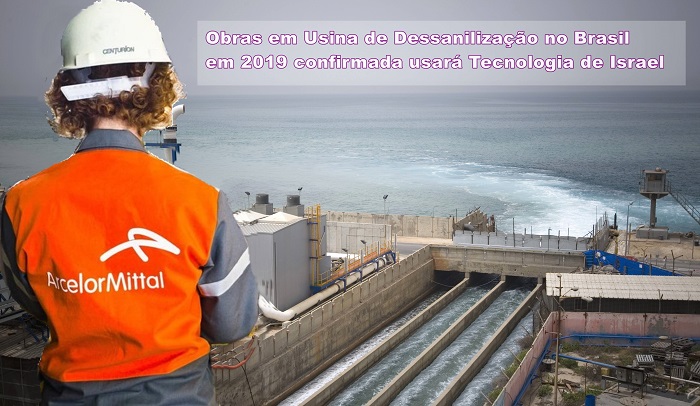
ArcelorMittal Will Use Desalination Technology Used in Israel for Water Supply to Its Steel Mill in Espírito Santo, Signaling Jobs and Construction.
ArcelorMittal SA (MT.AS), the world’s largest steelmaker, is set to build its first desalination unit in Brazil to meet unexpected water needs at its factory in eastern Espírito Santo, senior executives said in an interview on Friday. The unit aims to reduce the company’s dependency on the state water supply company Cesan and avoid production cuts during water crises, such as the state experienced in 2015 and 2016, said Jorge Ribeiro, president of ArcelorMittal’s Flat Steel Division in Brazil.
Although the plant will be ArcelorMittal’s first, desalination facilities have already become common in several rival steel mills and mining operations, which tend to be water-intensive.
-
Government unlocks R$ 554 million for a highway that has been requested for decades and accelerates the duplication of BR.
-
Without bricks, without cement, and without endless construction: the cardboard house that is assembled in modules and can be moved.

-
Billions of barrels on the equatorial margin could lead Amapá to double its oil production in Brazil — the state aims to enter the route of companies in the Campos Basin, attract investments, and boost jobs and businesses in the oil and gas sector.
-
Without bricks, without cement, and without endless construction: the cardboard house that is assembled in modules and can be moved.

The planned investment is around 50 million reais (US $ 13.32 million) and the project is expected to start operating in two years, he said.
In an initial module, the plant will be able to desalinate 500 cubic meters (132,100 gallons) of seawater per hour.
“It’s a modular process, more modules can be added in the future”, Ribeiro said.
The CEO of ArcelorMittal Brazil, Benjamin Baptista Filho, noted that during the 2015 water crisis in Espírito Santo, the company received a directive from the state government to reduce Cesan consumption by 30%.
“What we are doing is safe, because if there is another rationing event, we can respond… If there is another rationing, without desalination, we would have to halt part of production,” Filho stated.
According to Filho, the desalination plant will be the first in Brazil to operate exclusively with seawater. The plant will use reverse osmosis technology and will consume electricity produced by the steel mill itself.









Seja o primeiro a reagir!