





 Portuguese
  English
  Spanish
  5 min of reading
  0 comments


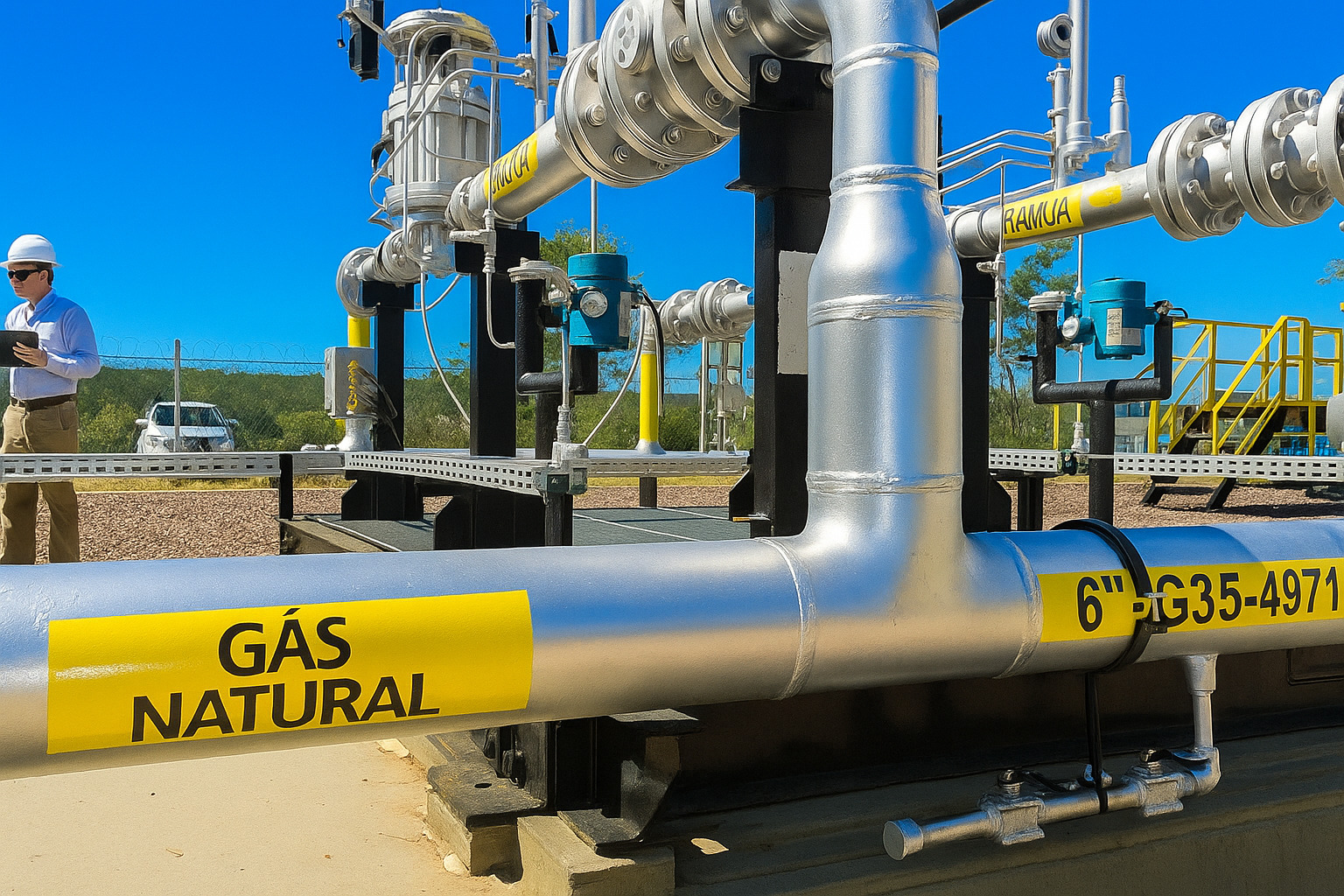
Brazil Returned 51.4% of Natural Gas to the Subsurface in July, Reinforcing Production and Energy Management Strategies Amid Challenges and Opportunities.
The Brazil has established itself as one of the largest oil and gas producers in the world. Therefore, understanding its numbers helps to see how the country organizes its energy matrix.
Among these numbers, one data point stands out: the reinjection of natural gas. In July, the country returned 51.4% of natural gas to the subsurface, which represents an essential practice to maintain reservoir pressure and ensure the continuity of oil production.
According to the National Agency of Petroleum, Natural Gas, and Biofuels (ANP), total production in July reached 188.9 million cubic meters per day. Out of this volume, 97.052 million were reinjected into the reservoirs.
-
Petrobras evaluates suspension of sales to distributors and considers canceling the cooking gas auction following guidelines from the Federal Government.
-
Lula reveals a masterstroke by Petrobras to undo a deal made by Bolsonaro, which involves the return of an important refinery that currently produces less than half of what was expected and makes Brazil dependent on international diesel.
-
A study confirms that the natural gas sector will reduce greenhouse gas emissions in Brazil by 0.5% and accelerate the energy transition by 2026.

-
Petrobras implements a severe adjustment and confirms a 55% increase in the price of aviation kerosene with a proposal for installment payments for the companies.


Thus, the process avoided losses, replaced the burning known as flaring, and ensured efficiency in the extraction cycle.
Additionally, this practice gained strength mainly from 2015 onwards, especially in fields located offshore, such as in the Campos Basin and the Santos Basin. In these areas, gas compression maintains natural pressure and prolongs the fields’ lifespan.
Therefore, reinjection serves a dual purpose: it ensures the continuous flow of oil and, at the same time, reduces environmental impacts.
The Evolution of the Reinjection Practice
Historically, the priority of the Brazilian industry has been on oil. However, over the decades, it became clear that natural gas could no longer remain in the background.
Since most of the gas in Brazil is of the associated type, that is, it appears alongside oil during extraction, operators have always had to make difficult decisions.
In this context, about 85% of the natural gas produced in the country needs to be directed to two possibilities: commercialization or reinjection.
Thus, each decision directly affects the economic viability of oil extraction.
Therefore, by returning natural gas to the subsurface in July, Brazil demonstrated not only technique but also a strategic energy management approach.
Besides the technical aspect, reinjection carries an economic weight. After all, when gas does not find sufficient infrastructure to reach the market, it needs to be reinjected.
Consequently, the country gives up part of its internal consumption potential.
Regulations and Recent Changes
The dynamics of the sector began to change in August 2024, when President Luiz Inácio Lula da Silva signed Decree No. 12.153.
Through it, the ANP gained authority to review reinjection plans even in fields in operation.
Thus, the agency started to control not only new projects but also ongoing ventures, even if contracts were still in force.
This change sought to reduce reinjection and increase the supply of gas in the domestic market.
As explained by the Minister of Mines and Energy, Alexandre Silveira, the objective is to promote a “gas supply shock”.
In this regard, the government also seeks to increase private sector access to transportation and processing networks, which had for many years remained under almost exclusive Petrobras control.
Therefore, the new regulatory scenario opens up space for more competition.
This way, it is expected to reduce prices, diversify suppliers, and expand the use of gas in strategic sectors.
As such, the resource may gain prominence not only as support for oil production but also as an essential fuel for industrial development.
Impacts on the Domestic Market and Industry
When Brazil returned more than half of the natural gas to the subsurface in July, a historic dilemma became evident.
On one hand, the practice maintains the efficiency of oil production.
On the other hand, it limits the availability of the input for the national economy.
Thus, the discussion surrounding reinjection involves much more than just numbers: it reflects decisions regarding the energy model that the country intends to adopt.
In the domestic market, logistical bottlenecks still hinder the distribution of gas.
Currently, most of the transport and offloading infrastructure is concentrated in specific regions, especially in the Southeast.
As a result, other areas of the country face access restrictions and difficulties in expanding their consumption.
However, with the entry of new operators and the opening of the network, these barriers tend to decrease.
Consequently, the industry sees natural gas as an opportunity to reduce energy costs and gain international competitiveness.
In addition to ensuring energy at more affordable prices, the input also helps modernize production processes and reduce carbon emissions.
Thus, companies can align their activities with global sustainability goals while simultaneously improving their economic performance.
The Role of Gas in the Energy Transition
When discussing the future of the energy matrix, it is inevitable to relate the topic to sustainability.
Thus, natural gas emerges as an intermediate alternative.
Although it remains a fossil fuel, it emits fewer pollutants than coal and heavy oil.
In this manner, it acts as a bridge between the present based on fossils and a future with more clean sources.
By returning natural gas to the subsurface in July, Brazil maintained its oil production at a steady pace.
However, at the same time, it reignited debates over the best way to take advantage of this resource.
Alongside the advancement of solar and wind energy, gas positions itself as a complementary source.
It ensures stability during moments of lower renewable generation, functioning as a pillar of energy security.
Therefore, reinjection should not be seen merely as a technical measure.
On the contrary, it is part of a set of choices that determine the balance between oil exploration, natural gas expansion, and encouragement of renewable sources.
Thus, thinking about long-term strategies involves considering how these three elements can integrate harmoniously.
The fact that 51.4% of natural gas was returned to the subsurface in July reveals how Brazil handles complex energy challenges.
While ensuring efficiency in oil extraction, the country still needs to expand its capacity to bring gas to the domestic market.
With the adoption of new rules, greater participation from the private sector, and constant investments in infrastructure, it becomes possible to balance reinjection and consumption.
Thus, Brazil can transform a challenge into an opportunity.
As a result, natural gas will have the conditions to establish itself as a strategic ally of the industry, economic competitiveness, and energy transition.
Therefore, the future of Brazilian energy policy will depend not only on oil exploration but also on the ability to fully leverage natural gas.
In this way, while preserving its fields, the country can boost industrial growth and strengthen its role on the global stage.










Seja o primeiro a reagir!