





 Portuguese
  English
  Spanish
  5 min of reading
  1 comment


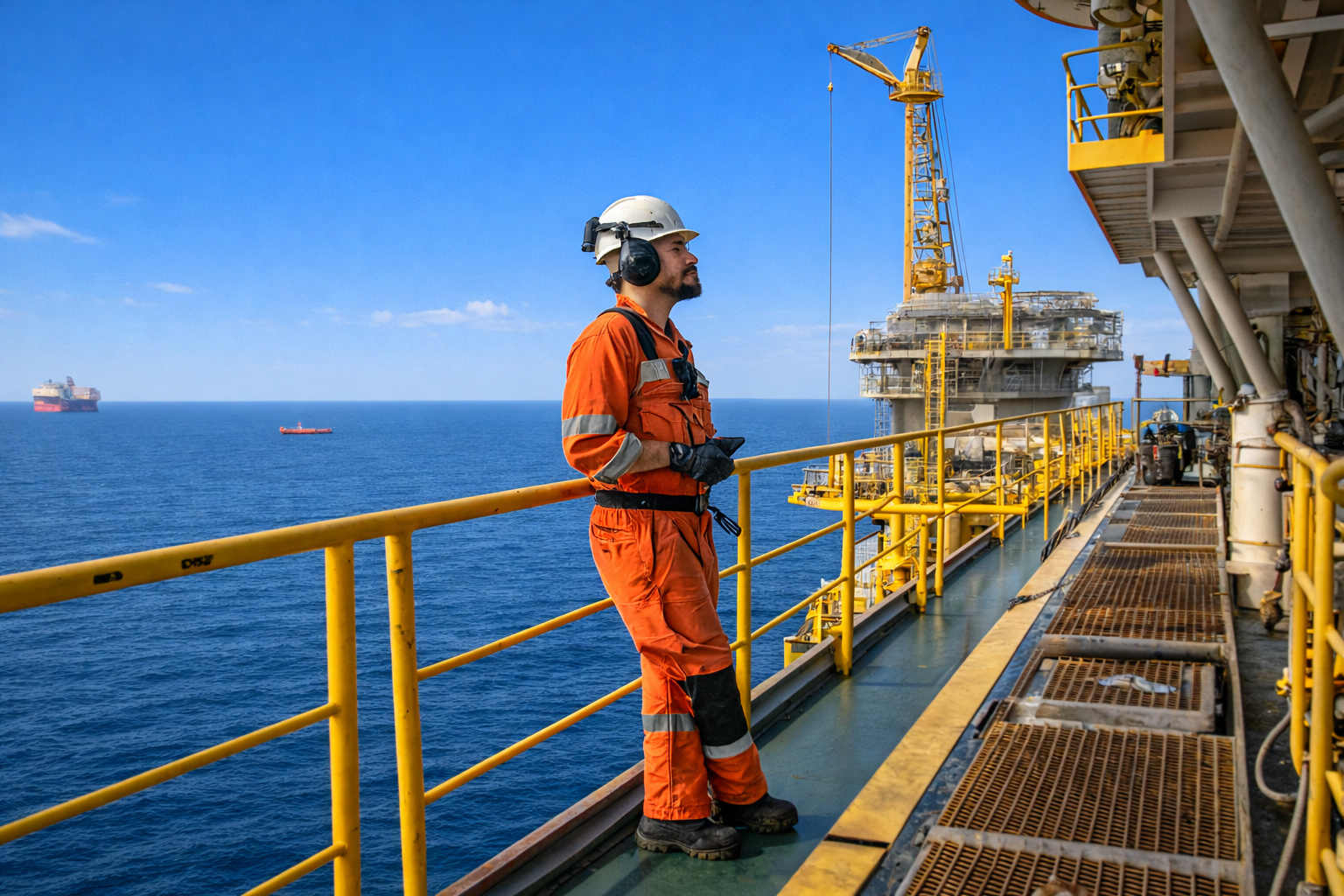


Oil Platform Offers Differentiated Schedule, Variable Pay, and Intensive Routine at Sea
Working on an oil platform can guarantee up to six months of time off per year, depending on the schedule adopted by the company, in addition to pay above the national average in various technical and operational roles.
The offshore routine draws attention mainly due to the work model. Many professionals work a 14×14 schedule, meaning they work 14 days on board and have 14 days off on land. Others follow a 28×28 schedule. In practice, this format can result in approximately half the year away from the maritime unit.
This difference sparks curiosity about salaries, requirements, and the real conditions of the profession. However, the pay varies according to position, experience, certifications, and type of contract.
-
Friends have been building a small “town” for 30 years to grow old together, with compact houses, a common area, nature surrounding it, and a collective life project designed for friendship, coexistence, and simplicity.

-
This small town in Germany created its own currency 24 years ago, today it circulates millions per year, is accepted in over 300 stores, and the German government allowed all of this to happen under one condition.

-
Curitiba is shrinking and is expected to lose 97,000 residents by 2050, while inland cities in Paraná such as Sarandi, Araucária, and Toledo are experiencing accelerated growth that is changing the entire state’s map.

-
Tourists were poisoned on Everest in a million-dollar fraud scheme involving helicopters that diverted over $19 million and shocked international authorities.


How The Routine Works on an Oil Platform
The worker usually embarks by helicopter or support vessel. Before that, they need to complete mandatory safety courses, such as survival training at sea and firefighting.
Upon arriving at the oil platform, they take on 12-hour daily shifts, either day or night. Production runs 24 hours a day, so teams rotate continuously.
During the time on board, the company provides meals, accommodation, laundry, and social areas. The professional remains on the unit until the end of the schedule, without returning home during this interval.
This model requires discipline, physical endurance, and adaptation to the confined environment. At the same time, it eliminates daily commuting and reduces personal expenses during the embarkation.
How Much Does Someone Working on an Oil Platform Really Earn
The offshore pay does not follow a fixed amount. The salary depends on the role performed, technical level, and accumulated experience.
Entry-level professionals, such as helpers and junior technicians, can earn between R$ 4,000 and R$ 8,000 per month, depending on the company and hiring arrangements.
Experienced technicians, production operators, instrumentation specialists, and skilled welders often reach higher pay ranges, which can exceed R$ 10,000 with bonuses.
Supervisory, coordination, and strategic operational roles offer higher salaries. Offshore engineers, especially in drilling, production, and operational safety, can earn over R$ 20,000, depending on their career length and the complexity of the unit.
In addition to the base salary, companies pay hazard pay, overtime, night shifts, and, in some cases, performance bonuses. Benefits such as health insurance and private pension also make up the package.
Therefore, there is no fixed salary for those working on an oil platform. Specialized technical roles and leadership positions concentrate the highest earnings.
What Professionals Work On Board
An oil platform brings together dozens of different roles. Technicians in mechanics, electricity, and instrumentation perform equipment maintenance. Operators control production systems and monitor pressure, flow, and temperature.
Engineers supervise processes and coordinate teams. Additionally, doctors, nurses, cooks, and hospitality professionals provide daily support to the crew.
Each role requires specific training. Technicians must complete recognized vocational courses. Engineers must have a degree and registration with their professional council.
Without offshore safety certification, the professional cannot embark.
14×14 or 28×28 Schedule: Why Time Off Can Reach Six Months
The schedule represents the main attraction of the career. In the 14×14 regime, the worker spends half the month on board and half at home. In the 28×28 regime, the proportion remains the same.
Over 12 months, this format can result in about six months of rest on land. However, the time on board requires total dedication.
During days on the platform, the professional maintains an intense work schedule and follows strict protocols. They remain available throughout the shift, with no possibility of returning home before the end of the schedule.
Thus, the long break compensates for the intensity of the offshore period.
Physical and Psychological Requirements for Working on an Oil Platform
Working on an oil platform demands physical fitness and emotional stability. The industrial environment involves heavy machinery, constant noise, and strict technical procedures.
Moreover, confinement can impact the psychology of those who do not adapt to the on-board routine. The professional must coexist with colleagues for weeks and maintain focus on tasks.
For this reason, companies conduct periodic medical examinations and assessments of physical fitness.
Recruitment specialists in the sector state that the ideal profile combines discipline, responsibility, and the ability to work under pressure.

How to Enter the Offshore Career
The first step is to obtain technical or higher education relevant to the desired role. Courses in mechanics, electricity, automation, welding, occupational safety, and engineering are in high demand.
After training, the candidate must complete mandatory offshore safety courses, such as basic training for boarding.
With certification in hand, they can apply for positions with oil operators or service companies.
Previous experience in an industrial environment increases hiring chances. Knowledge of English can also enhance opportunities, especially in multinational companies.
The Market Follows Investments in Pre-Salt
The job market on oil platforms keeps pace with investment trends in exploration and production.
In recent years, the expansion of pre-salt fields has increased the demand for specialized professionals. When companies expand operations, new offshore opportunities arise.
However, the sector also depends on the international scenario. Fluctuations in oil prices influence investment and hiring decisions.
Nevertheless, offshore production remains strategic for Brazil, especially in deep waters.
Is It Worth Working on an Oil Platform?
The offshore career combines competitive pay, differentiated schedules, and potential for technical growth. At the same time, it requires constant qualification and adaptation to the on-board routine.
For those seeking above-average earnings and willing to spend weeks away from home, the profession can represent a solid opportunity.
Before entering the field, the interested party should assess their profile, invest in suitable training, and understand the requirements of the offshore environment.
Working on an oil platform does not mean just taking six months off per year. It means taking on responsibility in one of the most strategic activities of the Brazilian economy.









Rapadura é doce, mas não é mole!