





 Portuguese
  English
  Spanish
 4 min of reading
  10 comments


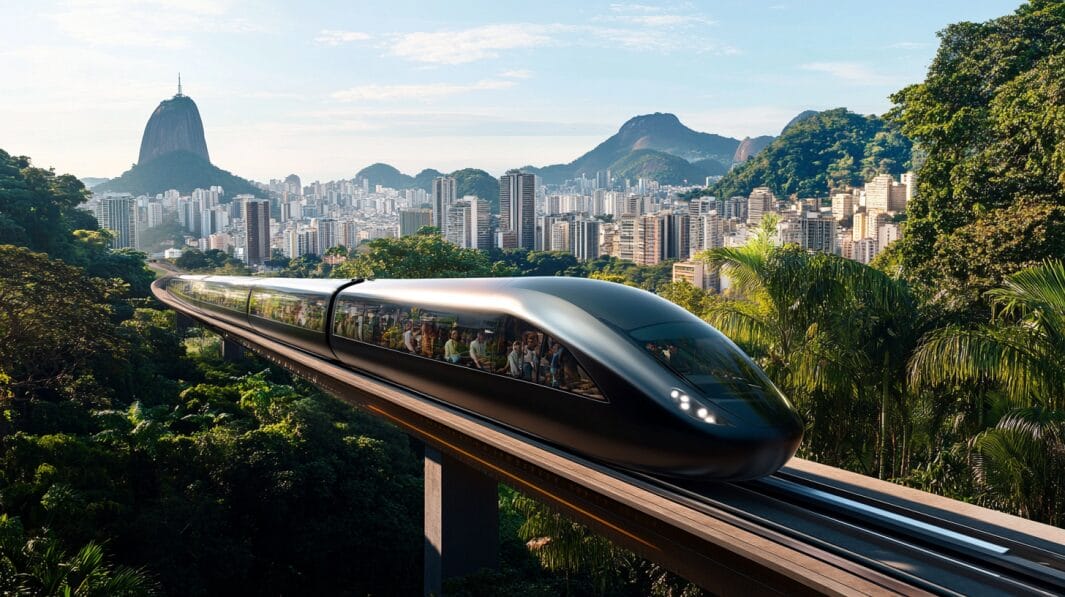

High-Speed Rail Project Rio-São Paulo Revives With Expected Start of Construction in 2027. But Is Brazil Ready for This Transportation Revolution?
With a promise that seems distant, the long-awaited high-speed rail between Rio and São Paulo gets a new chance to come to life! But will this project really take off this time? Millions of Brazilians are eager for this transportation revolution, but the road to its implementation is far from simple.
The project, which started over 35 years ago, still has to face a number of challenges. The good news is that a new push came with the authorization granted in February 2023. But will it be enough to turn this idea into reality?
According to the National Land Transport Agency (ANTT), the plan to create a high-speed rail system between Brazil’s two largest metropolitan areas, Rio de Janeiro and São Paulo, is finally closer to becoming reality.
-
The government requests the Federal Revenue Service for a new system to automate the income tax declaration, reducing errors, time, and bureaucracy for millions of Brazilians.

-
Pix in installments, international Pix, and contactless payment without internet: the Central Bank revealed the new features coming to the tool that is already used by almost every adult in Brazil.

-
Mercado Livre has just started selling medications with delivery in up to three hours to your door, and this move could completely change the way Brazilians buy medicines on a daily basis.

-
In Dubai, rising tensions from the war in the Middle East are causing super-rich individuals to leave the Gulf and direct their fortunes to a new financial refuge in Asia.

With a projection for private investment and the responsibility handed over to TAV Brasil, the high-speed rail schedule is already underway.
The expectation is that the project will benefit 30 million people annually, providing a travel time of just an hour and a half between the two cities.
Billion-Dollar Investment and Optimistic Schedule
The high-speed rail project, discussed since 2009, has always faced problems, mainly related to financing.
Now, TAV Brasil has taken on the challenge and is already attracting investors to raise R$ 30 billion needed for the construction.
According to Bernardo Figueiredo, former general director of ANTT and current CEO of TAV Brasil, the current schedule anticipates that construction will begin in 2027, and the train will be operational by 2032. This date may seem far away, but legal processes and feasibility stages require time.
Figueiredo also emphasized that the company is already in the final stages of feasibility studies.
Faster Route, But at a High Cost
The big promise of the high-speed rail is to significantly reduce travel time between Rio and São Paulo, which currently takes about 6 hours by road.
With the new system, this time is expected to drop to one and a half hours, something that even direct flights between the two cities cannot surpass as comfortably, considering travel and waiting times at the airports. However, this comfort will come at a cost.
For the express version of the train, the ticket will cost around R$ 500, which is comparable to airline ticket prices. For the version with intermediate stops, more similar to road transport, the price should be around R$ 300.
The train will have a maximum speed of 300 km/h and two service modes: the direct express and a version with stops, which is more accessible but has a longer travel time.
Alternative to Buses and Planes?
The question is whether this new transport will really be accessible and competitive against buses and planes, which already dominate the journey between Brazil’s two largest cities.
Comparing with land transport, the high-speed rail promises to reduce the travel time by more than 4 hours and 30 minutes, but the price of R$ 300 may deter those who opt for buses, whose tickets are usually cheaper.
Furthermore, the train may become an interesting alternative for those seeking more comfort and speed in long-distance travel, especially considering the recurring problems at airports, such as flight delays and long lines.
High-Speed Rail: Challenges on the Horizon
Despite the optimism, the high-speed rail project still faces a series of challenges. Raising funds is the biggest of them.
According to Figueiredo, the process to gather the R$ 30 billion needed continues, but it is not guaranteed that all investors will be willing to enter such a risky project, especially considering the many previous failures.
Another point to consider is the technical feasibility and environmental impacts. The 418-kilometer route will cut through various areas, which requires a detailed analysis of the impact this railway line will cause. These factors could further delay the schedule.
Expected Benefits of the High-Speed Rail
Despite the obstacles, the high-speed rail promises to bring significant benefits to Brazilian infrastructure and the economy.
The generation of direct and indirect jobs will be an immediate consequence with the start of construction, in addition to modernizing transportation in the country.
Another expected impact is the reduction of dependence on road transport, which currently dominates the flow of passengers between Rio and São Paulo, causing congestion and environmental issues.
With a capacity of 30 million annual passengers, the high-speed rail project may also ease congestion at airports, reducing pressure on the air system between the two cities.
Will the Project Get Off the Ground This Time?
The high-speed rail between Rio and São Paulo has been seen as a distant dream, but with new advancements and private sector involvement, there is hope that the project will finally materialize.
However, there are still doubts about whether the 2027 timeline for the start of construction will be met, and if the train will indeed be operational by 2032.
Will the project take off this time or will we have yet another delay on the list? And you, reader, believe that Brazil needs a high-speed rail, or is the implementation cost too high for the promised benefits?








O transporte ferroviário foi destruído no Brasil pela gangue que entrega o país dizendo que traição é soberania!
Sim, acho viável e será bem aproveitado pelos futuros usuários desse transporte ferroviário em deslocamento em longas distâncias. Nosso País já jogou muito dinheiro no lixo fazendo obras em países que não cumpriram seus contratos.
Daqui 20 anos tá pronto….