





 Portuguese
  English
  Spanish
  3 min of reading
  0 comments


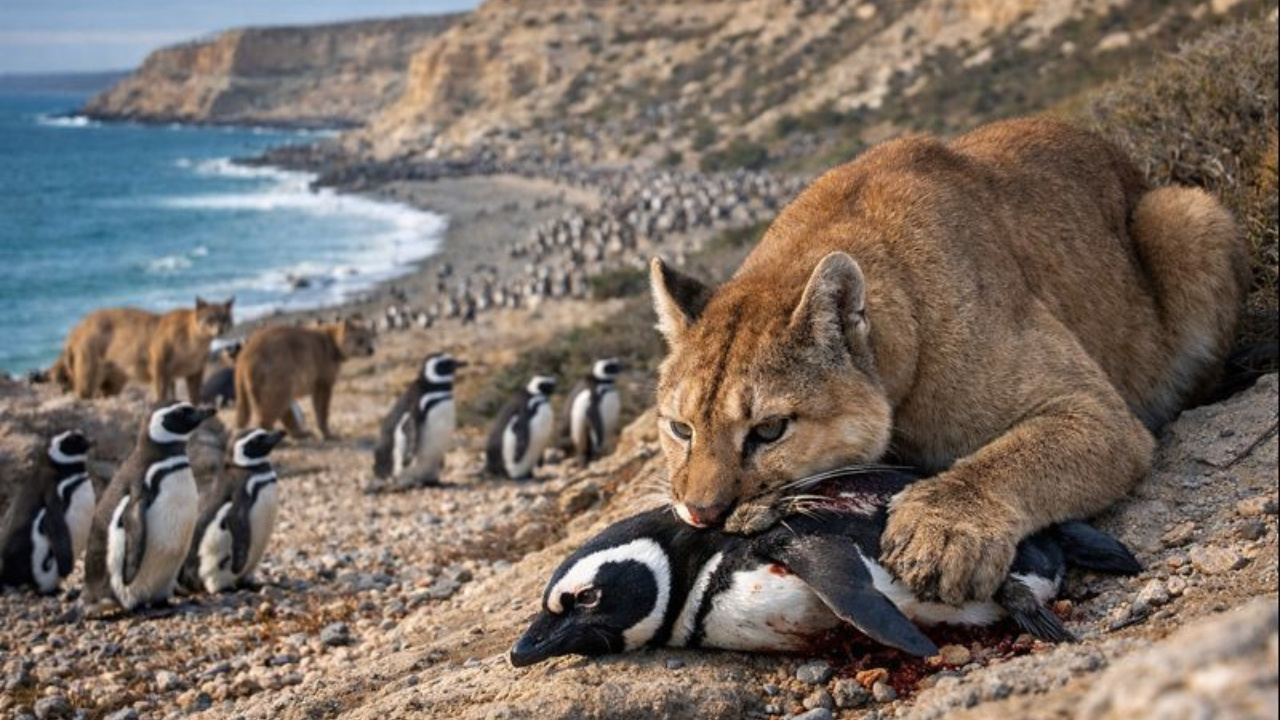
Pumas In Patagonia Have Started Preying on Penguins, Altering Animal Behavior and Creating Unexpected Ecological Interactions.
The reintroduction of pumas in Patagonia, in southern Argentina, triggered a surprising change in the environmental balance of a national park: the big cats began to feed on Magellanic Penguins, altering classic patterns of Predation and Animal Behavior.
The phenomenon was observed in Monte León National Park over the past few years and analyzed by researchers between 2019 and 2023.
The study, recently published in the Proceedings of the Royal Society B, shows that this new food source not only impacts the penguins but also transforms the way the pumas interact with each other, raising new challenges for Ecosystem Conservation.
-
With earth, bamboo, straw, and lime mortar, a specialist builds a house for just over $460 and draws attention for its cost being much lower than traditional construction.

-
Rodrigo de Freitas Lagoon advances in environmental recovery with sanitation, elimination of irregular sewage, and the resumption of water sports in Rio de Janeiro.

-
Sustainable housing gains strength with a nationally awarded project in Campo Grande, highlighting innovative solutions that combine sustainability, urban integration, and efficiency in the use of natural resources.

-
City Where Residents Live Underground to Escape 52°C May Be a Picture of the Future on an Increasingly Hot Planet


Reintroduction of Pumas Changed the Local Ecological Balance
For much of the 20th century, pumas disappeared from the region due to pressure from sheep ranchers.
The absence of the predator allowed various species to adapt to an environment with lower hunting risks.
This scenario began to change in 2004 with the establishment of Monte León National Park, when pumas gradually returned to the territory.
Meanwhile, a colony of Magellanic Penguins, previously restricted to islands, thrived on solid ground, gathering about 40,000 breeding pairs.
Penguins Became an Abundant and Accessible Prey
With the return of the felines, researchers began to identify penguin remains in the scats of pumas.
What seemed like isolated behavior turned out to be broader after systematic monitoring.
“We thought it was just a few individuals doing this,” said Mitchell Serota, an ecologist at Duke Farms in New Jersey.
“But when we got there… we noticed a large number of detections of pumas near the penguin colony.”
This new pattern indicates that pumas have begun to exploit an opportunity created by human transformation of the ecosystem, giving rise to Unexpected Ecological Interactions.
Monitoring Reveals Changes in Puma Behavior
To understand the phenomenon, researchers used camera traps along a two-kilometer coastal stretch.
Additionally, 14 pumas were fitted with GPS collars, allowing for the mapping of their movements and hunting areas over several seasons.
Data showed that nine of these pumas included penguins in their diet, while five remained focused on other prey.
This difference resulted in distinct patterns of territorial occupancy.
During the breeding season of the Magellanic Penguins, pumas remained close to the colony.
In summer, when the birds move away from the coast, the felines significantly expanded their movements.
Predation Alters Social Relationships Among Felids
One of the most relevant findings of the study involves the Predation and Animal Behavior of the pumas themselves.
Traditionally solitary, these felines began to tolerate each other’s presence more in areas rich in penguins.
A total of 254 encounters between pumas hunting penguins were recorded, compared to just four interactions among those that did not use this prey.
The majority occurred within a kilometer radius of the colony.
The abundance of food reduced direct competition, allowing for a population density over two times higher than the maximum previously recorded in Argentina.
Challenges for Modern Conservation
For experts, this case reinforces the complexity of Ecosystem Conservation in environments already transformed by human action.
According to Juan Ignacio Zanon Martinez, an ecologist at CONICET, understanding these new dynamics is essential.
“It is crucial for conservation planning, as it allows managers to… develop management strategies based on how ecosystems actually function today, not on how we assume they should work based on the past,” he told Live Science.
Though large colonies of penguins should not be significantly affected, predation may hinder the growth of smaller colonies, requiring attention from park managers.
Next Steps in Research
So in future studies, Serota intends to investigate how this new relationship between pumas and penguins influences other traditional prey, such as the Guanaco, a close relative of the llama.
The results reinforce that restoring native species does not mean simply “going back in time,” but rather dealing with living systems in constant transformation, where new relationships may emerge — and completely redefine how nature functions.










-

-

-

-

-

15 pessoas reagiram a isso.