





 Português
  Inglês
  Espanhol
  3 min de leitura
  0 comentários


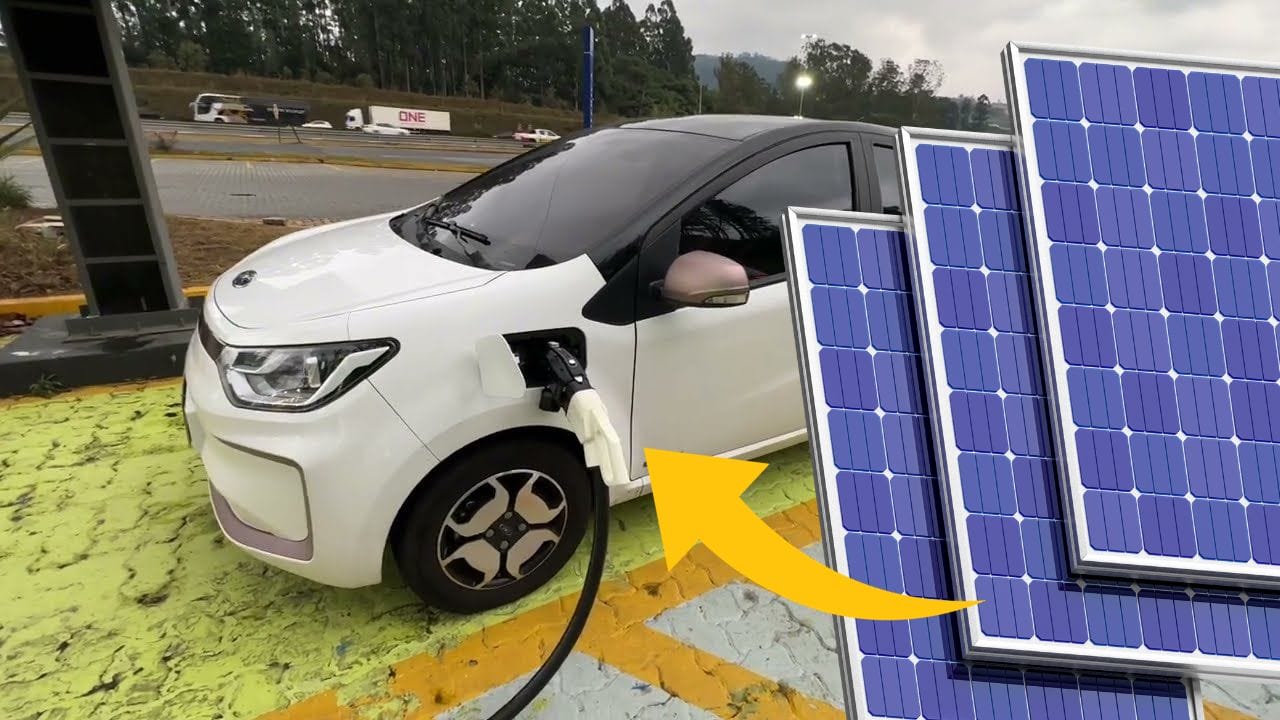
The Era Of Electric Vehicles Is Growing, And Along With It, The Curiosity About How To Charge These Vehicles Sustainably. Discover How Many Solar Panels Are Needed To Charge An Electric Car For Free.
Unlike traditional vehicles powered by liquid fuels, the electric car is fueled by electricity. This energy can be obtained from the power grid or from a photovoltaic system, in this case, solar panels. The energy is stored in the car’s battery and used to power the electric motor during travel.
A specific model, the JAC e-JS1, already commercialized in Brazil, was taken as an example. With lithium iron phosphate batteries of 30 kW, this vehicle consumes approximately 10 kWh for every 100 km driven, powering a 62 HP motor. Considering a daily distance of 30 km, the car has a consumption of 3 kWh per day. In this way, the 30 kW battery can keep the vehicle charged for up to 10 days.
Cost To Charge The Electric Car


In Minas Gerais, the cost of kWh is about R$ 0.95. Thus, the monthly cost to charge the car would be approximately R$ 85.50, considering a consumption of 90 kWh per month.
-
The Sol do Agreste Photovoltaic Complex begins operations in Pernambuco and accelerates the expansion of solar energy in Brazil, directly impacting the reduction of emissions and strengthening the sustainable energy matrix.

-
OMODA & JAECOO grows in Europe in 2026 with an integrated strategy of sales, innovation, local production, and technological advancement in the United Kingdom, Italy, and Spain.

-
OMODA & JAECOO expands after-sales service in Brazil with competitive maintenance, a 7-year warranty, and high availability of parts for technological SUVs.

-
OMODA & JAECOO appoints Alessandra Souza as executive marketing director in Brazil and accelerates brand expansion with a focus on innovation, networking, and hybrid portfolio.


Electricity rates can vary significantly between different regions of Brazil. Thus, the cost of charging an electric car in São Paulo may differ from the cost in Rio de Janeiro or other regions. The increase in electricity rates can directly impact the cost of maintaining an electric car. Therefore, it is important to consider rate fluctuations when estimating long-term costs.
To overcome the high energy costs, many electric car owners in Brazil are investing in photovoltaic systems. After the payback period, the energy generated can be used to charge the vehicle practically at no cost. The Brazilian government and some energy companies offer incentives for the adoption of electric cars and the installation of photovoltaic systems, such as tariff discounts and financing with reduced interest rates.
Determination Of The Power Required In Solar Panels
To calculate the total power of solar panels needed, the formula considers the monthly consumption of the vehicle, the local solar irradiation, and the efficiency of the photovoltaic system. In this example, using the irradiation of Brasília (5.47 kW/m² day) and a system efficiency of 75%, about 730 peak watts of power in solar panels would be required.
Considering standard panels of 560 peak watts each, approximately 1.3 panels would be needed to meet the monthly consumption of the vehicle. Rounding up, two solar panels are necessary to fully charge the electric car.
With just two solar panels, it’s possible to ensure the charge of an electric car with the described usage profile. This data demonstrates the feasibility and efficiency of photovoltaic solar energy for powering electric vehicles, offering a sustainable and economical alternative for energy supply.









-

Uma pessoa reagiu a isso.