Portuguese
  Spanish


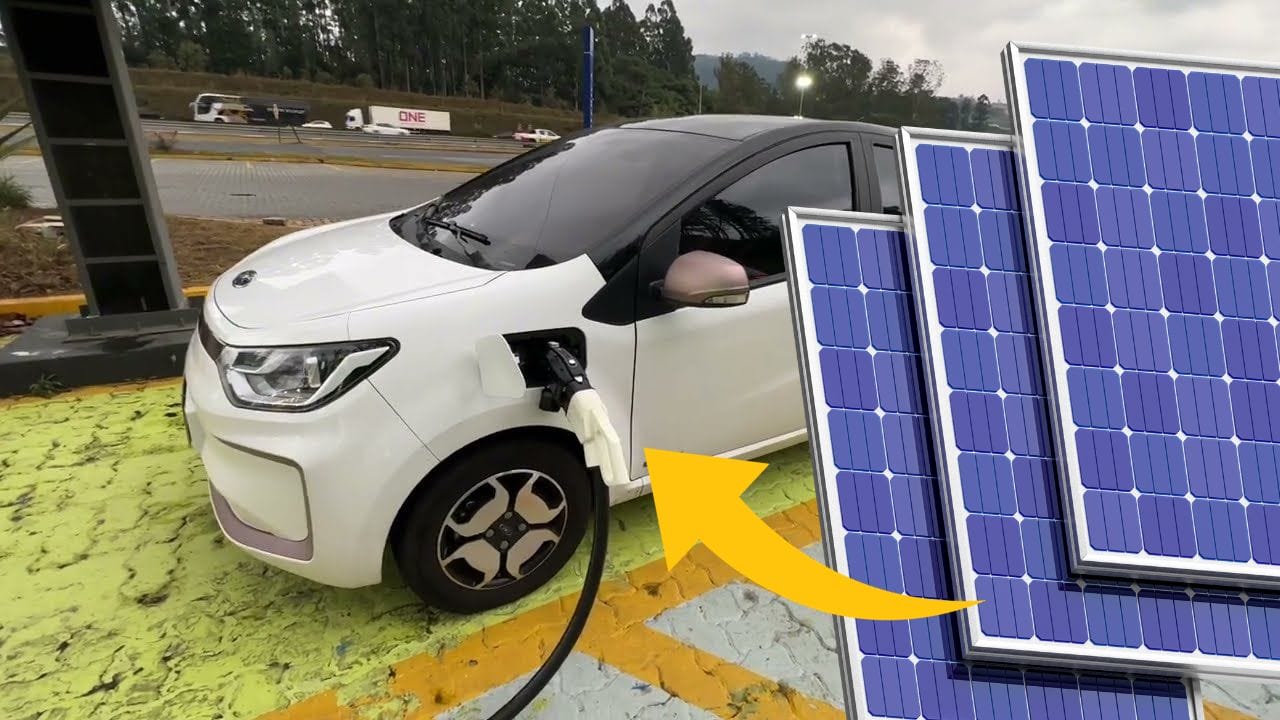


The Era Of Electric Vehicles Is Growing, And Along With It, The Curiosity About How To Charge These Vehicles Sustainably. Discover How Many Solar Panels Are Needed To Charge An Electric Car For Free.
Unlike traditional vehicles powered by liquid fuels, the electric car is fueled by electricity. This energy can be obtained from the power grid or from a photovoltaic system, in this case, solar panels. The energy is stored in the car’s battery and used to power the electric motor during travel.
A specific model, the JAC e-JS1, already commercialized in Brazil, was taken as an example. With lithium iron phosphate batteries of 30 kW, this vehicle consumes approximately 10 kWh for every 100 km driven, powering a 62 HP motor. Considering a daily distance of 30 km, the car has a consumption of 3 kWh per day. In this way, the 30 kW battery can keep the vehicle charged for up to 10 days.
Cost To Charge The Electric Car


In Minas Gerais, the cost of kWh is about R$ 0.95. Thus, the monthly cost to charge the car would be approximately R$ 85.50, considering a consumption of 90 kWh per month.
-
Automatic, economical, and known for reliability: with a 1.5 engine of up to 110 hp, CVT transmission, seven airbags, and fuel consumption of up to 15.9 km/l, this used hatchback appears as a rational alternative to Polo, HB20, and Onix; meet the Toyota Yaris XLS 2020.

-
Brazil saved US$ 32.4 billion in 2025 by switching from fossil to renewable energy and only ranked behind China and the United States on the IRENA global podium.

-
He surpassed the Tera, Creta, and Tracker: With a TSI engine of up to 150 hp, 6-speed automatic transmission, and a 373-liter trunk, the Volkswagen T-Cross was the best-selling SUV in June, with 11,753 registrations.
-
It looks factory-made, but it came out of a workshop: a mechanic from Pernambuco builds a handcrafted “mini Toyota,” drives it through the streets, and the video goes viral on social media, leaving residents astonished.



Electricity rates can vary significantly between different regions of Brazil. Thus, the cost of charging an electric car in São Paulo may differ from the cost in Rio de Janeiro or other regions. The increase in electricity rates can directly impact the cost of maintaining an electric car. Therefore, it is important to consider rate fluctuations when estimating long-term costs.
To overcome the high energy costs, many electric car owners in Brazil are investing in photovoltaic systems. After the payback period, the energy generated can be used to charge the vehicle practically at no cost. The Brazilian government and some energy companies offer incentives for the adoption of electric cars and the installation of photovoltaic systems, such as tariff discounts and financing with reduced interest rates.
Determination Of The Power Required In Solar Panels
To calculate the total power of solar panels needed, the formula considers the monthly consumption of the vehicle, the local solar irradiation, and the efficiency of the photovoltaic system. In this example, using the irradiation of Brasília (5.47 kW/m² day) and a system efficiency of 75%, about 730 peak watts of power in solar panels would be required.
Considering standard panels of 560 peak watts each, approximately 1.3 panels would be needed to meet the monthly consumption of the vehicle. Rounding up, two solar panels are necessary to fully charge the electric car.
With just two solar panels, it’s possible to ensure the charge of an electric car with the described usage profile. This data demonstrates the feasibility and efficiency of photovoltaic solar energy for powering electric vehicles, offering a sustainable and economical alternative for energy supply.