





 Portuguese
  English
  Spanish
  8 min of reading
  8 comments


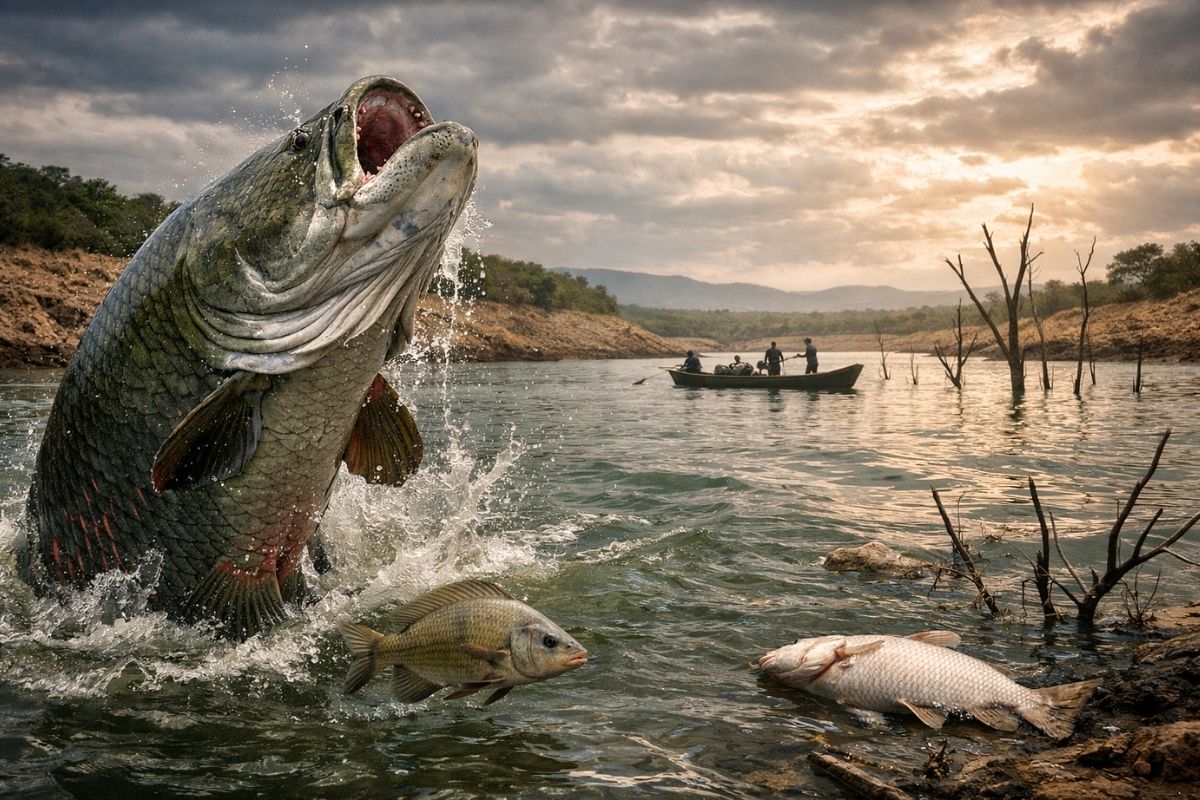


Outside the Amazon Biome, The Brazilian Fish Has Started to Appear in Isolated Reservoirs in the Northeast and in Rivers in São Paulo, Bahia, Minas, and Pantanal, Attracting Fishing and Tourism, but Being Treated as an Exotic Species. Researchers Warn That, Without Natural Predators, the Impact Could Be Nearly Irreversible in Many Basins.
In isolated reservoirs in Brazil’s Northeast, outside the Amazon, the Brazilian fish pirarucu has reemerged as a predator too large for a closed system, where water lacks the dynamics of rivers and floods, and diversity can quietly decline.
At the same time, this Brazilian fish has also been recorded in rivers and reservoirs in five states outside its natural biome, reigniting a warning: a species restored in its place of origin can lead to ecological imbalance when moved to environments where there are no natural brakes.
Where the Brazilian Fish Has Been Found Outside Its Natural Biome

According to the portal CNN Brasil, records cite the presence of the Brazilian fish in different parts of the country, always outside its traditional Amazonian environment and with clear signs of territorial expansion.
-
Archaeologists find an intact tomb over 2,500 years old, with more than 100 preserved objects, weapons, jewelry, and human remains never touched.

-
Volcanic lava transforms into threads as fine as human hair that travel over 30 kilometers by wind and fall like cutting rain on roofs and backyards in Hawaii and Iceland.

-
NASA issues a warning for the feared Godzilla El Niño that could change the planet’s climate in 2026 with extreme warming of the Pacific capable of causing devastating droughts in some regions and historic floods in others simultaneously.

-
Archaeologists discover a 100-meter ship graveyard in a submerged Greek city, and what has appeared on the seabed of Libya could change what was known about this ancient port.

In the state of São Paulo, the pirarucu appears in the Rio Grande, including in municipalities such as Cardoso and Mira Estrela, where the capture of large specimens is frequently reported and helps attract tourists and fishermen to the region.
In Minas Gerais, there are records of the Brazilian fish in Lake Furnas, in the municipality of Guapé, in the interior of Minas, as well as occurrences in the Rio Grande in the area bordering São Paulo.
In Pantanal, the pirarucu has been found in the Prata Basin, with specimens captured in the Cuiabá and Paraguay rivers, which make up a central axis of Pantanal waters and sustain ecological chains and traditional fishing-related activities.
In Mato Grosso, the Brazilian fish was caught in rivers that are not part of its natural biome, such as Teles Pires and Juruena.
In 2024, the State Secretary of the Environment of Mato Grosso authorized the fishing of pirarucu in these rivers, precisely because it is treated as an exotic species in the region.
In Bahia, the Brazilian fish appeared in captures in the municipality of Dom Basílio and in the village of Pau d’Arco, in Malhada, in the southwestern part of the state.
The two areas are located about 260 kilometers apart, indicating the possibility of dispersion through rivers linked to the São Francisco basin. One of the specimens cited in the region weighed 87 kilograms.
Why Isolated Reservoirs in the Northeast Have Become the Perfect Scenario for Imbalance

The case of the isolated reservoirs in Brazilian Northeast attracts attention for a simple reason: there, the environment is closed.
In a closed system, the Brazilian fish does not face the same ecological barriers that exist in expansive and connected flooded areas, where floods and dry periods redistribute food, shelter, and competition.
In small reservoirs, the logic is one of limits. Limit of space, limit of food, limit of replenishment. When a top predator starts to dominate this type of environment, the impact does not need to be sudden to be serious.
Instead of a visible collapse, what tends to occur is a progressive impoverishment: smaller species cease to complete cycles, reproduction declines, diversity disappears quietly, and the body of water starts to “look normal,” but sustains less and less life.
This is why the Brazilian fish serves as a warning in these reservoirs: the constant, repeated presence of an efficient predator can disrupt the functioning of the ecosystem without the change appearing immediately to those who only see the surface.
What Makes The Brazilian Fish Pirarucu So Difficult to Contain
The pirarucu is described as one of the largest freshwater fish on the planet.
The Brazilian fish can exceed three meters in length and weigh up to 200 kilograms, a scale that completely changes the relationship with the environment where it is introduced.
Besides the size, there is a characteristic that influences both fishing and monitoring: the Brazilian fish needs to surface approximately every ten minutes on average to breathe, due to a modified swim bladder.
This habit, which has already made it vulnerable to capture during periods of uncontrolled fishing, also helps explain why it can remain a dominant predator: it is a resilient animal adapted to varied conditions.
Another point mentioned is the feeding profile. The Brazilian fish is described as a generalist carnivore or omnivore, with a tendency to occupy the top of the food chain.
In environments where there are no natural predators of the pirarucu, this position becomes even stronger. Without competition and without ecological control, the top becomes a monopoly.
The Risk to Native Species and Regional Fishing
When the Brazilian fish enters rivers and reservoirs outside its natural biome, the central concern is not just the presence of a large animal.
It is what this presence does to the species that already lived there and sustained local fishing.
Researcher Lidiane Franceschini, from Unesp, Ilha Solteira campus, who investigates the advance of the Brazilian fish in non-Amazonian rivers since 2022, warns that the absence of natural predators and competing species can lead to severe impacts, including local extinctions of species and competition for environmental resources.
The effect can also directly impact regional fishing, with a reduction in species important to the activity.
This type of change generally appears in layers. First, the Brazilian fish grows and establishes itself. Then, smaller species begin to lose space.
Next, the ecological base changes, and fishing begins to depend on a poorer set of species, often with less stability throughout the year.
The Critical Stretch in the Southeast and the “Corridor” Effect Between Dams
In the Southeast, there is a detailed geographic cut on where the Brazilian fish has been found most frequently: a stretch of 120 kilometers of the Rio Grande, between the dams of the Marimbondo hydroelectric plant and the Água Vermelha hydroelectric plant.
This type of configuration creates a corridor effect controlled by structures, which can favor the permanence and circulation of the Brazilian fish within a delimited range, while also hindering the recovery of balance, because the environment continues without natural predators and with a prey supply adjusted to a system that did not evolve with this predator.
In São Paulo, the Secretary of the Environment, Infrastructure, and Logistics states that the Brazilian fish is considered exotic in the state and poses a risk to native species.
The guidance provided is straightforward: once captured, the fish should not be returned to the natural environment, with a recommendation to send them to authorized facilities and research institutions.
How The Brazilian Fish Spreads and Why The Return to “Before” Is So Difficult
Reports indicate that there are breeding operations for the Brazilian fish in captivity in regions outside the Amazon, including in Pantanal and in areas where captures have occurred in rivers from other basins.
This helps to understand why dispersion is plausible: when a species is bred outside its place of origin, any containment failure can open the way for entry into the natural environment.
The reversal is described as almost impossible for a practical reason: once the Brazilian fish establishes itself, it efficiently occupies the top, and total removal becomes a long, costly, and incomplete mission.
The main measure cited for containment is the release of sport and professional artisanal fishing throughout the year, but the assessment presented is that this measure is insufficient to contain biological invasion.
The hardest point of this story is that control depends on persistence and scale, because the problem is not solved with a single action, but rather with continuous removal, oversight, and adequate logistics to properly dispose of the captured animals.
From Near Extinction to Management in the Amazon: When Conservation Worked in the Right Place
The contrast with the Amazon is central to understanding why the Brazilian fish can be both a symbol of recovery and an ecological warning.
In the 1990s, scientists even foresaw the complete extinction of the pirarucu due to uncontrolled fishing.
The Brazilian fish lives mainly in Amazonian lakes and becomes vulnerable precisely because it needs to surface to breathe, which facilitates capture.
With the alert raised, research and sustainable management projects began to promote organized breeding and protection, involving public agencies, companies, environmental organizations, and riverine communities, fishermen, and indigenous peoples.
There was even the formation of sentinels to watch over lakes and prevent predatory fishing.
An example cited is the Pirarucu Collective, which since 2018 has brought together fishermen, representatives of grassroots organizations, extension technicians, researchers, and government agents to strengthen the management of the Brazilian fish in the basins of the Purus, Negro, Juruá, and Solimões rivers.
In 2022, the Association of Rural Producers of Carauari was able to open a slaughterhouse in the town to process, package, and sell the meat of the Brazilian fish, with revenues allocated to members according to the rules of each community.
The number cited is over 2,500 families involved in management.
It is also mentioned that Ibama launched, in February of this year, the Arapaima Program to stimulate community practices for protecting aquatic environments where the populations of the Brazilian fish naturally occur, promote collective organization, and support socioeconomic benefits linked to the conservation of Amazonian floodplains.
And there is reference to an official lunch on the 25th where a dish based on pirarucu from Médio Juruá, a product of sustainable management, was served.
The Final Warning That The Brazilian Fish Leaves For The Country
The story of the Brazilian fish shows two truths at once. In the Amazon territory, management and protection helped prevent extinction and created income for thousands of families.
Outside the natural biome, the same species can put ecosystems at risk due to a lack of predators, by occupying the top of the chain, and due to the real difficulty of reversal.
When a Brazilian fish occupies rivers and reservoirs of other basins, the debate ceases to be just about fishing or tourism.
It becomes about ecological governance: the fate of the captured animal, oversight, clear rules for captivity, and the understanding that conservation is not just about saving a species, but maintaining the context where it belongs.
What do you think should be the strictest rule to prevent the Brazilian fish from continuing to spread to new rivers outside the Amazon?







Quando apareu o peixe tucunare nos rios fora do seu bioma foi um alvoroco ,todos os ambientalistas diziam que iam acabar tudo e nada aconteceu.
Porque voces nao falam do bagre africano que acaba com tudo e esta em todo lugar e desloca hora dagua e vive ate em esgoto….
Palhaçada!!!! Faz um mistério pra dizer o nome do peixe…
É a mania do sensacionalismo, que empobrece a mídia.
Palhaçada !!!!!!!
Fala, fala, ….mas não diz sobre o título da matéria…..
Não sei por quê criar esse ar de suspense, já que não é um livro de suspense nem roteiro de filme de suspense….