





 Portuguese
  English
  Spanish
  4 min of reading
  0 comments


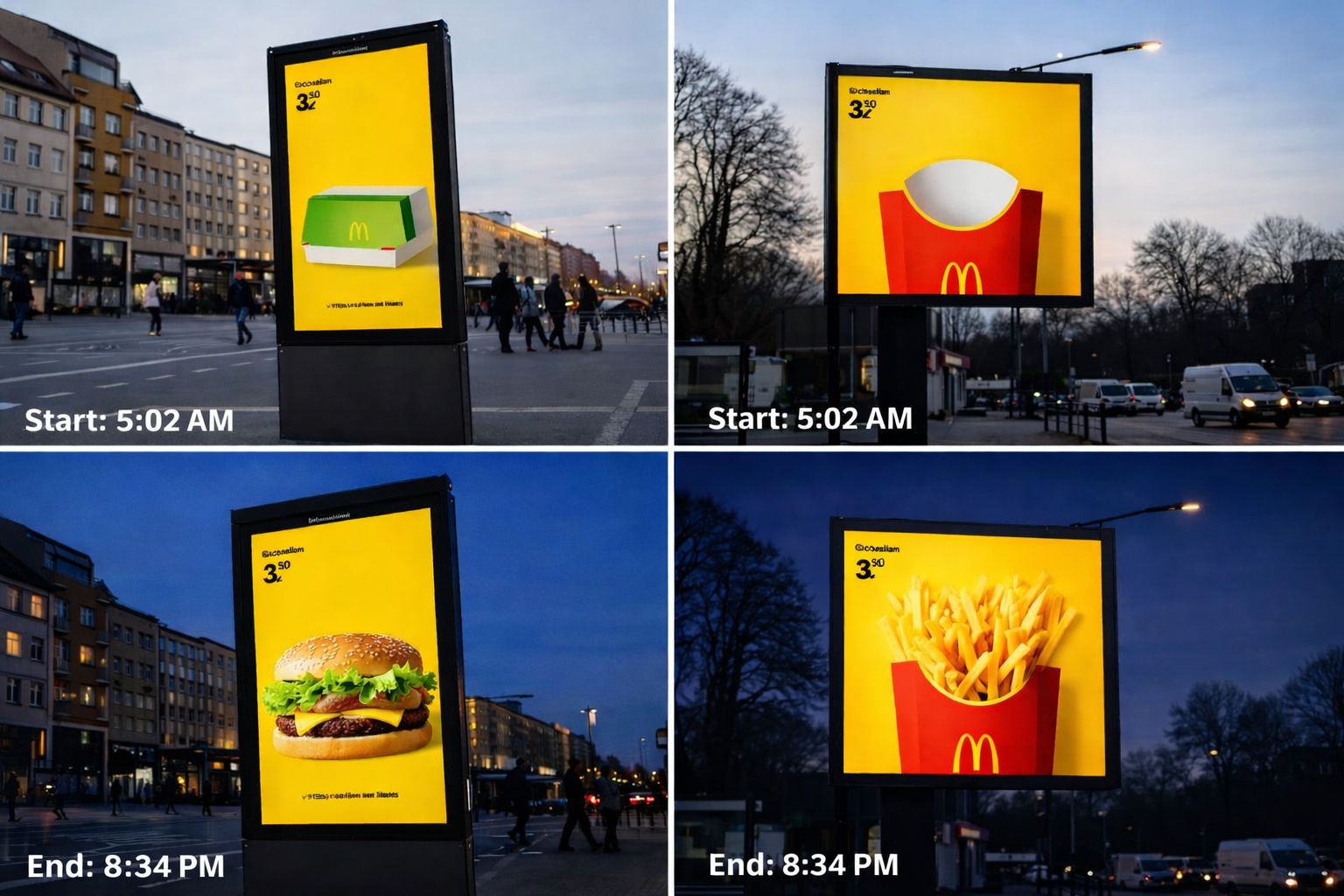
McDonald’s Hides Burgers and Fries in Its Street Campaigns and Only Reveals Food at Sunset, in a Synchronized Action with Ramadan Fasting. The Idea Triggered Diverse Reactions on Social Media.
Imagine walking through the center of a German city during the day and seeing digital billboards from McDonald’s featuring empty burger and fries wrappers, without the traditional juicy snack you expect. Only when the sun sets, at the exact moment when Muslims break their daily fast at iftar, do these images “fill in” in real-time with burgers and fries.
This creative change is part of a campaign synchronized with the fasting times during the sacred Islamic month of Ramadan, and it’s generating a lot of conversation, ranging from praise for cultural sensitivity to criticism about its necessity and impact.
An Advertisement from McDonald’s Thought Out for Ramadan
During Ramadan, millions of Muslims around the world abstain from food and drink from dawn until sunset. It is one of the pillars of the Islamic faith, the fast (sawm), and is practiced with discipline and profound spiritual significance, starting with the meal before dawn (sahur) and ending with iftar at dusk.
-
Friends have been building a small “town” for 30 years to grow old together, with compact houses, a common area, nature surrounding it, and a collective life project designed for friendship, coexistence, and simplicity.

-
This small town in Germany created its own currency 24 years ago, today it circulates millions per year, is accepted in over 300 stores, and the German government allowed all of this to happen under one condition.

-
Curitiba is shrinking and is expected to lose 97,000 residents by 2050, while inland cities in Paraná such as Sarandi, Araucária, and Toledo are experiencing accelerated growth that is changing the entire state’s map.

-
Tourists were poisoned on Everest in a million-dollar fraud scheme involving helicopters that diverted over $19 million and shocked international authorities.


McDonald’s in Germany decided to adapt its advertising during this period using Digital Out-of-Home (DOOH) technology.
The digital billboards were programmed to display only the iconic empty wrappers of burgers and fries during the day, removing images of tempting food that could become difficult to ignore for those who are fasting.
When the sun sets, the campaign, created by the German agency Scholz & Friends, causes the same pieces to transform, showing burgers and fries in harmony with iftar.
Technology Synchronized with Sunrise and Sunset
The trick behind this visual change is more technological than it seems at first glance: the panels use real-time data on sunrise and sunset times and also respect local prayer times to know exactly when the fast ends in each locality.
This synchronization turns ordinary screens into messages that keep pace with the daily rhythm of Ramadan observers, showing food only at the right moment.
This strategy is cited as an example of how advertising can be more contextual and culturally conscious, using digital media tools to “speak” with the social environment in which it is inserted.
Reactions on Social Media
As soon as the campaign started circulating online, opinions quickly became divided. Some people praised the initiative as a thoughtful and respectful gesture for those who are fasting, a recognition of an important religious practice.
Others, including Muslims, felt that this was an exaggeration or a kind of unnecessary “virtue signaling,” with comments such as:
“This is so thoughtful,”
and
“I practice Ramadan and seeing food doesn’t bother me at all. This is an exaggeration of virtue signaling.”
These responses show that even in attempts at respect, not everyone sees this sensitivity as essential.
How Many Muslims Live in Germany?
Recent data indicates that approximately six million Muslims live in Germany, representing about 6.4% to 6.7% of the country’s population.
This means that a significant part of society may observe Ramadan, and understanding this context has become an important consideration for brands operating in the local market.
Cultural Sensitivity in Advertising: Trend or Necessity?
What McDonald’s did in Germany is not entirely isolated. The brand has already explored Ramadan-adapted campaigns in markets like Indonesia and Malaysia, incorporating local cultural traditions and narratives to connect better with their audiences in these regions.
Advertising experts note that we are entering an era where campaigns that respect cultural and religious traditions go beyond basic symbols; they start to “respect time” and social context.
This means not only adapting images and texts, but also considering when and how these messages are shown to the public, as this campaign did during Ramadan with synchronized technology.
What the McDonald’s Campaign Says About the Future of Advertising
Whether seen as a gesture of respect or a topic of debate, this action shows how big brands can experiment with new forms of advertising that respond in real-time to cultural and social elements.
Replacing the constant presence of burgers and fries with a design that “remains silent” during the day and only reveals itself at nightfall is proof that sensitivity can go hand in hand with technology.










-

-

-

-

-

14 pessoas reagiram a isso.