





 Portuguese
  English
  Spanish
  6 min of reading
  0 comments


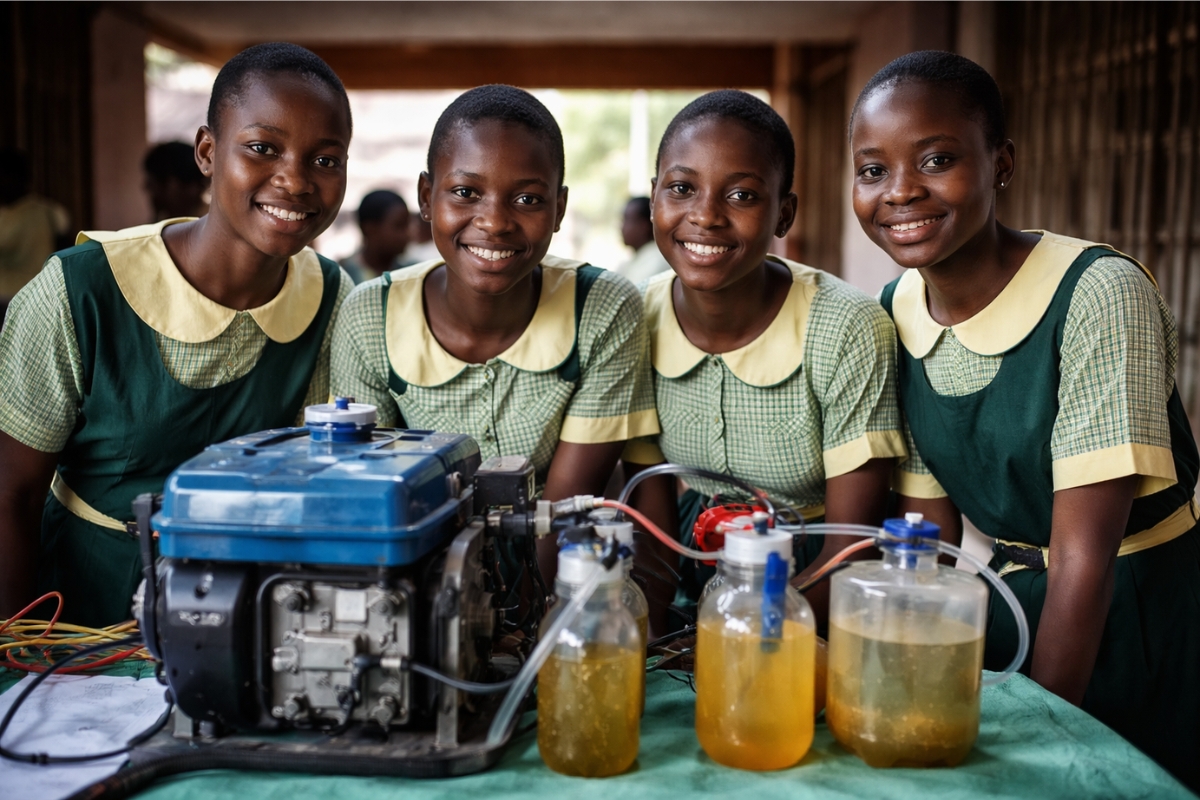
For Less Than $25, A System Developed by Teens in Lagos Uses Urine to Generate Hydrogen and Power Basic Appliances for Up to 6 Hours of Electricity
In November 2012, four Nigerian students aged 14 to 15 presented a prototype of an electric generator capable of running on human urine. The invention, showcased at Maker Faire Africa in Lagos, became an international media phenomenon and sparked a debate about youth innovation, alternative energy, and the energy challenges in Africa.
The Inventors
The creators of the project were Duro-Aina Adebola, Akindele Abiola, Faleke Oluwatoyin, and Bello Eniola, students of the private secondary school Doregos Private Academy in Lagos, Nigeria. The four were members of the JETS Club (Junior Engineers, Technicians and Scientists Club), an extracurricular club encouraging students to seek solutions to problems in their surroundings.
The project was born when Adebola read online about nine family members who died from inhaling carbon monoxide emitted by a conventional household generator. Moved by the tragedy, at the beginning of the school year in September 2012, she convinced her three classmates to design a safer generator that would not rely on fossil fuels.
-
Motorola launched the Signature with a gold seal from DxOMark, tying with the iPhone 17 Pro in camera performance, Snapdragon 8 Gen 5 that surpassed 3 million in benchmarks, and a zoom that impresses even at night.

-
Satellites reveal beneath the Sahara a giant river buried for thousands of kilometers: study shows that the largest hot desert on the planet was once traversed by a river system comparable to the largest on Earth.

-
Scientists have captured something never seen in space: newly born stars are creating gigantic rings of light a thousand times larger than the distance between the Earth and the Sun, and this changes everything we knew about stellar birth.

-
Geologists find traces of a continent that disappeared 155 million years ago after separating from Australia and reveal that it did not sink, but broke into fragments scattered across Southeast Asia.


The Context: The Electricity Crisis in Nigeria
Nigeria suffers from a chronic energy crisis. In 2009, only about 50% of the population had access to electricity, leaving tens of millions without service. Blackouts could last almost six hours on average and occur many days each year, according to World Bank data.
In light of this reality, millions of households rely on gasoline or diesel generators, which are expensive to operate and emit toxic gases. Oluwatoyin, one of the inventors, shared that her home used four generators—two large and two small—to power different appliances, consuming a significant amount of fuel.
Why They Chose Urine?
The students evaluated several alternatives to fossil fuels to obtain hydrogen through electrolysis: water, saline solution (brine), and urine. They eliminated each option for specific reasons:
| Substance | Reason for Choice/Exclusion |
|---|---|
| Water | Requires a higher electrical voltage to break the molecules and release hydrogen. |
| Brine | Generates chlorine during electrolysis, which can damage the generator’s motor. |
| Urine | Chosen: Requires lower voltage to separate hydrogen, yields more gas, and has zero cost. |
As Adebola explained, the amount of voltage needed to “break” a urine molecule is lower than that required to separate hydrogen from water, which would allow for a higher yield using urine as a feedstock.
How the Generator Works Step by Step
The system operates through an electrolysis process that decomposes urine into hydrogen and oxygen. In summary, the operation is as follows:
- Electrolytic Cell: Urine is placed in an electrolytic cell powered by a discarded car battery. In this cell, urine is electrolyzed and releases a mixture of hydrogen and oxygen.
- Water Filter: The gas mixture passes through a water filter that removes impurities that may have come into contact with the gas.
- Storage Cylinder: The gas is stored in an empty gas cylinder.
- Cylinder with Borax: Next, hydrogen passes through a borax (hydrated sodium borate) solution, which acts as a drying agent, removing moisture and residual impurities.
- Generator: The purified, dry hydrogen fuels a conventional generator, whose ignition point has been delayed by a few degrees to accommodate the slower combustion of hydrogen compared to gasoline.
Safety Measures
After an explosion during the initial tests—caused by gas returning toward the electrolytic cell—Professor Oluseyi Lawal advised the students to install a check valve (a one-way valve improvised from a bicycle tire valve) to prevent the gas from flowing backward.
Materials and Cost
The students used low-cost and largely recycled materials:
- An electrolytic cell repurposed from waste
- A water filter
- An empty gas cylinder
- Borax as a drying agent
- A modified conventional generator
According to them, the cost of materials, excluding the generator, ranged from 3,000 to 4,000 naira (about 20 to 25 dollars at the time). The young women stated that one liter of urine could keep the generator running for up to six hours, powering lights, a fan, and a television.


Reception at Maker Faire Africa
Maker Faire Africa is a pan-African festival dedicated to inventors and creators. The urine-powered generator was one of the most talked-about demonstrations at the 2012 edition in Lagos.
Organizers and visitors praised the creativity and leadership of the teens, highlighting the fact that they were high school students, not university researchers, proposing a solution to a national problem.
Scientific Analysis and Limitations
Despite the excitement, experts raised important criticisms:
Electrolysis consumes more input electrical energy than the hydrogen produced can generate in the form of electricity. In other words, the system is not a “magic energy generator,” but rather a conversion and storage arrangement: initial energy (for example, from a battery or the grid) must be provided for electrolysis to occur. Therefore, the prototype is better suited as a principle demonstration and educational tool than as a practical self-sufficient solution.
Some researchers also pointed out that statements like “one liter of urine generates six hours of electricity” tend to be exaggerated or imprecise, as they do not specify the consumed power (how many bulbs? of what power? what type of load?).
Scalability
Energy experts consider it unlikely that the system, as presented, could be scaled for widespread household use. The cost of developing a compact, safe, and durable piece of equipment based on hydrogen extracted from urine would be significantly higher than that of a cheap conventional generator imported.
Safety
Hydrogen is a highly flammable and explosive gas. The very group of students experienced this firsthand when their first prototype exploded during testing. Designing storage, flow control, and combustion systems for hydrogen with an adequate safety level requires advanced engineering, strict standards, and reliable components, which increases cost and complexity.
Impact and Legacy
Even without reaching the market, the project has had significant impacts:
- Global Inspiration: The story made headlines in major international media and spread across social networks, becoming a symbol of African creativity.
- Recognition for the Students: The inventors received awards, invitations to events, and educational opportunities, serving as role models for other girls interested in science and technology.
- Debate on Energy in Africa: The case brought visibility to the reality of millions of Africans without reliable access to electricity and the need for innovative local solutions.
- Strengthening Female Participation in STEM: Four teenagers demonstrated that girls can lead applied science and engineering projects at a high level.
The students expressed a desire to patent the idea and, ideally, develop a more compact and practical version of the system in partnership with companies. To date, however, there is no news of a consolidated commercial version derived directly from this prototype.
Related Research: Urine as an Energy Source
The work of the Nigerians aligns with other research worldwide exploring urine as an energy source:
- Robotics and bioenergy labs, such as the Bristol Robotics Lab in the UK, have already demonstrated the use of microbial fuel cells that generate electricity from urine degradation by bacteria, even powering small electronic devices.
- It is estimated that humans produce tens of billions of liters of urine daily, which, in theory, represents an abundant resource if efficient and economically viable technologies are developed.
- The electrolysis of urine, consuming less energy than that of water and releasing more hydrogen atoms per molecule, is mainly studied in contexts such as wastewater treatment, where it is possible to combine sanitation and energy recovery.
Final Consideration
The urine-powered generator created by the four Nigerian teenagers is a real, creative, and important project from both an educational and social perspective. Its technical limitations—especially concerning energy efficiency and safety—prevent it from being a practical large-scale solution in its original form. However, the symbolic and inspiring value of the invention is enormous: it shows how young people, with few resources, can propose bold solutions to critical problems and helps pave the way for new generations of African scientists and engineers.
The information in this article has been synthesized from reports by international technology and science outlets, articles about Maker Faire Africa 2012 in Lagos, interviews with the students themselves and energy and electrolysis experts, as well as subsequent analyses discussing the technical feasibility of the urine-powered generator.








-

-

-

-

-

-

137 pessoas reagiram a isso.