





 Portuguese
  English
  Spanish
  7 min of reading
  0 comments


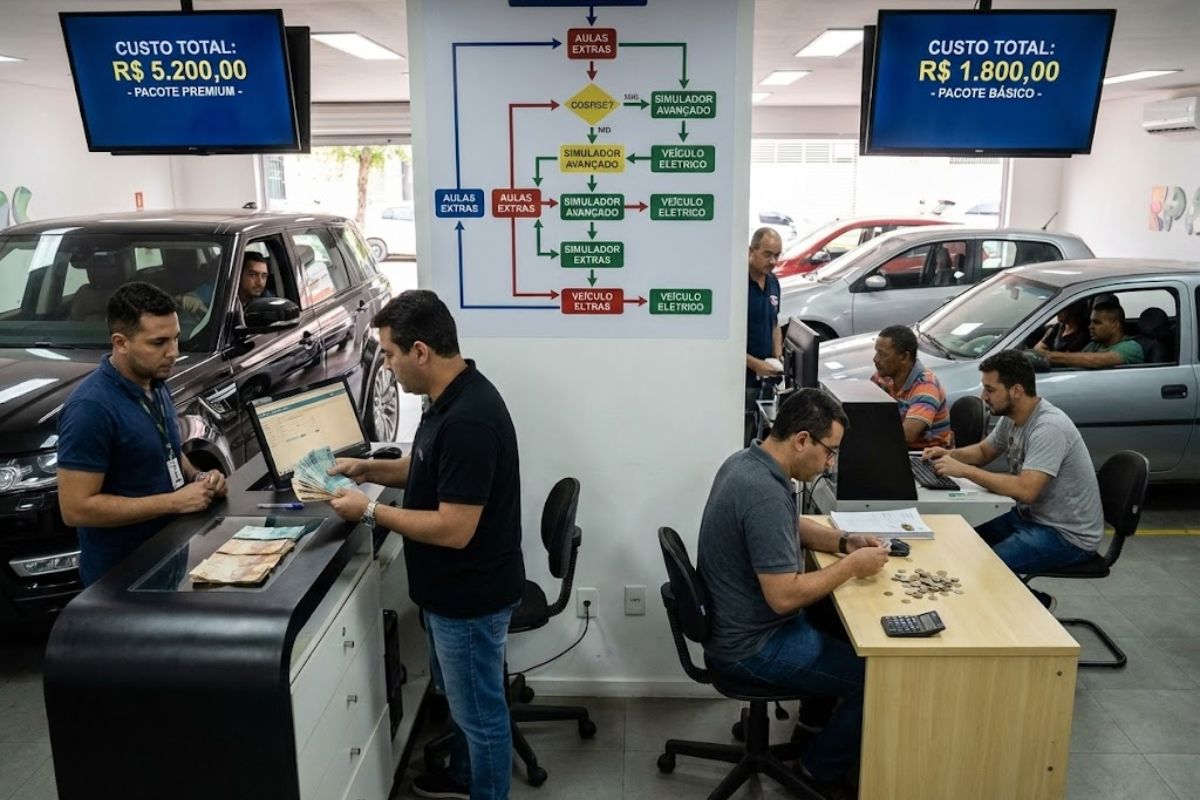
With New CNH Rules in 2026, Candidates No Longer Depend Only on Driving Schools: Free Online Theory, Practice with a Private Instructor or Experienced Driver, and Mandatory Steps Continue at Detran. The Minimum Becomes Predictable, but Failures, Packages, and Optional Services Push Fees and the Total Up to R$ 5 Thousand.
The new CNH rules in 2026 significantly change the cost of obtaining a CNH in Brazil starting in 2026. The changes approved by Contran redistribute steps, reduce dependence on driving schools, and make the final value vary more according to individual candidate choices than just legal requirements.
Even with the more flexible model, the process is still based on unavoidable payments and services that can be avoided or contracted. In all states, the candidate pays medical and psychological exams, a theoretical test, a practical test, and Detran administrative fees, and the difference between spending less or getting close to R$ 5 thousand arises from the chosen path and possible failures.
What Changes with New CNH Rules in 2026

The package of changes mainly alters the way of learning and training.
-
A new Brazilian shopping center worth R$ 400 million will be built in an area equivalent to more than 4 football fields, featuring 90 stores, 5 cinemas, a supermarket, a college, and parking for 1,700 cars, potentially generating 3,000 jobs.

-
Larger than entire cities in Brazil: BYD is building a 4.6 km² complex in Bahia with a capacity for 600,000 vehicles per year, but the discovery of 163 workers in conditions analogous to slavery has shaken the entire project.

-
With an investment of R$ 612 million, a capacity to process 1.2 million liters of milk per day, Piracanjuba inaugurates a mega cheese factory that increases national production, reduces dependence on imports, and repositions Brazil on the global dairy map.

-
Brazilian city gains industrial hub for 85 companies that is equivalent to 55 football fields.


The content on legislation, defensive driving, and first aid becomes available online through the Ministry of Transport, at no direct cost to the candidate.
In practice, this shifts part of the expenses that were previously concentrated in driving schools to a format where theory can be accessed without additional payment.
Flexibility is also evident in driving.
The practical training no longer depends exclusively on driving schools, allowing lessons with a private instructor or with an experienced driver, according to local rules.
Driving schools remain authorized to offer courses and support but cease to be mandatory intermediaries in all steps, which changes the pricing structure and expands the differences between cost trajectories.
What Remains Mandatory at Detran and Why This Maintains a Spending Floor
Despite the change in the path, the roadmap to obtain the first license does not disappear.
The new CNH rules in 2026 change the way of studying and training, but do not remove the need to prove knowledge and skill.
The medical exam, the psychological assessment according to category and state rules, the theoretical legislation test, and the practical driving test continue to be required.
Additionally, all Detran fees remain payable.
This detail supports a spending floor: even when the candidate chooses to avoid packages and reduce services, exams, tests, and fees continue as basics.
In other words, the new CNH rules in 2026 open alternatives but do not eliminate public costs and assessment stages.
How Much Does It Cost to Get the CNH Today and the Example of Minas Gerais with R$ 858.53
The expression how much does it cost to get the CNH has gained weight because the process mixes public fees and private services.
In all states, the candidate needs to pay for health exams, evaluations, tests, and Detran administrative fees, even when trying to minimize contracted services and organize preparation independently.
In Minas Gerais, the total of mandatory fees is around R$ 858.53, including health exams, psychological assessment, tests, learning permit, and the start of the licensing process.
This figure serves as a reference for the floor: it shows how Detran fees exist before any decisions about driving schools and helps understand why the new CNH rules in 2026 could lower some paths without making the CNH free.
How Driving Schools Cease to Be Mandatory and Where They Continue to Burden the Wallet
The turning point of the new model is that driving schools become optional.
This tends to reduce the part of the cost that previously came from closed packages with in-person theory classes, practical workloads, and internal administrative routines.
At the same time, optionality does not mean disappearance: driving schools continue to compete for those who prefer complete structure, organized schedules, and ongoing support.
In practice, the new CNH rules in 2026 can push the market towards two extremes in the same municipality.
A candidate can spend little if they use free online theory and practice with an experienced driver within the local rules.
Another can pay a lot for a more guided path, with complete packages, extra materials, and support, keeping the CNH close to the old standard.
Three Cost Trajectories with New CNH Rules in 2026
The new CNH rules in 2026 make the final cost more sensitive to choices.
The same structure can become cheaper when the candidate uses free online content and organizes practice outside driving schools, or more expensive when buying complete packages and needing to redo steps.
The design is flexible but also unequal, because the “cheap” depends on practical learning conditions.
Below are three typical trajectories described, not considering local promotions or exemption programs.
In any scenario, failures can generate new fees to retake tests, reopening costs that many do not include in the initial budget.
Scenario 1: Spending Close to the Minimum Without Paid Lessons
In the most economical scenario, the person only fulfills the steps required by Detran, studies using free online materials, and practices driving with a licensed mentor authorized by state legislation.
Here, the spending concentrates on the mandatory fees and required evaluations.
In places with costs similar to those in Minas Gerais, the mentioned range is between R$ 800 and R$ 900. Even on this path, the new CNH rules in 2026 do not eliminate exams, tests, and Detran fees.
They reduce the need to pay for the theoretical part in driving schools and open practice to permitted alternatives, keeping the budget tighter when preparation works without paid reinforcements.
Scenario 2: Hiring Some Practical Lessons and Exceeding R$ 1,500
In the second profile, the candidate hires some practical lessons for specific adjustments, such as maneuvers and driving on busy roads. The total cost of the CNH starts to vary according to the number of hours contracted and the price charged in each municipality, which increases the cost dispersion even with similar rules.
The total can exceed R$ 1,500 in many municipalities. At this point, the difference between fees and services becomes clearer: Detran fees remain as a basis, while the rest depends on lessons, private instructor, and learning pace.
In the new CNH rules in 2026, this combination can be the line separating “savings” from “moderate spending.”
Scenario 3: Complete Training in Driving Schools and Costs Near R$ 5 Thousand
In the model closest to the old standard, the candidate opts for complete training in driving schools, with in-person theoretical classes, extensive driving hours, and administrative support.
The new CNH rules in 2026 do not prohibit this path; they only make driving school optional, allowing the candidate to pay for convenience and structure.
In states with higher costs, the final value can approach or exceed R$ 5 thousand, especially with extra materials and failures.
This is where the system shows its record-breaking side: the sum of packages, fees, and repeating tests can push the budget up, turning the CNH into a high expense for those needing more support.
Why Some Reach R$ 5 Thousand and Others Spend Less
The main reason is not a single new fee but how costs are distributed.
With the new CNH rules in 2026, part of what used to be a package becomes a choice, and choices have a price.
Those who can study with free online theory and train with an authorized experienced driver can reduce expenses associated with driving schools.
On the other hand, those who need many lessons, prefer complete structure, or face failures tend to accumulate costs.
Each extra attempt may require new fees, and the repetition of tests becomes a financial multiplier.
The result is a process where two people can fulfill the same mandatory steps at Detran and end up with very different final accounts.
How to Organize Choices and Avoid Surprises with Fees and Failures
As the process remains structured, practical guidance is to map the steps and understand where the new CNH rules in 2026 allow savings without compromising preparation.
Starting with free online content, planning practice within local rules, and leaving room for additional fees in case of failure helps reduce shocks.
It is also useful to separate what is mandatory from what is optional. Exams, tests, and Detran fees are the backbone of the cost.
Lessons at driving schools, in-person packages, and extra materials are decisions that change the total. In a more flexible model, the final bill results from the path, not just the rules.
The new CNH rules in 2026 make the process less dependent on driving schools and more open to personalized trajectories but maintain a floor of Detran fees and widen the gap between those who can afford little and those who get close to R$ 5 thousand.
Before starting the process, it is advisable to simulate scenarios, define the level of support needed, and consider the risk of failures to avoid turning the CNH into a financial shock.
Do you think the new CNH rules in 2026 will lower CNH costs for most people, or just increase the inequality between those who depend on driving schools and those who can train outside?










-

-

2 pessoas reagiram a isso.