





 Portuguese
  English
  Spanish
 4 min of reading
  0 comments


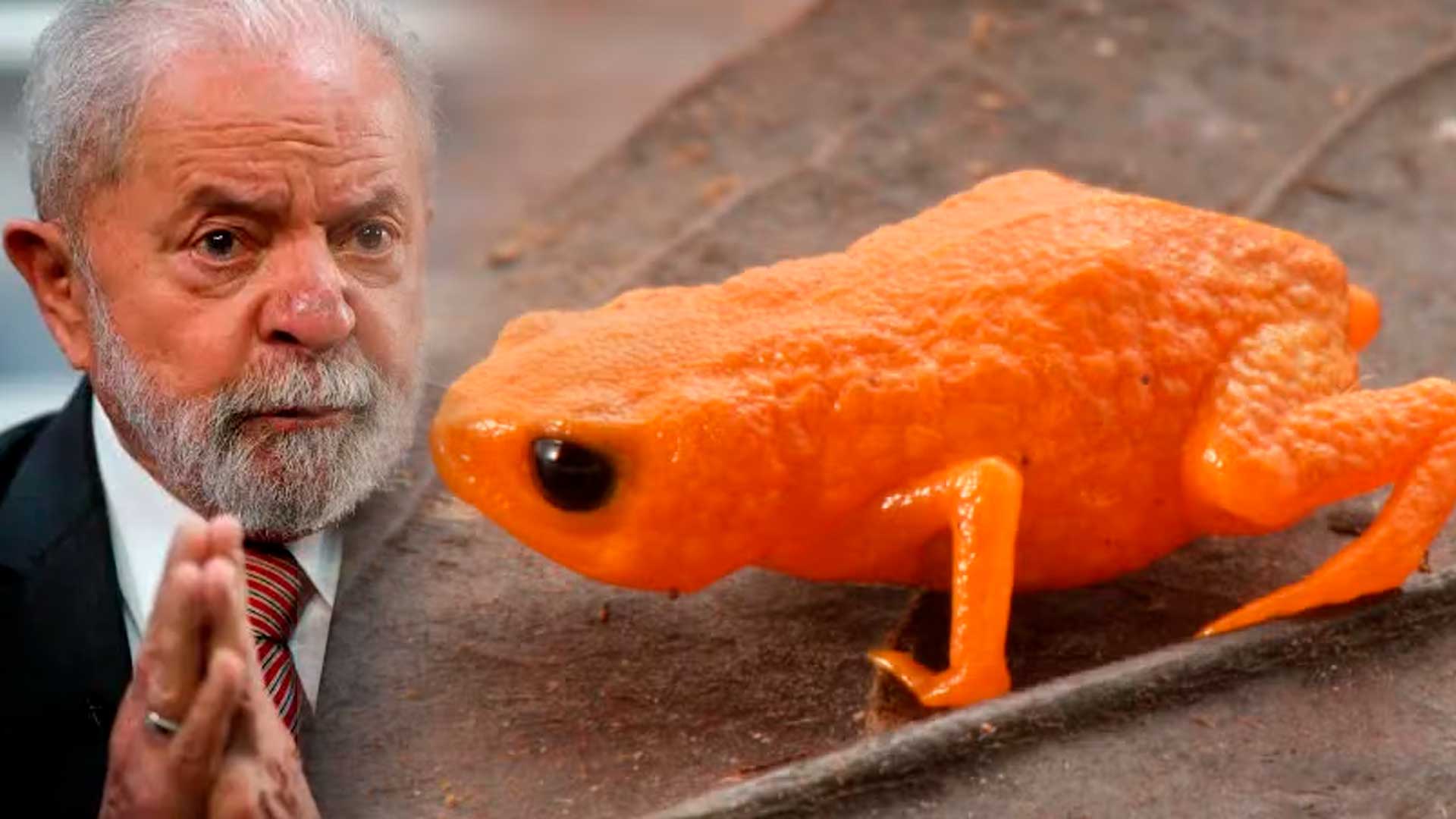
The Species, The Size of a Pencil Tip, Was Described in a Study in PLOS One and Received Its Name in Honor of President Lula. Scientists Propose a Wildlife Refuge to Protect High-Altitude Areas and Other Endemic Amphibians.
A new Brazilian species of amphibian, a tiny orange-colored frog, was described by researchers in the Serra do Quiriri, in northern Santa Catarina. The work was published in the scientific journal PLOS One on December 10, 2025.
Named Brachycephalus lulai, the animal measures about 8.9 to 11.3 millimeters in males and 11.7 to 13.4 millimeters in females. Its body has an intense orange hue with small green and brown markings, and its occurrence is restricted to a very specific area of the mountain range.
The tribute to President Luiz Inácio Lula da Silva, according to the authors, aims to draw attention to the conservation of the Atlantic Forest and, especially, to miniaturized and highly endemic amphibians. This explanation appears in the etymology section of the article.
-
The Argentine government celebrates the lowest poverty rate in 7 years, but experts warn that the methodology has changed, real wages have fallen, unemployment has risen, and the number of people on the streets of Buenos Aires has increased by 57% since Milei took office.

-
7.8 magnitude earthquake in Indonesia frightens the population, triggers tsunami alert, and hits an island with over 200,000 inhabitants this Thursday.

-
Google will finally let you change that embarrassing Gmail address you created in your teenage years without losing any accounts, logins, or old emails: the feature is already available in the United States.

-
Heading to Brazil in a Bonanza F33 single-engine aircraft: a couple departs from Florida on a visual flight, makes technical stops in the Caribbean to refuel and organize paperwork, and begins the staged crossing until they reach the country.


In addition to the formal description, the study presents a proposal for territorial protection: the creation of the Serra do Quiriri Wildlife Refuge. The idea is to preserve high-altitude areas and species with extremely limited distribution, which are more vulnerable to environmental changes.
Serra do Quiriri in Santa Catarina: Why the Cloud Forests Became Biodiversity Islands
The Serra do Quiriri is located on the border between Santa Catarina and Paraná and reaches over 1,500 meters in altitude at its highest point. The terrain combines high-altitude fields and patches of forest, with stretches of cloud forest at higher elevations.
It is in this mosaic that Brachycephalus live, diurnal anurans that spend the day in the leaf litter, the layer of leaves on the forest floor. The new B. lulai has been associated with environments starting at 750 meters, in a mountainous area with a high degree of ecological isolation.
Outside the scientific article, the region has already appeared in discussions about creating larger conservation units on the border between the two states. A news report from the Legislative Assembly of Paraná mentions meetings with ICMBio and mentions public consultations planned for 2026 regarding a federal proposal involving Quiriri and neighboring areas.
How The New Species Brachycephalus Lulai Was Identified: Calls, Anatomy, and DNA

The first clue for the researchers came from the sound. The group reports that the mating vocalization did not match that of closely related species, an important type of evidence for separating amphibian species.
In the article, the authors state that they recorded 13 calls and describe specific announcement patterns, with groups of notes and pulses. This type of acoustic signature is used to differentiate species that may appear very similar to the naked eye.
The work also involved detailed collection and comparison of individuals. A total of 32 specimens were analyzed, with morphological descriptions to separate the new taxon from relatives in the same group.
To “see inside,” scientists used high-resolution computed tomography aimed at analyzing the skeleton. In parallel, they conducted genetic analyses with mitochondrial and nuclear markers, testing the position of the animal in the evolutionary tree.
The data indicate that B. lulai is close to two other species that also occur in the Serra do Quiriri. This proximity reinforces the idea that small patches of forest at altitude can generate speciation in “microrefuges” over time.
Why The Name Honors Lula and The Debate About Politics in Taxonomy
The formal description itself explains the choice of name. The epithet “lulai” honors Lula, recalling that he was elected president of Brazil three times, and associates the tribute with the objective of encouraging conservation initiatives in the Atlantic Forest.
In practice, naming species after people is an ancient tradition in science, but it is not always without controversy. To some in the public, the tribute may seem like politicization, while for others it acts as a spotlight for biodiversity and protection policies.
Conservation in The Atlantic Forest: Why The Study Speaks of “Little Threat” and Also Calls for Protection
In the technical text, the authors propose classifying B. lulai as “Least Concern”, citing the quality of the habitat at the moment and the absence of signs of population decline. Still, they emphasize that the situation needs to be continuously monitored.
The alert appears because the distribution is small and the species occurs near other endemic and threatened amphibians. The article mentions, for example, the toad Melanophryniscus biancae and notes the recognition of threats in a recent federal regulation and also in a global assessment.
In the list of human impacts observed in the mountain range, the study mentions recurring fires, cattle grazing, pine invasion, and kaolin mining. Erosion on roads and the effects of tourist trails in sensitive areas are also on the radar.
In response, the authors outline possible management measures within a conservation unit. Among them are assessing the impact of fire, defining controlled burns, limiting cattle stocking, mitigating the effects of mining, removing pines, and regulating tourism.
The central proposal is to create the Serra do Quiriri Wildlife Refuge, covering about 6,600 hectares, in the municipalities of Garuva and Campo Alegre. The article cites SNUC (Law 9,985/2000) to advocate for a model that can protect the area without requiring, as a rule, the expropriation of private land.
The tribute to the president was a good strategy to give visibility to conservation, or should science avoid names linked to living politicians to avoid dividing public opinion? Leave your comment with your point of view, as this type of debate helps define how society perceives and protects Brazilian biodiversity.










-

-

6 pessoas reagiram a isso.