





 Portuguese
  English
  Spanish
  4 min of reading
  0 comments


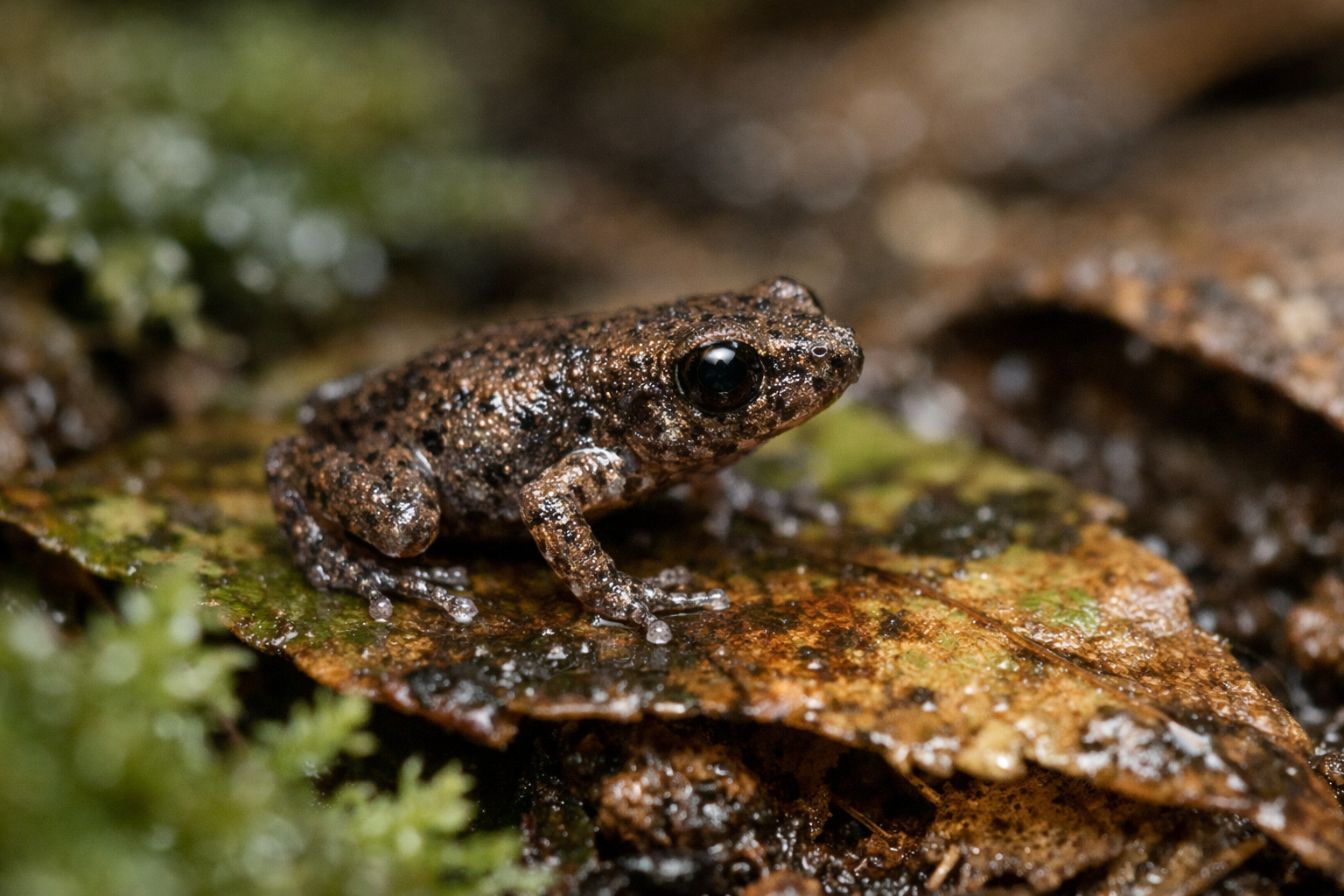
Smaller Than a Coin and Almost Invisible Habitat, a Small Frog From Oceania Reveals How Nature Still Hides Impressive Records at Microscopic Scales
Science Has Once Again turned its attention to an area that often goes unnoticed: the world of microscopic vertebrates. In this context, amidst moss, damp leaves, and the upper layers of soil, a tiny animal has once again gained the spotlight among researchers. This is the Paedophryne amauensis, a frog native to Papua New Guinea that measures only 7.7 millimeters and, thus, retains the title of smallest vertebrate in the world ever recorded.
Although this record was already known, recently, comparative analyses reinforced the species’ position in the biological ranking. Moreover, the frog’s size continues to impress experts. It is smaller than the diameter of many common coins and, therefore, makes the animal almost imperceptible to the naked eye in its natural habitat.
This information was disclosed by the Diário do Litoral, based on updated scientific surveys and recent taxonomic comparisons. According to researchers, no other known vertebrate has such reduced dimensions to date. Thus, the species remains isolated at the top of this curious biological record.
-
Spain surprises the world by erecting 62 artificial dunes, mixing sand with natural remains of posidonia, and causing the structure to lose only 1.4% of its volume in 1 year.

-
With 16 Bulava missiles, improvements in acoustic stealth, and a design focused on silent patrols, Russia’s nuclear submarine was born to ensure Moscow’s invisible retaliation and has become one of the pillars of its maritime strength.

-
‘Populous’ city in Rio among the worst in Brazil in national ranking and exposes silent development crisis.

-
Couple buys house in the South Zone of São Paulo, opens a hidden door in the garage, and finds a secret wine cellar with dozens of old wines forgotten since the 1970s.


More than just a number, however, the microscopic frog symbolizes something greater. It demonstrates how biodiversity still holds relevant surprises even at extremely small scales.
A Frog That Fits on the Tip of Your Finger and Lives in Hidden Microworlds
The Paedophryne amauensis lives in very specific micro-habitats. In general, these environments include damp foliage, tropical moss, and shallow layers of soil, where sunlight hardly reaches. Consequently, these spaces serve as natural refuges, as larger predators cannot access such narrow areas.
In this scenario, evolution has favored a compact, lightweight, and highly efficient body. Even so, despite its microscopic size, the frog possesses all the basic structures of a vertebrate. It has a backbone, functional nervous system, and a mode of movement adapted to its environment.
In addition, researchers highlight the scientific importance of the species. At the same time, the study of these animals expands the understanding of how microscopic ecosystems function, which are vital for the health of tropical forests. Even small, the frog plays a part in complex and highly specialized ecological chains.
Therefore, its environmental role should not be measured by body size but by the function it serves in maintaining the balance of nature.
The Smallest Vertebrates on the Planet and the Limits of Evolution

Although the Paedophryne amauensis leads the global ranking, on the other hand, other animals also stand out when it comes to extreme miniaturization. Among mammals, for example, the smallest known representative is the Kitti’s Hog-nosed Bat, commonly known as the bumblebee bat. It weighs about 2 grams and lives in caves in Thailand and Myanmar.
Meanwhile, in the fish group, the Paedocypris progenetica, found in Sumatra, can measure less than 8 millimeters, coming very close to the record of the microscopic frog. Similarly, among birds, the bee hummingbird, native to Cuba, weighs approximately 1.8 grams, making it the smallest known bird.
These examples illustrate how evolution operates at the physical limits of life. Consequently, lightweight bones, adjusted metabolism, and low energy expenditure ensure the survival of these animals in restricted environments. Additionally, extreme agility becomes an essential advantage for escaping predators.
Even so, however, science still knows little about many of these species. This occurs because access to habitats is difficult, and small size complicates more in-depth studies.
Challenges of Existing at Microscopic Scale and the Risk of Disappearance
Living at such small dimensions offers benefits but also imposes significant risks. In particular, microvertebrates rely heavily on environmental stability. Thus, any change in climate or habitat can jeopardize entire populations.
Most of these species live in tropical forests and wet areas. However, these environments are among the most sensitive to human actions. Deforestation, pollution, and soil fragmentation threaten these silent microworlds directly.
Finally, the preservation of micro-habitats becomes essential. Protecting these spaces ensures the survival of already-known species and, at the same time, allows for new scientific discoveries. The Paedophryne amauensis, therefore, emphasizes this urgency by reminding us that the grandeur of life can also exist within just a few millimeters.
Did you ever imagine that a vertebrate could be smaller than a coin and still play a vital role in nature?








-

-

-

-

-

12 pessoas reagiram a isso.