





 Portuguese
  English
  Spanish
  5 min of reading
  0 comments


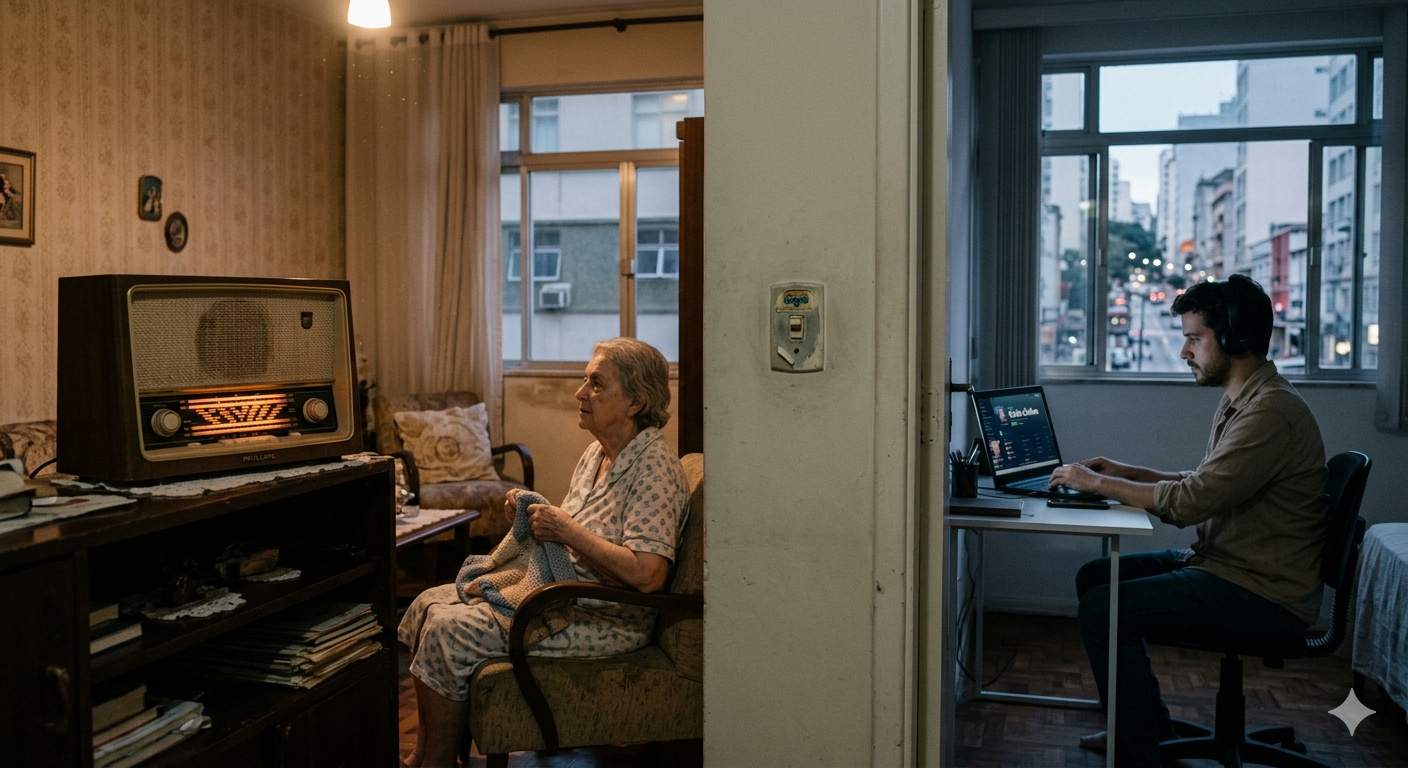
IBGE reveals historic decline of radio in Brazilian households in 2024: cell phones and Smart TVs replace the physical device in millions of homes.
The radio in Brazilian households has been present for decades as one of the main devices for communication and home entertainment. There was one device in the living room, another in the kitchen, and often a third in the bedroom. This pattern was repeated in more than half of the homes in the country for consecutive years, according to IBGE measurements since 2016. In 2024, this cycle came to an end. According to the TIC module of the IBGE Continuous PNAD, released in July 2025, only 48.5% of Brazilian households had a radio device in 2024, equivalent to 38.8 million homes. For the first time in the historical series, households without a radio outnumbered those that still had the device. Between 2023 and 2024, 2.3 million homes stopped having a radio, a decline of 4 percentage points in just twelve months.
The radio has not disappeared as a medium. What has begun to disappear is the physical device.
Decline of radio in Brazil: IBGE data shows structural change in audio consumption
The historical series from IBGE reveals an abrupt change after years of stability. In 2016, radio was present in 56.5% of Brazilian households. In 2022, this number remained exactly the same, indicating a prolonged period of stability even in the face of digital expansion. In 2023, it fell to 52.5%. In 2024, it reached 48.5%.
-
Scientists have excavated a giant cave beneath the snow of Antarctica to create a natural refrigerator at minus 50 degrees that operates without electricity and can preserve the Earth’s climate memory for entire centuries.

-
Scientists detect a rare and frightening phenomenon in the Pacific Ocean that could trigger a devastating Super El Niño as early as 2026, and American experts say it is one of the strongest ever recorded in history.

-
Researchers from Embrapa have discovered how to transform the saline water found in 140,000 wells in the Brazilian Semi-Arid region into a tool for producing food in an area where agriculture has always relied solely on rainfall.

-
China inaugurates a ghost factory that operates in the dark 24 hours a day without any human workers and produces 10 million smartphones a year using 97% of equipment developed by the company itself.


The decline of 2.3 million households in just one year is the largest drop ever recorded. In terms of scale, it represents a volume comparable to the total number of residences in entire states being impacted simultaneously.
Regionally, the scenario has also changed. Only the Southern Region remains above 50%, with 56.7% of households having a radio. In urban areas, the index fell to 48.1%. In rural areas, it is still at 51.8%, but on a downward trajectory.
The device that symbolized urban domestic life is now a minority in Brazilian cities.
Cell phones and internet replace physical radio in Brazilian households
The replacement of radio did not occur due to abandonment of the function, but due to technological migration. Cell phones are present in 97% of Brazilian households in 2024, according to IBGE. At the same time, 82.4% of internet users reported using the internet to listen to music, radio, or podcasts.

This indicates that the central function of the radio has been absorbed by already existing devices in daily life. The cell phone not only replaced the physical device but also expanded its functionalities.
The user no longer relies on an exclusive piece of equipment to listen to the radio. Access has become integrated, portable, and on-demand.
Smart TV accelerates the replacement of radio as the center of home entertainment
Another relevant vector of this transformation is the Smart TV. In 2024, 53.5% of internet users in Brazil accessed the internet through their television, surpassing half of the connected population for the first time. In 2016, this index was only 11.3%.
The connected television has begun to concentrate multiple functions: video streaming, music platforms, live radio apps, and podcasts.
This movement eliminated the need for multiple separate devices in the living room, including the radio and traditional sound systems.
Radio has not disappeared: the physical device has lost relevance
The decline in the number of radios does not mean a decline in the consumption of audio content. The IBGE data is specific: it measures the presence of the physical device in the household. It does not measure audio consumption.
More than 138 million Brazilians consume audio content via the internet. Traditional broadcasters transmit via apps with superior quality to the analog signal. The content continues to be consumed — it has just changed platforms. The radio as a medium remains active. The radio as a physical object has become dispensable.
Between 2016 and 2022, radio maintained a stable presence in Brazilian homes. Starting in 2023, the behavior changed abruptly. Two consecutive years of accelerated decline indicate a typical inflection point of technological replacement.
This pattern is recurrent: technologies remain stable for years until a change in habit accelerates their replacement in a short time.
North and Northeast still maintain the importance of radio in specific contexts
The decline does not occur uniformly across the country. In regions with lower internet coverage, especially in the North and Northeast, radio still plays critical roles. In rural areas, only 65.8% of households have access to mobile internet or telephony.
In these contexts, radio remains essential for local communication, alerts, and access to information. Nevertheless, the general trend is gradual reduction, accompanying the expansion of connectivity.
The phenomenon observed with radio has already occurred with another household device: the landline phone. In 2016, 32.6% of households had a landline phone. In 2024, this number fell to 7.5%.
The function remained, but the device disappeared. The same pattern applies to radio: the utility was maintained, but the dedicated hardware is no longer necessary.
Smart TV and cell phone consolidate a new logic of audio consumption
The integration of functions in a few devices has redefined home consumption. The cell phone concentrates mobility, personalization, and instant access. The Smart TV concentrates collective consumption within the home.
Both replace multiple old devices — radio, sound system, DVD player — in a single connected interface. This process is not just technological. It is behavioral.
Despite the advancements, there are limitations in the available data. IBGE does not distinguish, within digital audio consumption, how many users are listening to live radio and how many are consuming playlists or podcasts.
This prevents an accurate measurement of the actual audience of radio as a medium. But there is no doubt about the main point: the physical device has lost structural relevance.
What to expect from radio in the coming years in Brazil
The trend is for the continued decline in the presence of physical radio in households. The Southern Region still shows higher levels, but is expected to follow the same pattern. The rural area, currently above 50%, is expected to cross this line in the coming years.
The observed behavior indicates that the replacement will not be reversed. The change recorded by IBGE in 2024 does not represent the end of radio, but the end of the need to own a dedicated device to access it.
Millions of households have stopped having a radio without losing access to content. The transition was silent because it was functionally invisible to the user. The cell phone and Smart TV were already fulfilling this role.
This is the pattern of major technological changes: the object disappears, but the function remains. And, in 2024, Brazil recorded exactly this moment.








Seja o primeiro a reagir!