





 Portuguese
  English
  Spanish
  5 min of reading
  0 comments


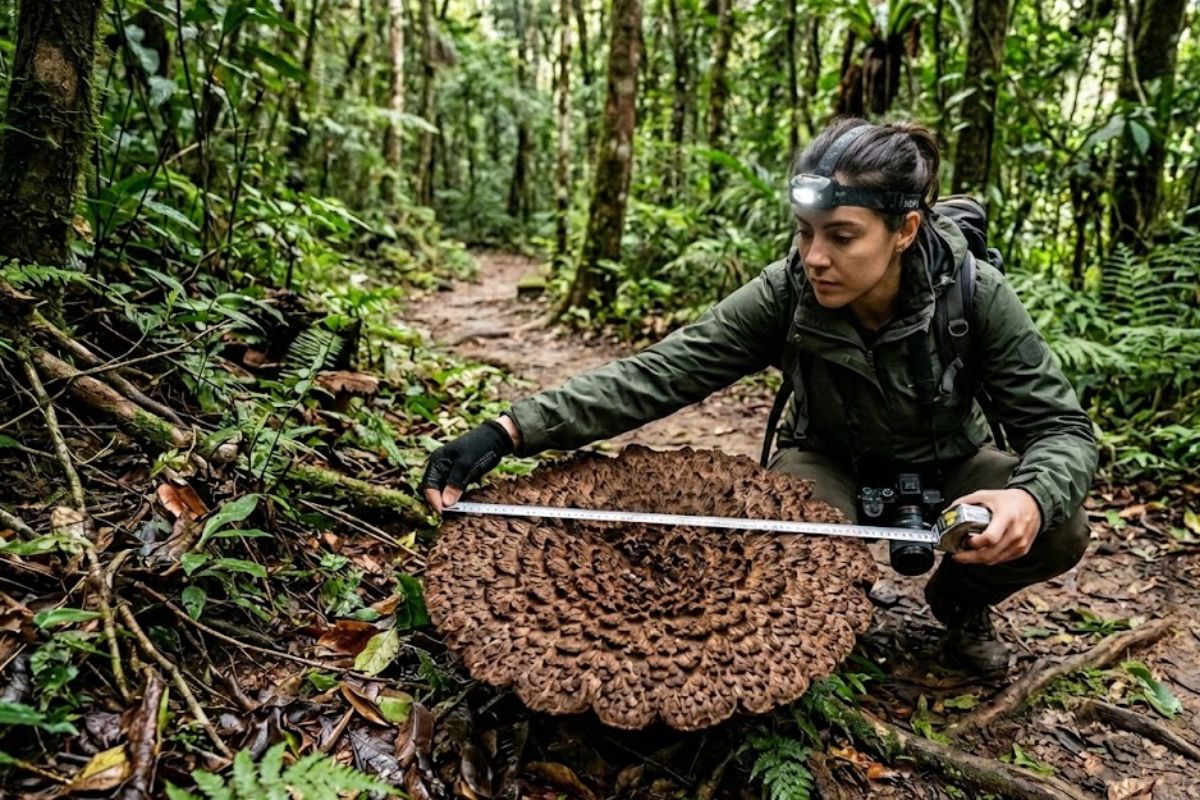
During the mapping of rare and centenarian species, teams from Semmas and Culture found, on a trail of the Edith Gaertner Botanical Garden, mushrooms of the species Kusaghiporia talpae with 75 cm in diameter, three months visible, and signs of active decomposition of dead wood, reinforcing the scientific interest in the location itself.
In one of the sections of the trail of the Edith Gaertner Botanical Garden, in the Historic Center of Blumenau, mushrooms of rare proportions have started to draw attention from those circulating in the area, especially due to their unusual size: 75 centimeters in diameter.
The specimen was located near the area known as the Cat Cemetery and identified during work conducted by professionals from the municipal secretariats of Environment (Semmas) and Culture and Institutional Relations, as part of a project that has been cataloging and signaling relevant species in the area.
Where the Specimen Appeared and Why It Matters for the Green Area

The presence of mushrooms of this size on a trail, in a tourist spot with established tree vegetation, becomes “curiosity” not only because it is photogenic: it serves as a biological message about what exists down below, in the soil and substrate. The Kusaghiporia talpae develops on logs, branches, or dead wood, connecting the finding directly to the decomposition cycle that sustains the urban forest.
-
Submarine cables installed to transmit the internet now also help scientists detect earthquakes.

-
After so many blackouts, a family transforms an electric truck into a power source for their home and shows how a 100 kWh battery can keep everything running for days.

-
Ukraine is already testing, and China has already shown the world, and now the Brazilian Army is developing its own swarm of autonomous drones with artificial intelligence that share data in real time and operate without centralized control, uniting military and universities.

-
Few people know, but the most nutritious part of wheat has been discarded for decades to produce white flour, and the “polyamine” spermidine activates cellular cleaning, reduces mortality, and may slow down memory loss.


In this case, the specimen emerged in an area of the Botanical Garden where there is available woody substrate and adequate moisture conditions, a scenario compatible with environments that maintain organic matter in decomposition. When mushrooms appear in this context, they signal active recycling processes, which is essential for the balance of the local ecosystem.
What Catches Attention in the Size and Longevity Outside the Standard
What made these mushrooms especially remarkable was not just the diameter. The species typically appears between January and February and generally remains visible for about three weeks. However, in the Botanical Garden, the observed specimen was already approximately three months old, an interval that deviates from the more common behavior attributed to the species.
The size also helped to put the finding into perspective: there had been previous records of mushrooms of the same species with about 38 centimeters in diameter, found in Joinville about 15 years ago. When a new specimen appears with almost double that size, the comparison is inevitable and reinforces why the case garners technical interest: it is too big and too long-lasting to be considered routine.
The Role of Fungi in Wood and What the Kusaghiporia Talpae Does There
From what is observed in the field, these mushrooms have a direct relationship with the decomposition of structural wood components. The Kusaghiporia talpae contributes to the degradation of lignin and cellulose, placing it at the center of a silent but decisive process: transforming dead wood into reusable matter in the ecosystem.
This decomposer role connects to what the environmental educator Jefferson Ribeiro highlights about fungi: they contribute to soil health, recycling important nutrients like carbon, nitrogen, and phosphorus. In practical terms, what appears to be just a “disk” on a log is, in fact, part of a mechanism that keeps the nutrient flow functioning, even in green areas within cities.
What Science Still Tries to Understand About the Species
Despite its visual prominence, the biology of Kusaghiporia talpae is still not fully understood, according to Professor Dr. Elisandro Ricardo Drechsler dos Santos from the Federal University of Santa Catarina. The species belongs to the Laetiporaceae family, known for encompassing fungi often associated with wood parasitism, which already opens a trail of hypotheses about interactions with the environment.
There is also an important particularity: this fungus develops on the root of a plant, which makes it difficult to accurately identify the species it may be associated with. This gives the finding in the Botanical Garden additional value, because it is not just about seeing large mushrooms, but having a living record that can help understand subterranean relationships that usually go unnoticed.
Mycorrhizas, Roots, and the Reason Why a Finding Like This Opens New Questions
When talking about fungi and roots, a key idea mentioned by Jefferson Ribeiro comes into play: mycorrhizas, symbiotic associations in which fungi interact with plant roots and can increase efficiency in the absorption of water and nutrients.
Even without turning every appearance into “proof” of a specific type of relation, the point is that fungi and plants often connect in complex ways, and this alters the interpretation of what is seen on the trail.
Therefore, the emergence of such rare and large mushrooms can be viewed as a concrete opportunity to deepen scientific research and reinforce the importance of environmental research and education.
Instead of an isolated event, the specimen becomes an invitation: to view the Botanical Garden as an open-air laboratory, where biological signals help guide conservation and knowledge.
What the Botanical Garden Project Aims to Map Beyond the Giant Mushroom
The finding occurred during a larger effort: the cataloging and installation of identification plates for trees, as part of the mapping of rare and centenarian species in the green area. In this context, mushrooms appear as an additional element within a living inventory that involves not only trees but also other organisms of environmental interest.
In addition to the giant mushroom, the project aims to identify other organisms such as flowers and foliage circulating in the area.
The next step includes developing protocols aimed at conserving the space and existing species, which gives the case a practical effect: point discoveries can influence how the area is cared for moving forward.
A specimen of mushrooms with 75 cm in diameter and approximately three months visible draws attention not only for being exceedingly rare and large but for bringing together, in a single record, clues about available dead wood, adequate moisture, decomposition processes, and a species whose biology still holds relevant gaps.
In a space like the Edith Gaertner Botanical Garden, this transforms a trail scene into a scientific and environmental signal that is hard to ignore.
To enrich the conversation further: have you ever found large mushrooms on trails or parks in your city? What kind of place was it, near logs, roots, or fallen wood?
And when you see an organism like this, is your reaction to take a photo and move on, or to stop and observe the surrounding environment and try to understand what it says about the area?





-

-

2 pessoas reagiram a isso.