





 Portuguese
  English
  Spanish
  6 min of reading
  0 comments


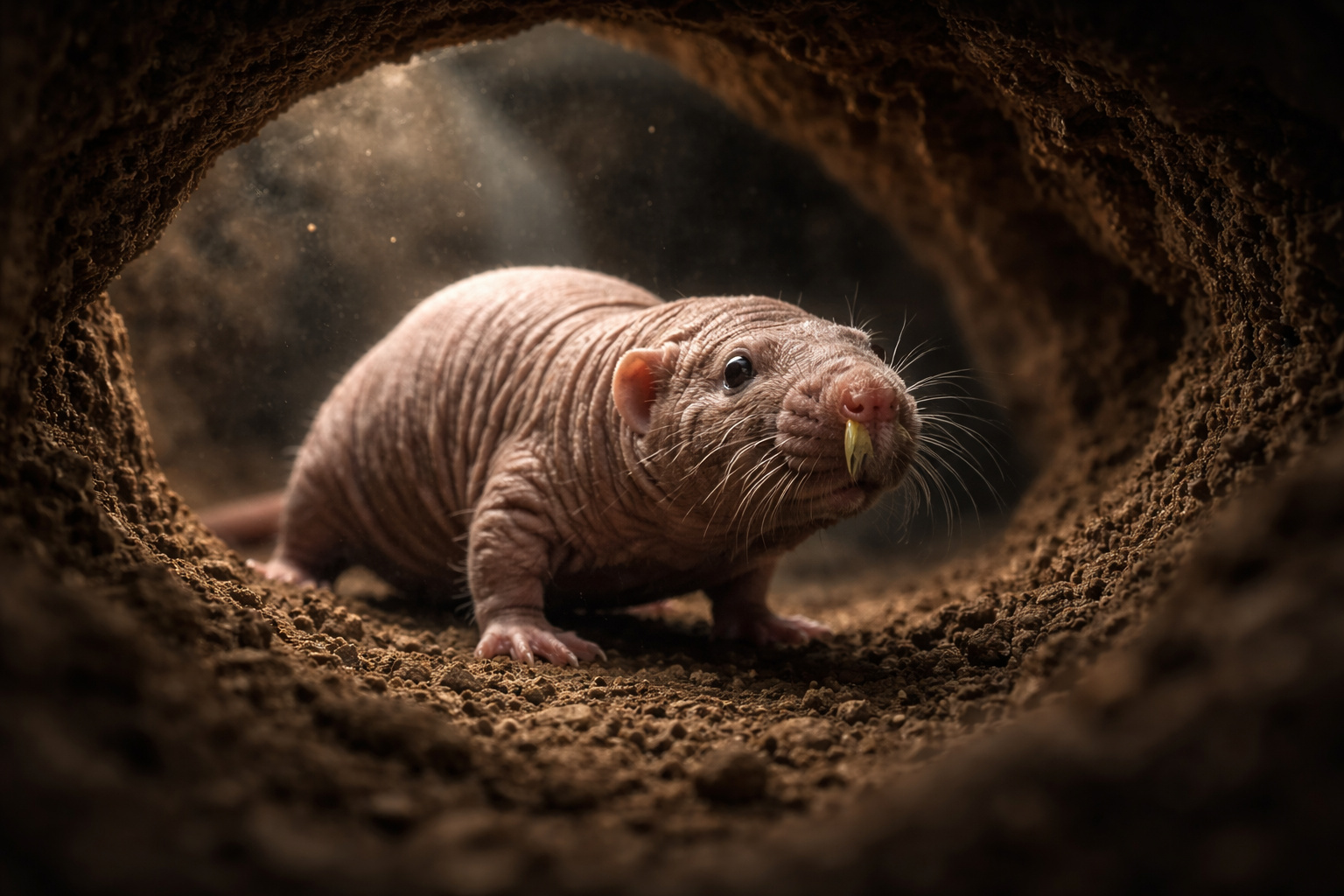
Naked Mole Rat Challenges Limits of Biology by Voluntarily Choosing Lethal Oxygen Levels, Opening New Scientific Clues About Metabolism, Longevity, and Protection Against Human Diseases
The breath you just took contained about 21% oxygen, the standard concentration of atmospheric air. However, if a person were placed in a sealed environment with no air renewal, that level would gradually fall. Upon reaching 15%, dizziness and increased heart rate would occur. At 11%, the human body would enter a state of mental confusion, nausea, and rising panic. Below 10%, loss of consciousness would be rapid, followed by irreversible brain damage and death within minutes.
However, under conditions that would be fatal for nearly all mammals, a small and peculiar African rodent would continue its routine as normal. The naked mole rat, a nearly hairless animal with limited vision and an unusual appearance, not only tolerates low oxygen environments but actively prefers to live in them, according to a recent study.
The information was released by Biology Letters, a scientific journal that published the results of a study conducted by scientists at the University of Ottawa, in Canada. The study reveals that this species is the first known mammal to deliberately choose hypoxic environments, meaning with oxygen levels significantly below normal.
-
With a cost per shot close to zero, the DragonFire laser could change naval warfare in 2027 and provide British ships with nearly unlimited defense against drones.

-
A British startup creates tires that generate electricity in electric vehicles when passing over potholes, speed bumps, and cracks.

-
Scientists have created robots made with living cells that have their own nervous system, swim on their own, explore the environment, and self-organize without any genetic engineering, and now they want to do the same with human cells.

-
Students create a solar-powered ambulance that operates without a plug, without fuel, and still keeps medical equipment running in remote areas.


Extreme Preference for Hypoxia Challenges Everything Known About Mammal Survival

Naked mole rats are native to East Africa and live almost exclusively in underground tunnel systems. In these colonies, which can gather up to 300 individuals, ventilation is limited and oxygen frequently drops to dangerous levels. Still, these animals have developed extraordinary adaptations to deal with hypoxia.
What surprised researchers, however, was the finding that these rodents not only endure but actively choose environments with extremely reduced oxygen. To test this hypothesis, scientists placed individual naked mole rats in an experimental system with two interconnected chambers.
One chamber contained normal air, with 21% oxygen, while the other had hypoxic air, with concentrations of 11%, 7%, or only 3% oxygen. The results were clear: although the animals showed no significant preference between 21%, 11%, or 7%, they consistently chose the chamber with only 3% oxygen.
“I did not expect this at all,” stated Matthew Pamenter, a biologist at the University of Ottawa and senior author of the study. He noted that the tests were repeated over an entire year, with different teams conducting and analyzing the experiments to ensure the data was reliable.
Additionally, when naked mole rats were tested in pairs, their behavior changed slightly. In this case, they began to prefer environments with 7% oxygen, still rejecting normal air. This raised the hypothesis that social factors also influence the choice of environment.
Slowed Metabolism Allows Survival Where Others Would Die in Minutes
Unlike most mammals, which react to lack of oxygen by trying to breathe faster or escape, naked mole rats adopt a radically distinct strategy. They drastically reduce their metabolism, lowering energy and oxygen requirements.
Previous studies have demonstrated that these rodents can reduce their metabolic demand by about 85%, remaining active and alert. Furthermore, they alter cellular metabolism to more efficient forms and stop expending energy regulating body temperature.
Thanks to these adaptations, naked mole rats can:
- Survive for days on just 8% oxygen
- Last for hours on 3%
- Withstand up to 18 minutes in total anoxia, that is, with no oxygen at all
For comparison, the human brain begins to suffer permanent damage after 4 to 6 minutes without oxygen. Still, these rodents endure extreme conditions without showing signs of severe inflammation or cell death.
According to Pamenter, this preference for hypoxia may be linked to the physiological pleasure of a slower metabolism. “Perhaps they enjoy this slower pace of life,” suggests the researcher, although he admits that the exact mechanisms are still not entirely understood.
Low Oxygen, Carbon Dioxide, and Possible Lessons for Human Diseases
Besides the drastic drop in oxygen levels, the burrows of naked mole rats present another critical factor: the increase in carbon dioxide (CO₂). In densely occupied underground environments, hundreds of animals breathing simultaneously continuously reduce oxygen and elevate CO₂ levels.
According to Rochelle Buffenstein, a biologist at the University of Illinois at Chicago, carbon dioxide plays a relevant role in these rodents’ response to hypoxia. Previous studies indicate that CO₂ stabilizes the nervous system of naked mole rats and helps prevent seizures, a rare effect among mammals subjected to oxygen deprivation.
In the study published in Biology Letters, however, the researchers chose to keep carbon dioxide levels constant, analyzing exclusively the impact of different oxygen concentrations. For Buffenstein, this may represent a confounding variable, since in nature, hypoxia and increased CO₂ occur simultaneously.
Pamenter acknowledges this limitation and states that future research will explore the combined effects of these gases. “Hypoxia generally causes the animal to breathe faster, while carbon dioxide may have a different impact on ventilation,” he explains. Understanding this interaction may reveal new pathways regarding how the body regulates breathing, metabolism, and neural protection.
What the Naked Mole Rat Can Teach Us About Stroke, Heart Attack, and Sleep Apnea
In humans, oxygen deprivation is directly associated with severe diseases such as stroke, lung diseases, myocardial infarction, and sleep apnea. Under these conditions, hypoxia triggers inflammation, cellular damage, and a cascade of processes leading to tissue death.
Naked mole rats, however, seem practically immune to these effects. By studying their biological mechanisms, scientists hope to identify molecular switches capable of limiting damage to cardiac and brain tissues. Research is already underway to understand how these rodents reduce heart damage in hypoxic environments, opening possibilities for new treatments in humans.
Dan McCloskey, a researcher at the College of Staten Island at the City University of New York, highlights that these animals could inspire strategies to protect the brain during a stroke. “They hold secrets from which we can learn,” he asserts. The expectation is that these discoveries will help minimize neurological damage caused by lack of oxygen.
Extreme Longevity, Cancer Resistance, and an Even Greater Enigma
The preference for low-oxygen environments may be linked to other extraordinary characteristics of the naked mole rat. For a rodent of its size, it lives exceptionally long, exhibits resistance to various types of pain, and almost never develops cancer.
A study published in October revealed that these animals have four specific alterations in a DNA repair enzyme, which may slow down aging and drastically reduce the risk of cancer. Scientists believe that these adaptations may be interconnected with the slow metabolism induced by hypoxia.
McCloskey suggests that many of these characteristics may be physiological byproducts of the preference for low-oxygen environments. A slowed metabolism would reduce cellular wear over time, favoring both longevity and resistance to degenerative diseases.
Are Naked Mole Rats Unique Among Mammals?
The discovery raises an intriguing question: are there other mammals capable of preferring hypoxic environments over normal air? So far, the naked mole rat is the only one known to clearly and consistently demonstrate this behavior.
According to Kenton Kerns, curator of the Small Mammal House at the National Zoo and Smithsonian Institute, it is possible that other animals exhibit similar responses but have never been studied from this perspective. Highly social mammals or tunneling species might be natural candidates for future research.
Still, Pamenter is cautious. For him, the active preference for extreme hypoxia is a profoundly strange response that is hard to envision as adaptable in other evolutionary contexts. “Perhaps, in this case, naked mole rats really are unique,” he concludes.
With information from: Fanni Daniella Szakal/Smithsonian Magazine







-

Uma pessoa reagiu a isso.