





 Portuguese
  English
  Spanish
  7 min of reading
  4 comments


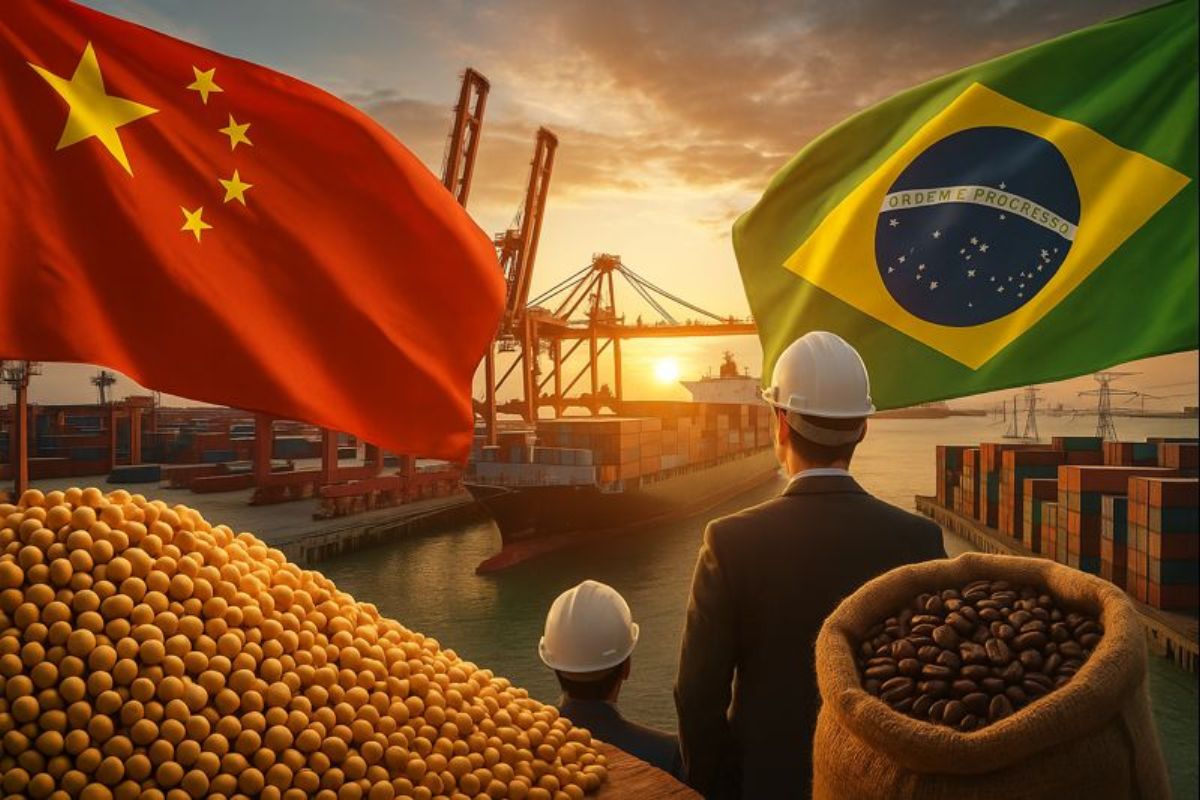


Global Trade Restructuring Pushes China to Heavily Invest in Brazil, Lead Purchases of Soybeans, Coffee, Oil, and Energy, Build Port Terminals, Expand Technology, Create Jobs, and at the Same Time, Expose Brasília to the Risk of Excessive Dependence on Beijing in a Board Disputed with the USA in the Midst of a Global Trade War
In 2024, China consolidated its position as Brazil’s largest trading partner since 2009, with investments from Chinese companies totaling US$ 4.18 billion, growing 113% from the previous year, while the trade war with the USA reshaped routes, tariffs, and capital flows. In May 2025, President Luiz Inácio Lula da Silva’s official visit to Beijing, alongside eleven ministers and over 150 businessmen, resulted in thirty agreements and signaled that the Sino-American dispute for control of Latin American trade by 2035 will centralize around Brazil.
On this new board, China is expanding its presence in soybeans, coffee, minerals, energy, ports, digital technology, and the automotive industry, while analysts project gains in jobs and productivity but also warn of the risk of the country becoming excessively dependent on the Chinese market and capital. The strategic challenge for Brasília is to use this rapprochement with Beijing to diversify its economy and climb the value chain, without repeating the historical pattern of being a commodities exporter and a technology importer.
Global Trade Restructuring Places China at the Center of the Brazilian Agenda

The trade war led by the United States, with high tariffs and protectionist measures, pushed Brazil to seek new markets and deepen its relationship with China.
-
Brazilian city bets on the business environment to generate jobs and attract investments in the energy sector — secretary reveals strategy at Macaé Energy 2026.

-
50 viaducts, 4 tunnels, 28 bridges, and 40 kilometers of bike paths: BR-262 in Espírito Santo will receive 8.6 billion reais for the largest engineering project in the state’s history, inspired by the Immigrant Highway in São Paulo.

-
Brazil produces too much clean energy and doesn’t know what to do with it: over 20% of solar and wind capacity was wasted in 2025 while investors flee and 509 renewable generation projects were abandoned in the last year.

-
Piauí will produce a new fuel that replaces diesel without needing to change anything in the truck’s engine and reduces pollutant gas emissions by half: truck drivers from all over the Northeast are already celebrating the news that will arrive later this decade.

The direct result is a shift in capital flow: in 2024, Chinese investments in ventures in Brazil reached US$ 4.18 billion, more than doubling in one year.
According to the Brazil-China Economic Council, about one-third of these investments is concentrated in energy, with generation and transmission projects, while critical minerals gain space in Beijing’s portfolio.
The view of economists is that, in a scenario of global trade restructuring, China seeks to ensure stable access to strategic inputs while positioning Brazil as a production and logistics base for Latin America.
During Lula’s visit to Beijing in May 2025, the agenda included open criticisms of unilateralism and protectionism in international trade, in addition to the signing of thirty agreements ranging from technological cooperation to infrastructure financing.
The movement reinforces the perception that China has evolved from a distant importer to a structuring actor in Brazil’s economic policy.
Soybeans, Coffee, and Energy: How China Redesigns Brazil’s Agribusiness and Logistics

In agribusiness, China already accounts for over 70% of Brazilian soybean exports, in addition to being one of the main destinations for iron ore, beef, and cellulose.
This weight alters not only the export profile but also the internal geography of grain and protein distribution.
To consolidate this position, the Chinese state-owned enterprise Cofco is building its main export terminal outside Chinese territory in Santos, Brazil’s largest port.
The structure is set to function as a global hub for soybeans, corn, and other Brazilian agricultural products destined for China and other Asian markets, reducing logistics costs and increasing loading capacity during peak harvest times.
Coffee is another symbol of this offensive. The Chinese embassy in Brazil announced, in early December, the “Brazilian Coffee” campaign, with about 400 million cups of Brazilian coffee distributed in thousands of coffee shops in China, in partnership with ApexBrasil.
In 2024, Brazilian coffee exports to the Asian partner totaled US$ 213.6 million, approximately 1.5 billion reais, according to the Trading Economics database.
In the energy sector, China also concentrates a significant portion of recent investments.
Investments in generation, transmission, and projects related to oil and renewable sources ensure the Asian country direct access to a critical axis of the Brazilian matrix.
For Beijing, energy and food form the core of strategic security; for Brazil, the question is how to convert this demand into qualified jobs and internal industrial linkages.
Jobs, Technology, and Productivity: The Positive Side of the Rapprochement with China
Economist Tomás Marques from the German Institute for Global and Area Studies (GIGA) assesses that Brazil-China cooperation has a direct positive impact on the Brazilian labor market, especially in technological sectors related to electric mobility and energy.
According to him, the condition is that Chinese investments should not be limited to acquiring assets but should stimulate productivity gains throughout the Brazilian economy.
In daily life, Chinese companies are already integrated into urban routines.
The 99 transportation app, operated by a subsidiary of Chinese DiDi, competes with global rivals like Uber.
The automaker BYD, which has become a symbol of a new phase of the electric automotive industry in the country, is another example of how China’s presence projects at the border of industry, employment, and regulation, including labor disputes involving accusations of conditions akin to slavery.
In the technology retail sector, consumer perception has also changed.
“Made in China” products, which in the 2000s were seen as synonymous with low quality, now dominate the market in segments like smartphones, with brands like Xiaomi leading sales in Brazil.
For analysts, this change in image facilitates the entry of Chinese companies into new niches and expands Beijing’s influence in the Brazilian digital economy.
Dependence on Commodities and the Risk of Imbalances with China
Despite the job and investment gains, the structure of bilateral trade remains marked by strong asymmetry.
According to Johann Fuhrmann, head of the Konrad Adenauer Foundation office in Beijing, about 80% of China’s imports from Brazil are unprocessed agricultural products, such as soybeans, in addition to energy sources like oil.
Conversely, China exports primarily high-tech goods, from industrial equipment to consumer electronics, deepening a pattern in which Brazil sells commodities and buys added value.
Think tanks like the Atlantic Council warn that, if this trajectory is maintained, Latin America could face historically high trade deficits with China by 2035.
This situation worries Brazilian specialists, who see the risk of the country becoming excessively dependent on the Chinese market for exporting soy, meat, minerals, and coffee, while losing room to develop more complex local industrial chains.
The central question is whether China will be a partner in industrialization or whether it will consolidate the role of a final destination for raw materials and a source of imported technology.
China, USA, and Brazil in the Midst of the Influence Dispute
The increasing presence of China in Brazil does not occur in a geopolitical vacuum.
Both Tomás Marques and Johann Fuhrmann point out that Beijing is using the combination of investments, technology, and digital commerce to compete directly with the United States for economic influence in the region.
In practice, Brazil today finds itself in a situation similar to that of Europe, where it must define its position between two competing trading partners.
Products, apps, electric cars, and infrastructure financed by China coexist with American interests in energy, technology, and defense.
Brazilian diplomacy seeks to extract benefits from both sides but acknowledges that conflicts may arise if the balance tilts too much toward Beijing.
Atlantic Council studies project scenarios in which China would surpass the USA as the main trading partner of Latin America and the Caribbean by 2035.
In this context, Brazil would function as China’s main Latin American platform, both for exporting primary goods and for assembling productive chains and logistics centers aimed at the continent.
Celac Forum, Belt and Road, and the Political Board with China
The rapprochement is not just economic.
At the Celac Forum held in May in Beijing, which brought together Latin American and Caribbean ministers and Chinese authorities, President Xi Jinping advocated for closer relations with the region through political, academic, and security exchanges.
In his speech, he criticized “intimidation and coercion” alluding to tariff disputes with the United States and tensions with countries in the region.
At the same time, China claims for itself the role of leadership of the so-called Global South, a discourse that interests Brazil in its quest for a more active place in an emerging multipolar world.
Studies from the Center for Strategic and International Studies indicate that Brasília bets on the partnership with China to have more weight in shaping the global order but fears that too deep a bond could result in a loss of autonomy and political dependence on Beijing.
Regionally, the sensitive issue is Taiwan.
Paraguay is currently the only South American country that maintains formal diplomatic recognition of Taipei.
Experts consider it plausible that, if economic ties between Brazil and China intensify further, pressure will grow for neighbors to reevaluate their positions, aligning themselves more clearly with Chinese foreign policy.
Interestingly, Brazil still resists formally joining the Belt and Road Initiative, considered a centerpiece of Xi Jinping’s foreign policy.
Brazilian diplomats assess that the relationship with China is already sufficiently advantageous without this seal and that membership would add more symbolic value than concrete benefits, compounded by additional strain with Washington at a time when the Planalto seeks to rebuild bridges after recent frictions.
What Brazil Does with China: Opportunity or Dependency Trap
According to analysts, the relationship with China will only be sustainable if Brazil can convert investments in energy, mining, logistics, and technology into lasting gains in productivity, innovation, and local industry.
This requires clear policies for national content, protection of competition, demands for labor and environmental standards, and market diversification beyond a single dominant buyer.
On the other hand, ignoring China’s weight in global trade and the Brazilian economy is also not a realistic option.
The question is less about accepting or rejecting Beijing and more about negotiating terms that reduce asymmetries and prevent the reconfiguration of global trade from transforming the country into a mere exporting platform for commodities.
In light of this scenario, with China pouring billions into Brazil, dominating soy, coffee, energy, digital technology, and strategic infrastructure while the USA loses relative ground, what is your perspective: Is Brazil using China as leverage to rise economically, or is it merely swapping one dependency for another in an increasingly polarized market?








Economicamente a China é um negócio da China! É Espiritualmente, o que a China ! Fatalmente a nossa dependência econômica esbarrará na cultura Chinesa!
Sou a favor de investimentos Chineses no Brasil , vai gerar empregos e desenvolvimento pro nosso país e também fazer crescer a nossa economia.
Desde que as negociações tragam desenvolvimento social e econômico aos brasileiros não vejo problemas salvo de as vantagens ficarem somente no bolso dos políticos aí sim continuaremos a ser roubados como ocorre há décadas… #AcordaBrasil